
By Ed Staskus
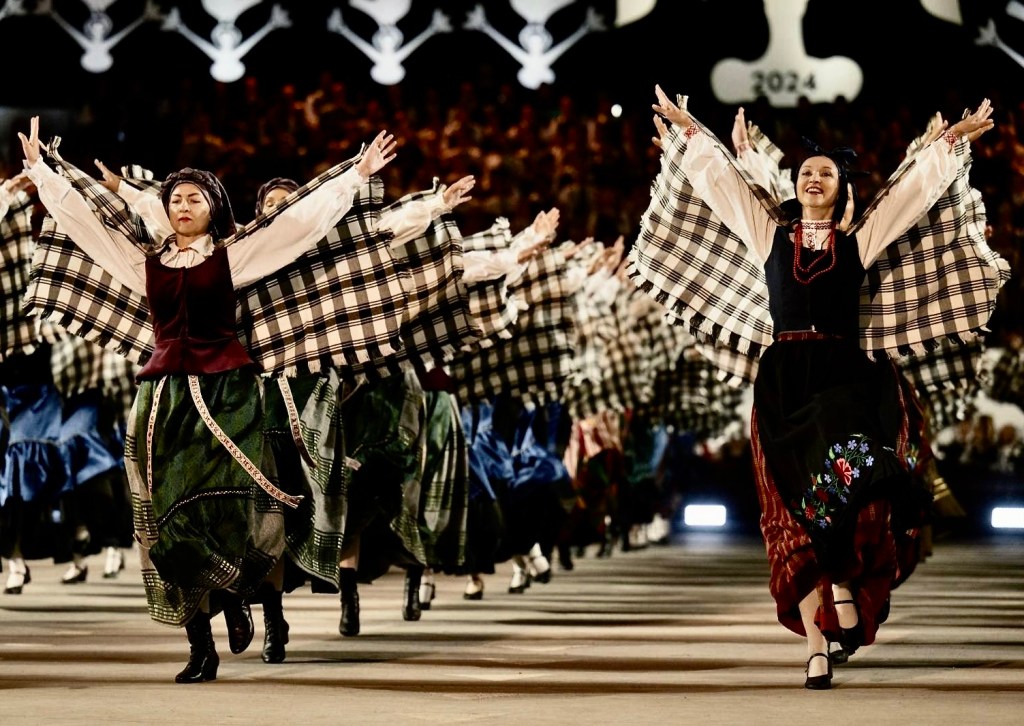
Folk dancing costumes are by and large traditional, except when they aren’t. When Gabriele Baltrunaite traveled from Cleveland, Ohio to the 2024 Centenary Song and Dance Celebration in Vilnius, the capital of Lithuania, she had to borrow one, even though she had one. “I had to borrow a dancing costume because, although I had one, but it was too Lithuanian,” she said. “They wanted us to wear our own versions for the festival.”
“It is important for us that every participating ensemble bring their own tradition, their own songs, those they inherited from their own place, their own dances and customs,” said Vida Šatkauskienė of the Folklore Day creative group. “And all that diversity, every region, every ensemble, every individual performer, are what makes up our day.”
The day lasted a week through the first week of July. It featured Folklore Day, Dance Day, Ensembles Evening, and Song Day. More than 9,000 dancers performed on Dance Day. Gabriele went with the Cleveland folk dance group Svyturys.
The dance group was established in 2003, when 16 young dancers got together to prepare for the XII Lithuanian Folk Dance Festival in Chicago. They perform at shows, festivals, and special events. They have appeared throughout the United States and Europe, as well as South America. They have organized “Concerts of Friendship” to which dancers from the Lithuanian diaspora are invited to participate.
“I started dancing at St. Casimir’s when I was in 2nd grade,” Gabriele said. “In the 8th grade I started dancing with Svyturys.” She has danced with the group since she was 13 years old, participating in many of its overseas excursions. “Sweden was my favorite trip,” she said. It’s hard to beat a breath of fresh Scandinavian air. In between breathing there is fika, the coffee break ritual of the Swedes.
“Dancing is fun and I like the exercise, although sometimes it can suck practicing every Sunday.” The group practices Sundays from 10:30 to 1:30 at the Kirtland Community Center on the east side of Cleveland. “It’s partner dancing in a group. It’s highly choreographed, with lots of circles, polkas, and spinning. I like the social aspect of being in the group, making friends and making deeper connections. When it’s getting close to a concert, we have boot camp and practice even more. I love dancing at concerts, the forms and shapes we make on the dance floor, and the attention, the fact that people are looking at me.”
Gabriele was born in Lithuania but grew up in the United States. In 1999 when she was three years old her parents Ausra and Gintaras tried their luck at the Green Card Lottery, a result of the Immigration Act of 1990. The new law allowed hundreds of thousands of immigrants to enter the United States. Lithuania was one of thirty one qualifying countries. Their luck was good. They were awarded visas. More immigrants were admitted into the United States from 1991 to 2000 than in any prior decade in American history, with11 million documented entries.
“My parents were doing all right, but the economy was bad,” Gabriele said. “They wanted more success in life. They wanted a change of pace, something new, even though all they knew about the United States was what they had seen on TV.”
Gabriele attended Eastlake North High School, Lakeland Community College, and graduated with a degree in Business Economics from Cleveland State University. She is a real estate agent with EXP Realty and operates her own commercial cleaning service with several employees. “I live by my phone,” she said.
The 2024 Centenary Song and Dance Celebration was one hundred years in the making. The first Song Day was staged in Kaunas in 1924 and continued to be staged all through the Soviet Occupation after World War Two. It became a World Celebration after the fall of the Iron Curtain, and in 1994 more than 1,200 singers, dancers, and musicians from ten countries participated in the event
This year’s event described itself as, “We, the singing and dancing people, make the living tradition that has survived through this century. We are the unique kin that meets every few years and speaks its own language. The language of this kin resembles the language of the earth – the language of the bird and the river, the culture and the memory, for our language is the one of life, spoken by all the members of the Cantor Lituanus kinship.”
Flying from Cleveland to Helsinki to Vilnius takes about a full day and night with layovers. It takes a couple of days to get over the jet lag. The Svyturys group numbered more than forty on the plane, from dancers to teachers to volunteer support. They got to Lithuania a week before the big show. They stayed in the Old Town of Vilnius, brought back to life after the country recovered its independence in 1991. Nearly $30 million euros have been spent on restoration projects. Everybody got a complimentary bus pass with which to explore the city, of which there is much to explore. There are the Gates of Dawn, the Palace of the Grand Dukes, and the notorious Soviet-era Lukiskes Prison, which has morphed into a go-to for hundreds of artists and musicians who have set up their studios in renovated spaces there. Kankles are mightier than the sword.
On Friday, the day after they arrived, the group boarded a chartered bus and went to Palanga for the weekend to lay their jet lag out in the sun. Palanga is a resort town in western Lithuania on the shore of the Baltic Sea. In the height of summer, the sun comes up at 5 AM and doesn’t set until after 10 PM. “It doesn’t get totally dark until 11,” Gabriele said. It is the country’s largest seasonal resort, sporting beaches 11 miles long and 1,000 feet wide, with sand dunes to boot.
Lithuania was the last European country to give up paganism and adopt Catholic Christianity. There used to be a pagan shrine at the base of a hill in Palanga watched over by a beautiful priestess by the name of Birute. She tended the ceremonial fire. One day Kestutis, the Grand Duke of Lithuania, laid eyes on her and decided he had to have her, even though she had promised the sky god Perkunas to remain a virgin as long as she lived. Kestutis wasn’t going to be denied, however, and took her back to Trakai, his fortress home. There was a lavish wedding, but the joy didn’t last long. Kestutis was murdered soon after and buried with his weapons and horses. Once free, Birute went back to Palanga, resumed her duties at the shrine, and when she died was buried at the top of the hill, as close to the stars as she could get.
When the group got back to Vilnius from Palanga on Sunday they had a free night and the next day visited Seimas Palace, which is where the Parliament of the Republic of Lithuania meets. After that they had the rest of the day to themselves. Everybody tried to hit the hay early, although with little success, there being too much to do and see.
Each and every one of them knew that the next day the hard work was going to begin. The hard work coming up was going to be three straight days of practice. “Our practices were at a nearby park deep in the woods,” Gabriele said. “It was an athletic complex with fields, food trucks, and port-a-potties. Our practices were on one of two fields depending on the choreography. One part of one of the fields was super dusty. We had to run the field while dust kicked up, for two hours, running back and forth. When I got done my nose was full of dark boogers. It was tough.”
What was tougher was the eagle-eyed man on the platform calling out instructions. “He was on a platform maybe 30 feet up, with a microphone and loudspeakers,” Gabriele said. “He had written the part of the concert we were going to perform. He had a PhD in folk dancing.” There wasn’t going to be any easy way of explaining away missteps. “He knew every group’s assigned number.”
As the first and second 12-hour days of practice unfolded Gabriele heard less of “Number 37, you’re doing it wrong.” Her group was Number 37. Nobody wanted to be the group whose number was being repeatedly called out. Svyturys kept their eyes open and their feet moving.
“During one dance, which is actually technically easy, but it’s hard to remember, it’s always changing from a circle to a square to a diamond, he had to keep calling out and reminding us of the order,” Gabriele said. “But one group couldn’t get it right, no matter what.”
“Number 13, stop it, you keep doing it wrong!” the man on the platform finally barked. “Get out of here.”
“They had to leave and practice on their own until they got it right,” Gabriele said.
The last day of practice was Thursday. The practice and subsequent dress rehearsal ended close to midnight, a 16-hour day instead of a 12-hour day. “It went so long they ran out of food,” Gabriele said. “I was sick tired. My calves were cramping so bad. I was praying to God, let me get through this. At one point I had to stop. And then the man on the platform pointed at me and said, ‘You need to run!’”
In the end it ended well. The man on the platform announced they wouldn’t have to brush anything up on Friday morning. “Thank you so much for everything you’ve done,” he said. “I really appreciate it. I know I’ve been yelling at you guys, but you have all been fantastic. I love you.”
“It was so heartfelt and moving,” Gabriele said. “ He told us to go out and just dance.”
The theme of the 2024 Centenary Song and Dance Celebration was “May the Green Forest Grow.” It brought together 37,000 artisans, singers, and dancers. The audience for the 14 large scale events during the week was in the hundreds of thousands. Song Day on July 6th featured 400 choirs on the outdoor stage. The performance was in the spirit of the Singing Revolution of 1987-91, when Latvia, Estonia, and Lithuania defied their Soviet occupiers by breaking out into native songs. When the Soviet Union collapsed in 1991 everybody sang “Hit the Road Jack.” They put some oomph into it by finishing with “and don’t you come back no more, no more.”
“The event shows our resilience and that music unites people and inspires them to break free from repressive regimes and fight for their country’s sovereignty,” said Saulius Liausa, director of the Lithuanian Song Celebration. “We had to fight for freedom to preserve our cultural identity, traditions, and language.”
Friday was Dance Day. Svytutys performed at 1 PM and again at 9 PM. “The dance concert was close to where we were staying,” Gabriele said. “We walked there in our costumes.” The were many other groups walking to the venue as well. The streets were soon overflowing with them. “There were thousands of us.” The groups gathered and waited on adjoining fields for their turn to dance in the stadium. At the event groups rotated in and out during the two-hour shows. Video cameras on the ground and in the sky recorded the carousal.
“My mom went to the show,” Gabriele said. “She said it was OK, but when she saw the replay on LRT TV, she said it was amazing.”
On Saturday morning a parade of the singing and dancing participants walked the several miles to the Song Day venue. “All of us had our full costumes on,” Gabriele said. “It was very cool.” The participants included children, teenagers, adults, and older folks. “My uncle lives in Lithuania, on a farm. He’s in his late 60s but came to Vilnius to dance.”
When the last song faded away late Saturday night, the 2024 Centenary Song and Dance Celebration was officially over. The participants from 21 countries said their goodbyes and went their own way. The Australians had the longest flight home. They smeared their crackers with Vegemite, the down under by-product paste.
“History is pretty clear today,” Saulius Liausa said “Our festival was the only way to keep the tradition alive, to not forget.” It kept the cultural fires burning through the war years and the occupation years. The flames reached free Lithuanian communities everywhere. A fair highlighting those communities around the world was sponsored by the Vilnius Town Hall Square.
The song and dance showcase on native soil happens every four years. The next one is in 2028. Lithuanian folk dancers worldwide are tapping their toes and waiting for their cue. Gabriele is sprucing up her old school costume and going back to practice.
Ed Staskus posts monthly on 147 Stanley Street http://www.147stanleystreet.com, Made in Cleveland http://www.clevelandohiodaybook.com, Atlantic Canada http://www.redroadpei.com, and Lithuanian Journal http://www.lithuanianjournal.com.
“Cross Walk” by Ed Staskus
“Captures the vibe of mid-century NYC, from stickball in the streets to the Mob on the make.” Sam Winchell, Beyond Fiction
Available on Amazon: https://www.amazon.com/dp/B0CRPSFPKP
Late summer and early autumn. New York City, 1956. President Eisenhower on his way to the opening game of the World Series. A hit man waits in the wings. A Hell’s Kitchen private eye scares up the shadows.
A Crying of Lot 49 Publication
 Lithuanian Journal