
By Ed Staskus
The day Frank Domscheit pulled Ernest Hemingway out of the de Havilland Rapide, the day it crashed and caught fire, he didn’t know who the man in the airplane was, although he knew who Ernest Hemingway was. He had read one of his books before the war and liked it. It was about bullfighting. The man he pulled out of the airplane was covered in blood and babbling. He beat out the flames on the man’s arms and hands. He pulled him away from the airplane as fast as he could. The man was big and heavy but able to stumble forward with his help.
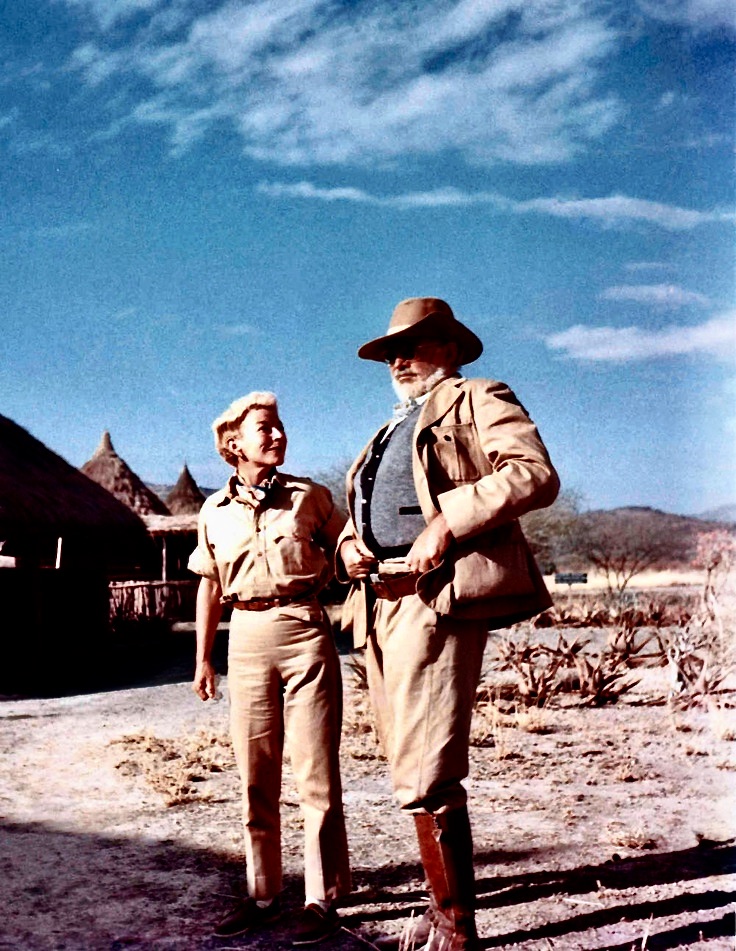
Frank was in the Upper Nile country of Uganda the last week of January 1954 tending to the wife of an Egyptian businessman, getting her ready to fly back to Cairo, when Ernest Hemingway’s airplane crashed and caught fire. It was more bad luck for the writer. It was his second airplane accident in two days. The Cessna 180 he and his wife had been on the day before, sightseeing the wilds surrounding the Great Rift Valley and Murchison Falls, encountered a large flock of birds. The pilot dove to avoid them but clipped an abandoned telegraph line, lost control, and crashed. Mary Hemingway, the writer’s fourth wife, suffered two cracked ribs, and Ernest Hemingway banged his head. Roy Marsh, the pilot, was unhurt.
They couldn’t send a distress call. Their on-board radio was broken. They walked away from the airplane where it was wedged in scrub trees. They walked to the Victoria Nile River. When night came they built a fire. They had some apples and biscuits. They had bottles of Carlsberg beer and a bottle of Scotch that survived the crash. The men drank warm beer while Mary eased the pain of her cracked ribs with whiskey. Elephants trumpeted and hippos snorted at the waterline.
“We held our breath while an elephant twelve paces away was silhouetted in the moonlight, listening to my wife’s snores,” Ernest Hemingway said.
The British Colonial Administration sent search planes. They found the Cessna 180 soon enough. “One wheel of the undercarriage was broken, but otherwise the plane appeared little damaged,” said Capt. R. C. Jude, the pilot of the British Overseas Airways Corporation plane that circled the crash three miles below Murchison Falls. “The chap did a neat job getting her down.” When a ground rescue team reached the airplane, however, they discovered the Hemingway’s and their pilot were not there.
Uganda was more than 2,000 miles from where Frank Domscheit lived and worked in Cairo. He wasn’t an Egyptian. He was a Prussian Lithuanian. He had settled in Cairo after deserting the Afrika Corps. During World War Two the Afrika Corps was the 15th and 21st Panzer Divisions. There were some Italian armored and infantry divisions, as well. The Germans were highly skilled at desert tactics and noted for their esprit de corps. The Italians didn’t want to be in North Africa, surrendering whenever they could. When the British Eighth Army broke through the Axis defense lines and minefields at El Alamein, forcing General Erwin Rommel to withdraw, the war ended for Frank. The Afrika Corp went west, retreating to Tunisia. Frank went east, escaping to northern Egypt.
His family were fish merchants south of Klaipeda in Lithuania Minor on the Baltic Sea. They were herring wholesalers. He had been conscripted by the German Army in 1940, ending up as an ambulance driver. He served during the assault on France until France fell. After that he stayed in Paris. It might have been the best year of his life. He shipped out to North Africa in September 1941. The next year was the worst year of his life.
Soldiers desert for many reasons, including home sickness, harsh conditions, and fear of combat. Frank deserted because he was sick of the day-to-day bloodshed. He didn’t know enough about why the war had started or why it was still going on. He didn’t disagree with German military policies or the leadership of his superiors. But he wasn’t invested in victory like they were. He didn’t care anymore. It seemed like a pointless struggle. He was sick of stitching some men up and burying the rest of them.
When Ernest Hemingway, his wife and their pilot, were reconnoitering the morning after the crash, the writer spotted a launch on the river. “We had seen mirages when the sun got high, and at the sight of the launch, I thought, I must check my eyesight,” he said. “I called Mary and told her it looked like a launch was coming up the river. She looked and said it was.”
The launch was the SS Murchison, the same boat that had been used in the 1951 movie “The African Queen.” It was piloted by Edwiges Abreo, a Goan from the west coast of India. “It was an excellent launch, fairly old-fashioned in lines,” Ernest Hemingway said. The captain told them it would cost one hundred shillings per person for the rescue. The writer paid the captain and they set off downriver to Butiaba on Lake Albert.
When they got to Butiaba they disembarked and sat down under a silky oak tree to keep the sun off them. They waited for another airplane to arrive and take them to Nairobi for medical attention. It was a little-used airstrip. It was very hot and humid. When a de Havilland Rapide arrived they boarded it with their pilot and a policeman. They were near the end of the runway, a few seconds from liftoff, when the airplane hit an anthill, lost its balance, and crashed. The fuel tank exploded and they were engulfed in flames.
Frank was watching the take-off from an open thatched-roof hut. His Egyptian patient was napping in a folding canvas chair. She had fallen off a horse while on safari and hurt her head. When she didn’t improve, but rather got worse, Frank was eventually sent for. He was a neurologist, some said among the best in Egypt. He had studied medicine at Cairo University, starting before the war ended. He spoke German, Lithuanian, and English. He learned to speak Arabic. He became a doctor and trained at the Qasr El-Eyni Hospital. He was going to take his patient there for treatment.
When he saw the airplane crash and explode he leapt to his feet and ran towards it. By the time he got to the airplane the policeman had gotten out, the bush pilot was dragging Mary Hemingway out through a broken front window, but Ernest Hemingway was trapped. The doors were jammed. He was banging on a side window with his head, trying to break it and get out that way. Frank could see that he would never get through the window frame, being too large of a man. He found a stick, jimmied the door with it, and when the door popped open, quickly frog marched Ernest Hemingway to safety.
He sat him down on the dry black Nile mud. The writer had a scalp wound and burns up and down his arms. A part of his face was burned. Frank found out later he had suffered a crushed vertebra and damage to his liver, spleen, and kidney. Their passports, all their money and clothes, and three pairs of the writer’s glasses were lost in the fire.
He removed the rings on Ernest Hemingway’s fingers. He carefully cut away his shirt. He cooled his burns with water and covered them loosely with gauze. He checked him for shock, but his skin wasn’t clammy and his pulse was good. He thought the man might be in his 60s, although he seemed strong enough. He later found out he was in his 50s.
His eyes were glassy, however. He was disoriented. There was something wrong.
“How is your head?” Frank asked.
“My head hurts,” Ernest Hemingway said.
“You might have a concussion.”
“I probably do.”
“Have you had one before?”
“I’ve had half-a-dozen, maybe more. I tore my shoulder and banged my head yesterday when we went down at the falls. My head hasn’t killed me yet. I’m a writer. I need my head on straight. My luck is still good.”
What he didn’t know was his luck was running out fast. It wasn’t ever going to be as good as it had been. His luck was going to get worse and worse.
“Do you have a headache?’
“Yes.”
“Are you dizzy at all?”
“Yes.”
“I want you to look to the right of the sun.”
The African sky was clear and the sun was high. When Ernest Hemingway looked in the direction Frank indicated, he quickly looked away.
“Are you sensitive to the light?”
“Yes.”
“Let me stand you up for a second.”
“All right.”
“How’s your balance?”
“Not very good.”
“That’s fine, let’s sit you down again.”
“I need a drink.”
“That would be a bad idea.”
“My father was never the same after those two plane crashes,” Patrick Hemingway said. “When he visited me in Shimoni afterwards the atmosphere was bad.” Patrick was Ernest Hemingway’s second son. Shimoni was a small village on Kenya’s south coast, popular with divers and fishermen.
“It was like King Lear. He would shout, ‘What’s going on here? Aren’t I king?’” Ernest Hemingway had been a heavy drinker most of his life. He was drinking heavier in Shimoni. “I sympathized with his problems but you have to show some restraint. The last few weeks in Africa, he lost all restraint. I finally had enough. We never saw each other again.”
The policeman who had been on the de Havilland Rapide stepped up and stood beside them. He was a native. His black face was shiny with sweat. There was blood on his shirt.
“How is he?”
“He’s got some burns that need to be treated as soon as possible. I think he’s got a concussion too. He needs to be examined in a hospital.”
“Are you a doctor?”
“Yes.”
“He’s a famous writer,” the policeman said.
“That’s what he said, that he’s a writer. I once read one of his books.”
“I don’t read anything. I don’t know how to read.”
A dark green Land River pulled up beside them. Two British Colonial Police Officers stepped out. Uganda was a British protectorate. They were wearing khaki jackets and short pants, black knee-high boots, black Sam Browne belts, and shiny billed black caps.
“Is he fit enough to travel?”
“Yes,” Frank said. “But he needs a hospital.”
One of the policemen led Ernest Hemingway to the Land Rover. Frank walked beside the writer, offering his arm in support. The native policeman helped Mary Hemingway into the back seat next to her husband. They were both quiet. They looked very tired.
“I liked your book about Spain, about bullfighting,” Frank said, breaking the quiet.
“Thank you but I’m not getting into the ring with Tolstoy,” Ernest Hemingway said. “I love bullfighting, have for a long time. Bullfighting is the only art in which the artist is always in danger of death.”
“Take care of yourself,” Frank said.
“I’m happy you liked the book,” Ernest Hemingway said.
The Land Rover took them to Masindi, which was on the road from Murchison Falls towards Entebbe. They stayed at the Masindi Hotel, the oldest hotel in Uganda. That night the bar ran short of gin and Scotch while Ernest Hemingway entertained a pack of reporters with tales about his near death. “I’ve never felt better,” he said. “It was just a bump on the head.” When they got to Entebbe he was admitted to a hospital where he stayed for several weeks. His head was leaking cerebral fluid. Doctors told him he had fractured his skull.
Three months later Frank got a hand-written letter from Ernest Hemingway thanking him for his help. He opened it after stopping for lunch at the Tahrir Café opposite the Egyptian Museum. He had a bowl of koshary, which was vermicelli, fried rice, and brown lentils topped with garlic vinegar, and tomato sauce. He read the letter while he was eating.
“I want to thank you for your help, even though I can’t write letters much on account of right arm which was burned to the bone third degree and it cramps up on me. Fingers burned and left hand third degree too, so can’t type and can’t get any work done. The big trouble is inside where right kidney was ruptured and liver and spleen injured. I am weak from so much internal bleeding. Being a good boy and trying to rest.”
Seven months later Frank was reading the International Herald Tribune when he saw a news item about Ernest Hemingway. He had won the 1954 Nobel Prize for Literature. The prize cited ‘The Old Man and the Sea,’ which was his last novel. As it turned out, it was his last novel. He never wrote another book.
Frank bought a copy of the book and read it. He didn’t like it. It seemed solemn and maudlin. The old man was a Christ-like fisherman. The book was full of Christian symbolism. It was about redemption, as if there were such a thing. The only parts of the book he liked were the parts about Joe DiMaggio. Baseball players weren’t symbols. They were like the bullfighters in the other book he had read.
He had seen the flesh and blood of Ernest Hemingway in Africa. The only sense of it in ‘The Old Man and the Sea’ was the sharks who devoured the marlin the old man had landed. The book didn’t feel true to him. The writer had once been able to take the bull by the horns. He had been a correspondent during the Spanish Civil War and World War Two. The writing was clear-headed and hard-eyed. Frank wondered if the man’s concussions had made him sentimental. He wondered if his pen had dried up.
When he had been talking to Ernest Hemingway in Butiaba, leaning into the Land Rover, he heard him say, “I never knew a morning all my years in Africa when I woke up and was not happy. I’m always happy to be alive, but I’m not happy about anything else anymore.”
It was a broken-hearted thing to say. It ached of loneliness. Frank had never gone back to Lithuania, even though he was lonely for it. He couldn’t go even if he wanted to. The Iron Curtain was securely in place. Eight years after helping save the writer, when Frank read about him again in the International Herald Tribune, he read that Ernest Hemingway had committed suicide. He wasn’t surprised. Committing suicide is braving death, although there is rarely anything brave about it. It is a desperate act. “There is no lonelier man in death except the suicide,” is what Ernest Hemingway said. It was a desperate man’s way of escaping ills that had no remedy.
Ed Staskus posts monthly on 147 Stanley Street http://www.147stanleystreet.com, Made in Cleveland http://www.clevelandohiodaybook.com, Down East http://www.redroadpei.com, and Lithuanian Journal http://www.lithuanianjournal.com. To get the site’s monthly feature in your in-box click on “Follow.”
“Bomb City” by Ed Staskus
“A police procedural when the Rust Belt was a mean street.” Sam Winchell, Beyond Books
Cleveland, Ohio 1975. The John Scalish Crime Family and Danny Greene’s Irish Mob are at war. Car bombs are the weapon of choice. Two police detectives are assigned to find the bomb makers. Revenge is always personal. It gets personal.
A Crying of Lot 49 Publication
 Lithuanian Journal