All posts by Edward Staskus

Edward Staskus is a freelance writer from Sudbury, Ontario. He lives in Lakewood, Ohio. His crime thrillers "Cross Walk" and "Bomb City" can be found on Amazon.

Spoiling for a Fight

By Ed Staskus

   Even though Ukraine wasn’t Ukraine in the 14th century lots of folks called it that so that is what it was. The word itself means borderland. The Lithuanians visited every summer. They did it for their health, if not for the health of the natives. When they did they had good times marauding and looting and drinking too much whenever the devil got the better of them. They didn’t control the land so much as take advantage of it. The less governance the better is the way they saw it. “We do not change old traditions and do not introduce new ones,” they said.

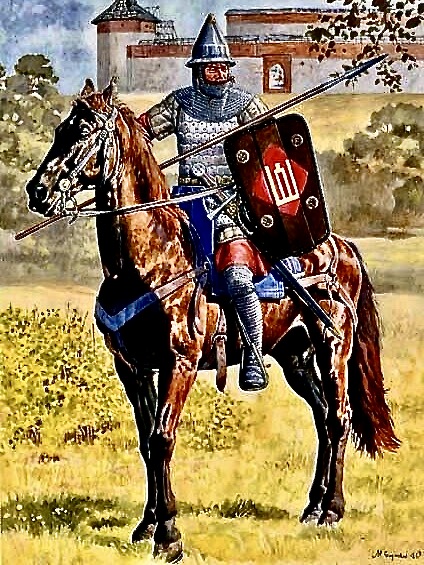
   They were freebooters who became empire builders. The boyars rode fast horses, big and fit, were outfitted in chain mail, wore conical metal helmets, were armed with lances, swords, and knives, and carried a black shield emblazoned with the red emblem of the Columns of Gediminas. They weren’t draftees or recruits. Those who were, walked and died where they stood. The boyars were tough men who could be dangerous in the blink of an eye. The Golden Horde warned would-be enemies of them, “Beware the Lithuanians.” That was all they ever said.

   They had to be rough and tough. When they went to war they didn’t launch cruise missiles and kill their enemies at great distance, checking the body count with drones. They hacked their enemies to pieces with long swords face to face and watched them bleed to death in the mud at their feet.

   By the end of the 14th century the Grand Duchy of Lithuania was the biggest country in Europe. Today it is one of the smallest countries in Europe. When they were growing fast and furious they didn’t do it by being soul brothers or good trading partners. They did it by getting on their horses and taking what they wanted. They didn’t bother explaining.

   The Grand Duchy got started in the early 13th century when Prince Mindaugas united his Baltic forest clans, swamp tribes, and fiefdoms into a feudal state. They were desperate times. The Teutonic Knights were on a rampage. They wanted to incorporate all of Lithuania into the Teutonic Order. They never stopped trying. Between 1305 and 1409 they launched 300-some military campaigns. They slaughtered more peasants than anything else. The Lithuanians beat them back time and again. Finally, in 1410, at the Battle of Grunwald the Lithuanians and Poles destroyed the Teutonic Knights. Most of the order’s leadership was killed or taken prisoner. The Grand Master ran away. They never recovered their former power. When the carnage was over, the Lithuanian-Polish alliance became the dominant political and military force in the region.

   When I was a kid almost everybody called the Ukrainians Russians. We didn’t call them that because we knew what was up with the Reds. They had done the same thing to Lithuania, enslaving the country, and reaping something anything everything for nothing. Both of my parents came from there after WW2, so we knew what was up. We didn’t have to read between the lines of whatever Washington and Moscow were forever saying.

   Even though Ukraine didn’t become a nation-state until 1991, after getting their feet wet for a few years after WW1, it was extant in the 14th century, and well before that. We all knew about the Ukrainians when I was growing up, The first Ukes came to Cleveland, Ohio in the 1880s. They settled in the Tremont neighborhood. Their idea was work hard in the factories of the industrial valley, get rich, go back home, buy some land, and live happily ever after. Between the world wars lots of former freedom fighters came. They were goners if they had stayed. Stalin was itching to get his hands on them. Most of them settled in Parma, a southwest suburb, where they built churches, schools, and started their own aid associations and credit unions.

   We didn’t live in Parma, but on the east side along the lake. Nevertheless, among the Poles, Hungarians, Croatians and Slovenians, and anybody else who could sneak into the country when the Statue of Liberty wasn’t looking, there were some Ukrainian families in our neck of the woods. One of them operated a gas station on St. Clair Ave. not far from where we lived. One of their handful of sons who was our age messed around with us summers, when we had three no-school months to mess around in. His name was Lyaksandra. It sounded like a girl’s name, so we called him Alex.

   We played pick-up baseball at Gordon Park, from where we could see Lake Erie. We once asked him, taking a break in the action, what he thought about the Russians. He growled, made an obscene gesture, spit sideways, and said, “There are lots of Russki’s in Ukraine. They are liars about everything. They aren’t all bad, but they all hate themselves. We hate them, too.”

   Ukraine is the second-largest country in Europe. It is bordered by Russia and Belarus, as well as Poland, Hungary, and Romania, among others. It has coastlines along the Black Sea and the Sea of Azov. It has its own language. Most people speak Russian, as well. The Muscovites are always trying to convince them to drop the Uke talk and speak only Russian.

   “We don’t talk that Russki talk anymore,” Alex said. “Not here, no way.”

   In the Middle Ages Ukraine, which is about the size of Texas, was the epicenter of East Slavic culture. It was, at least, until the Kievan Rus was destroyed by Mongol invasions in the 13th century. Somebody is always trying to beat up on Ukraine. From then to the 20th century Ukraine was variously ruled by the Lithuanian-Polish Commonwealth, the Ottoman Empire, the Austrian Empire, and the Tsars of Russia. Everybody wanted to be the boss of the Ukes. It’s a miracle they have prevailed and are still prevailing, facing the long odds of going against the vaunted Red Army.

   The Russians are finding out what it is like to go toe to toe with somebody who is not afraid of them and has the up-to-date American rockets and artillery to back up their bravado. The Ukrainians are fighting an existential battle. Their backs are against the wall. They have nowhere to fall. The Red Army is fighting to save its skin and make it home alive for Defenders of the Fatherland Day. The soldiers throw their uniforms into the nearest sewer when they desert.

   When I was a boy I played with toy soldiers. There wasn’t any such thing as a Lithuanian mounted  boyar toy soldier, so I pretended that anybody on a horse was a Lithuanian knight. They were always the good guys. They won every fight battle and war. They were my heroes. I didn’t know what sons of bitches they must have been. They weren’t any different than anybody else in power back then. They were all sons of bitches, including the Holy Roman Church, whose popes ruled by the sword whenever the pen wasn’t convincing enough. 

   In the early 16th century Pope Julius I, the Fearsome Pope, imported Swiss Guards to be his personal bodyguards. He strapped on armor and led the Papal State armies against the Venetians, the French, and the Spanish. His armor plating covered every inch of him just in case the grace of God didn’t get it done, including a helmet made to look like a miter. Everybody on his side was allowed to join the Holy League. Everybody else was badmouthed and excommunicated.

  After Pope Julius died a rumor had it that if he was denied entrance at the Pearly Gates, there would be hell to pay. He would storm them, St. Peter or no St. Peter, and never mind his set of silver and gold keys. It was every man for himself and God against all.

   Until the end of the 14th century Lithuanians didn’t give a damn what the Vatican did. They were pagans. They were the last pagans in Europe. The word “Lithuania” is first mentioned in 1009, in an account of the murder of Saint Bruno by “pagans on the border of Lithuania and Rus.” He was trying to convert them. That was a mistake. Their headman, whose name was Dievas, ruled the universe from his kingdom in the sky. He didn’t like anybody popping up with new ideas about Heaven and Hell. Perkunas, the god of thunder and lightning, was his right-hand man and enforcer. The holy fires were guarded by Vaidilutès, the Lithuanian equivalent of Vestal Virgins. They buried their dead with food and household goods. The last pagan grand duke was buried with his hounds, horses, and falcons.

   When they finally joined the God-fearing club it was a political move. They were doing a dynastic union with Poland, and one of the conditions the Poles laid down was that the Lithuanians had to convert to church-going and dump their veneration of the forces of nature. It didn’t change their business plan in Ukraine, other than to make them more organized. They transitioned from frat parties to fancy dress balls.

   The Grand Duchy of Lithuania had controlled Belarus for some time and when they went after Ukraine they got it, extending their control to the open steppe and eventually to the Black Sea. The Ukes learned to “Beware the Lithuanians.” When they started to get what they wanted they left their freebooting days behind and started building castles to keep their loot secure. It was  a ten-day ride from Vilnius to Kiev. Why not ditch the seasonal exploitation and make the most of the four seasons?

   It wasn’t their land, but it is finders keepers. They meant to keep what they had subjugated. The Ukrainians didn’t have a say in the matter. They told the Ukes, “We may not be perfect but we’re Lithuanians so it’s almost the same.” The Ukes said, “We promise not to laugh when your oven is on fire.” The Lithuanians weren’t offended. They just said, “Show us the goats.”

   They built the Lutsk Castle, which later became a museum. They built the Olyka Palace, which later became an insane asylum. They built the Kremenets Castle, which later fell into ruins after the Cossacks sacked the city at the bottom of the hill. In the meantime, the boyars lived the high life. They started with red borscht, green borscht, and cold borscht. They feasted on holubtsi, cabbage leaves stuffed with minced meat, rice, and stewed in tomato sauce. They ate slabs of kholodets, a cold jellied meat broth. They drank vodka between courses. Ukrainians to this day drink more vodka than beer. When they were done with dinner they went to bed, snoring and cabbage farting in their sleep.

   Even though the Lithuanians always said the Ukrainians welcomed them with open arms, they built their castle-fortresses on high hills with steep inclines, the rockier the better, fitted with one main gate and plenty of towers, arrow slits, battlements, and dungeons. They kept big rocks and hot oil handy to toss down on door-to-door salesmen. If you ended up in the dungeon you found out soon enough they weren’t playing Dungeons and Dragons.

   Imperialism is never cozy and consensual. It’s more like assault and battery. The movers and shakers of power politics don’t get thrown in jail until long after they are dead. My friend Alex had never heard of Lithuanians living it up in Ukraine. He was surprised to hear they had once been a super power. He was chagrined to find out there were more invaders of his homeland than he had realized.

   “How come the Lithuanians push us around back then?” he asked. Most of us playing ball at Gordon Park were second generation Lithuanian Americans. We weren’t even teenagers, yet. None of us had a good answer, much less a sensible answer of any kind.

   “Somebody always wants to be the top dog,” Kesty said.

   “No, that wasn’t it,” Arunas said. “They just wanted to have somebody else do all the work, like make dinner and clean the toilets.”

   “It was the Ukrainian girls,” Romas said. “Ukrainian girls are hot.”

   Romas was over-sexed, and everybody knew it. Nobody had any other ideas. We went back to playing ball in the summer sun. When we got overheated we walked to the shore and sat on the edge of a cliff in the breeze. Lake Erie was in front of us, the water rippling, the tips of the waves white.

   “Can we see Ukraine from here?” Alex asked.

   “No, it’s that way,” Arunas said pointing over his right shoulder. When we looked all we could see was Bratenahl, where rich people lived in mansions. They made the rules, for what they were worth. Our grade school class practiced duck and cover once a month, just in case the Russki’s dropped an atomic bomb on Cleveland. We brought our own lunches every day but wondered where our next lunch was going to come from if all the food stores got blown up. Many of the Bratenahl bluebloods had their own fallout shelters. They didn’t worry overmuch about starving.

   All good things must come to an end. The Lithuanians were strong in Ukraine for several centuries, but the deal they made with Poland reaped a better harvest for their next-door neighbors than my ancestors. The Poles say, “A good appetite needs no sauce.” By the mid-16th century Lithuanians were sauce. Their goose was cooked. The dynastic link was changed to a constitutional one by the Union of Lublin in 1569. Ukraine was set free of the Lithuanians but was annexed by Poland the next day.

   The more things change the more they stay the same, until they don’t. The new would-be colonialists calling the shots in the Kremlin are finding that out, to their discomfiture. They make a wasteland and call it New Russia. They have been looking grim lately. The once-mighty boyars are rolling over in their graves, their visions of conquest and glory gone sour, their iron fists gone rusty. Lithuania has gone egalitarian, joined NATO, and gotten out of the plunder and pillage business. 

Ed Staskus posts monthly on 147 Stanley Street http://www.147stanleystreet.com, Made in Cleveland http://www.clevelandohiodaybook.com, Atlantic Canada http://www.redroadpei.com, and Lithuanian Journal http://www.lithuanianjournal.com

A New Thriller by Ed Staskus

Cross Walk”

“A once upon a crime whodunit.” Barron Cannon, Adventure Books

“Captures the vibe of mid-century NYC.” Sam Winchell, Beyond Fiction

Available on Amazon: https://www.amazon.com/dp/B0CRPSFPKP

Late summer and early autumn. New York City. A Hell’s Kitchen private eye. The 1956 World Series. President Eisenhower at the opening game. A killer in the dugout.

No Man’s Land

By Ed Staskus

   My grandmother was a Russian, a schoolteacher in Saransk, when my grandfather met her before the start of World War One. He was a Lithuanian. The town and the garrison were in the Penza, four hundred miles southeast of Moscow. It was somewhere but in the middle of nowhere. Antanas Staskevicius was an officer in the Russian Imperial Army, not that he wanted to be, but the Muscovite landlords of the Baltics demanded it.

   Saransk later became the capital city of the Republic of Soviet Monrovia, but long before that happened my grandfather had returned to Lithuania. Native soil is always better than the Saransk’s of the world. Home is where the heart is, but not necessarily where the heart is forcibly relocated.

   The town in the Volga Basin was founded as a fort, on the left bank of the Isar River, at the crossroads of Moscow and the Crimea. Before the First World War its commercial life revolved around leather, meat, and honey. After the war its factories were closed for more than ten years when there weren’t any available fuels or raw materials. In the meantime, the Kremlin stayed stocked with vodka and caviar.

   “My father was trained as an officer and sent to serve there in the Czar’s army with an infantry regiment,” my father, Vytas Staskevicius, said. “It was a hard post for him, because back then they said drinkers go to the navy and dimwits to the infantry.” The Imperial Russian Army had more than a million men, most of them conscripted, and most of them dirt-poor peasants. There were a quarter million Cossacks, too. Only the Cossacks knew what they were doing.

   “He met and courted my mother, Antonina, and they got married. They had my older sister, Eugenia, in 1917. We called her Genute. My sister Gaile was born the next year.” Vytas was born six years later, in 1924, in Siauliai. “My father named me after King Vytautas the Great.” His mother called him Vytas. His sisters called him many things, including the little prince and the rotten prince.

   Siauliai is home to the Hill of Crosses, a hill where there had once been a fortification less than ten miles from the town. It is covered with tens of thousands of crosses, crucifixes, and holy statues. It was after Czarist forces crushed Lithuania’s November Uprising of 1831 when the first of them appeared.

   By 1918 Lithuania had been missing from the map for more than one hundred years, having been disappeared after the Partition of Poland. Since that time, it had been under the thumb of the Czars. In late 1919, when the Bolshevik Revolution had become a Civil War, Antanas Staskevicius went home to a newly independent Lithuania.

   “Lithuania didn’t have many officers when they formed their own army,” said Vytas. “Most of them were men who had been conscripted into the Imperial Army before the war. My father fought in the post-war battles around Klaipeda and after that he served in the secret service in Kaunas, which had been made the capital.”

   Lithuania declared independence in February 1918 and for almost three years fought Russians, West Russians, and Poles for their land. Finally, they formed their own government, although they lost Vilnius, their historic capital, to the Poles, with whom they remained officially at war with no warfare after 1920. “After the post-war fighting with the Poles my father got some land for serving his country, near Siauliai. We lived on a farm.”

   During World War One most of Siauliai was destroyed and the city center was obliterated. Since its founding in the 13thcentury, it had burned down seven times, been struck by plague seven times, and World War Two was the seventh conflict that wrecked the town. It was rebuilt after every catastrophe.

   “We lived there for several years, but then my father became the governor of the Panevezys district and we moved to the city there.” Panevezys, a royal town founded in the early 16th century, is on the plain of the Nevezis River, about fifty miles east of Siauliai. During the years between the world wars Lithuania was divided into 24 districts and each district had its own governor. My grandfather was the governor of Panevezys until 1938.

   Vytas went to grade school and high school in Panevezys, but his father was later transferred to Zerasai, a place that was a summer resort. In 1834 Zerasai had burned down and been rebuilt. Two years later it was renamed Novoalexandrovsk, in honor of Czar Alexander’s son, but after the Great War the name was expunged. There was no love lost between the Baltics and the East Slavs.

   “When my father became the governor of Zerasai, my mother didn’t want to move there, since it was more than seventy-five miles from where we lived, so I stayed with her. But I didn’t get along with the students at the high school there. It was a strict school and everyone had to dress nice. On my first day of classes I was dressed up too nice, like I was going to a wedding, with a tie and everything, and everybody laughed at me. Where are you from, they all said. I didn’t make any friends there.”

   He told everyone, “I’m going to Zerasai.” He moved there in 1939 and lived with his father. “We always studied a second language in school, and since my mother was Russian, studying it was easy for me. But when I got to Zerasai I found out they only had English as a second language, no Russian. My father had to hire a tutor to help me.”

   All during the 1930s the world had been changing fast. In 1940 the Lithuanian world changed even faster. Father and son moved back to Siauliai. “The Soviets came that year. All the high officials were let go and the Russians selected new people who they wanted to run the country. They said they didn’t run the country themselves, we Lithuanians did, but it was the Lithuanian Communists who were in charge, so it was actually the Rus.”

   The family went to their farm, while renting a house in Siauliai, dividing their time between town and country. “It was only a few miles from our farmhouse to town. I used to walk or bicycle to Siauliai. But the mood was bad, very bad. Everybody thought something terrible was going to happen.”

   The Russian annexation of Lithuania was completed by the late summer of 1940. Businesses were nationalized and collectivization of land began. As the Russian presence expanded the family discussed leaving the Baltics.

   “Why don’t we go to Germany?” my grandmother asked.

   “We had a chance to leave the country then and go somewhere else.,” my father explained. “My mother wanted to go. We talked about it often, about going to Germany.”

   But my grandfather didn’t want to leave Lithuania. “I have never done anything wrong that they would put me in jail,” he told his family. “I have always been good to people. They aren’t going to put me in jail.” He stopped short of laughing it off.

   In the fall of 1940, a passing troop of Russian infantry commandeered their farm for several days. “They didn’t mistreat us or do anything bad,” my father recalled. “They stunk bad, though. They hadn’t washed in months. They rolled their Bulgarian tobacco in newspaper. They smoked all the time. It took a week to air out the house.” The tobacco came from the infertile fields of the Rhodope mountains, which were suited to little else other than tobacco.

   The family stayed on their farm through the winter. Then, as the mass arrests and deportations of almost 20,000 Lithuanian policemen and politicians, dissidents, and Catholics began in June 1941, my grandfather was picked up by NKVD plainclothesmen. It was a mild cloudless day.

   “He was gardening in our yard, weeding the cabbages, wearing a shirt, old pants, and slippers when they drove up, a carload of Russians, and stopped, saying there was something wrong with their engine. ‘I’ll help you out,’ my father said. He walked over to their car with them. They shoved him into the back seat and drove him to jail. He never came back.”

   Vytas was in school in Siauliai taking his final exams that morning. “My mother called the school and told me my father had been taken. I ran out of class and went home right away on my bike.” His mother packed clothes, socks and shoes, and soap for her husband. She went to see him the next day.

   “The man who was running the jail was a Jewish fellow. He had grown up with us and was a friend of our family, but when my mother asked him to help us he said the old days were over.” There was a new boss in town. There was a new order.

   “He was a Communist and had been in and out of jail because of his political activities. He was always in trouble. My father usually let him go after a few days, telling him to not get involved in politics anymore. ‘Just be a nice boy,’ he would tell him, but then the next thing we knew he was in jail again. He wouldn’t help my father when he was arrested. ‘Everything is different now,’ he said. Times had changed. Everybody was looking out for themselves, only themselves.”

   The man who had once commanded the local police stayed in stir. “They didn’t let my mother talk to my father. We went to the jail several times, but they never let us see him. We didn’t ever see him again.”

   Antanas Staskevicius was taken to Naujoji Vilnia and loaded onto a boxcar. The train left Lithuania on June 19, 1941. Four days later, between June 23 and 27, at the Battle of Raseiniai, the 4th Panzer Group, part of the first phase of Operation Barbarossa, the German invasion of Russia, effected the almost complete destruction of Russian armored forces in Lithuania. Within a week Nazi Germany seized all of Lithuania.

   My grandfather was transported to Russia’s far east to a labor camp near Krasnojarsk in Siberia. He was put to work logging in the thick forests and starved to death in the winter of 1942. Anton Chekhov, a noted Russian short story writer, once wrote that Krasnojarsk was the most beautiful city in Siberia. My grandfather was never able to catch the tour bus there.

   “The morning after my father was arrested, I drove our horse and wagon to school to finish my exams. I had to deliver milk to my teacher’s family, too. But when I stopped at his house, he ran out with his family and said, ‘Help take us to the railroad station.’ I said OK and they all got into my wagon, his wife and he and their two children. I took them to the station. After that I never saw them or ever found out what happened to them. The next day one of our neighbors told me the Russians had gone to the teacher’s house that same afternoon looking for him. Teachers, lawyers, anybody from an educated family, they were worried about all of them. They were afraid high-class people were against them.”

   When NKVD men began mass arrests of Lithuanians, officials seized their property, and there was widespread looting by Lithuanians among themselves. It was every man for himself, unless you were a Red. “If you were a Communist then you were all right. The father of one of my friends was a metal worker. He didn’t even know how to read, but the Russians made him the mayor of Siauliai because he was a Communist.”

   Antonina, Genute, and Vytas stayed on the farm after Antanas’s arrests arrest. Gaile was living in Vilnius. When the mass arrests intensified, they became alarmed. “We were determined about leaving the farm. It was dangerous everywhere. We went into the forest. But then my mother told me to go to Vilnius and tell Gaile our father had been arrested. She wanted her to know to be careful. I took a train to Vilnius, but as soon as I got there, I got a phone call saying my mother had been arrested. When I got back to Siauliai, I found out she was being deported. Somebody probably complained and informed on her. We had land, 160 acres, so we were considered capitalists. We weren’t rich, but we weren’t poor, either. There was no real reason that I ever found out about for why they took her. I went to the train station but didn’t see her anywhere. She was sent to a prison camp.”

   His mother was released from the Gulag in 1956, after Stalin’s death, but not allowed to return to her home in Siauliai. The Communists didn’t want her stirring up trouble, even though they were stirring the pot. “My God, you’ve gotten older,” was the first thing Antonina said when she saw her son again in 1979, come from the United States to behind the Iron Curtain. It was thirty-eight years after she had been transported.

   After his mother’s arrest and exile my father, not yet 17-years-old, left Siauliai and moved to Vilnius, staying with his sister Gaile and her husband. At the time almost everyone living in Vilnius was either Polish or Jewish. Lithuanians in the former capital city of Vilnius were relative strangers in their own land.

   “The day the Russians left and before the Germans came, everybody rushed to the food warehouses and broke into them. It wasn’t that we were robbing them, but everybody was doing it, since there was no food. Gaile and I went, too. We filled up our bags with bread and pork, all kinds of food, and took as much as we could home. When the Germans arrived, they put a stop to it.”

   He stayed in Vilnius for several months, but then decided to go home before the end of summer. The family farm had to be cared for, but, first, he had to get a travel permit. “I couldn’t get in to see a single German to apply for a permit, but finally I talked to someone who had known my father and got an appointment. The officer told me they weren’t issuing any for the time being and to come back, but after we talked about my father a little more, he said all right, and wrote one out for me.”

   He took a train back to Siauliai and walked to the farm, but when he got there, he discovered a company of Wehrmacht had taken over the  homestead. “They were there about two weeks, more than seventy of them. I couldn’t even get into our house since the officers had taken it over. Those Germans were good men. They didn’t do our farm any harm. They had their own quarters and their own mess. I made friends with some of them. We drank wine together at night.”

   His father’s business practice had been to have a foreman run the farm. The foreman hired three men and three women every spring. Although the farm had chickens and pigs, and draft horses to do the heavy work, it was mostly a dairy farm with more than twenty cows.

   “It was a model farm,” said Vytas. “Every summer students from the agricultural academy would tour our farm. When I came back, my sister Genute was there, but she wasn’t interested, so she didn’t do any work. I started taking care of things, even though I didn’t know much, which was almost nothing. I knew the cows had to be milked and the milk had to go to the dairy. But about growing crops, and the fields, I didn’t know anything. But I did everything as though I knew what I was doing.”

   That fall he sent his hired hands out to till the ground in a nearby field. When his nearest neighbor saw them working, he ran across the road towards them, waving his arms.

   “What in the hell are you doing?” he yelled.

   “I told him we were preparing the ground for next year. He said, ‘You’re ruining this year’s seed and you won’t have any grass next year.’ We stopped right away. I learned what to do.”

   A year later he was on a horse-drawn mower cutting hay when he saw storm clouds gathering. He thought he would be better served walking the horses, so they could pull the mower faster, and jumped down from his seat. “As I hopped down, I stumbled and fell on the blades of the mower. The horses stopped right away. My hand was almost cut off. The boy who was helping me ran over. When he saw what happened, he passed out.”

   While the war dragged on across Europe, he had problems keeping the farm going. He had only partial use of his injured hand and farmhands everywhere were deserting the land. “I went to the prisoner-of-war camp where I knew the Germans used to give Russians out. They gave me five of them. They were nice guys, worked hard, and sang at night. One morning after a month I woke up and there wasn’t one of them left. They were all gone. I had to go back and ask for five more. My God, how they yelled about it. One officer shouted that I hadn’t looked after them, shouted that I needed to lock them up at night, and shouted that they weren’t going to give me anymore. In the end I said, I need five more, so they gave me five more. I kept them locked up after that and they were still there when the Russians returned.”

   In 1944 the Red Army stormed back into Lithuania. My father escaped with a mechanized company of Germans, whisked up by them in their vehicles as they passed. They had been stationed near the prisoner-of-war camp. They told him he had five minutes to decide whether or not he was coming with them as they retreated.

   “They told me the Russians were on the other side of the Hill of Crosses. They were in a big hurry. I only had time to fill a bag with a few clothes, a little money, and photographs of my parents.”

   His sister Genute, not at the farm that day, fled separately. She got across the border into East Prussia, and later into Germany. His other sister, Gaile, wasn’t able to escape Lithuania in time. “She had a problem at the border and didn’t make it. The Russians had taken that area, so Gaile was forced to stop in a little town there. She had her daughter and her husband’s mother with her.” In the end the three of them were compelled to remain where they were.

   “She stayed there after the war and finished a trade school, became a nurse, and never told anyone where she was from. The Communists never found out anything about her. If they had, it would have been the end of her.”

   In July the Red Army captured Panevezys. Later that month they took Siauliai, inflicting heavy damage on the city. Black smoke filled the sky. Two months later the counterattacking German 3rd Panzer Army was destroyed and for the next nearly fifty years Lithuania became part of the Union of Soviet Socialist Republics.

   “I was glad to get out of Siauliai in 1944,” my father said. He fled to the German border and landed in Hamburg. “There was no future in Lithuania anymore. I was very glad to get out in time.”

Ed Staskus posts monthly on 147 Stanley Street http://www.147stanleystreet.com, Made in Cleveland http://www.clevelandohiodaybook.com, Atlantic Canada http://www.redroadpei.com, and Lithuanian Journal http://www.lithuanianjournal.com

A New Thriller by Ed Staskus

Cross Walk”

“A once upon a crime whodunit.” Barron Cannon, Adventure Books

“Captures the vibe of mid-century NYC.” Sam Winchell, Beyond Fiction

Available on Amazon: https://www.amazon.com/dp/B0CRPSFPKP

Late summer and early autumn. New York City. A Hell’s Kitchen private eye. The 1956 World Series. President Eisenhower at the opening game. A killer in the dugout.
Never Look Back

By Ed Staskus

   The blitzkrieg that started World War Two in 1939 won the Third Reich most of Europe and substantial parts of Russia. Five years later the Red Army was poised to take revenge on its enemy. When the Wehrmacht on the Eastern Front tried to weather the storm and fight out of encirclements, the Russians did what the Germans would have done, fed armor into the attack, maintaining mobility, and forcing the issue deep into rear areas, faster than the enemy could respond. Their M4A2 Sherman tanks, built by the United States, could be replaced when destroyed faster than German factories could take a breath. “Gute trauer” was all they could say.

   “The Russians came fast,” Angele Jurgelaitis said. “We listened to the radio every day. We could hear booming in the distance, the bombs and cannons. The Germans were all over the roads. The Russians were to the north and the east of us. Everybody knew they were coming.”

   The baby of her aunt’s family, the family Angele was child minding near Alvitas, in southeastern Lithuania, didn’t know, but everybody else in the Baltics knew the Red Army was coming back and there was going to be hell to pay. “Everybody was worried and unhappy.” Most Lithuanians had sided with the Germans. There were centuries of enmity between Vilnius and Moscow. The Russians were imperialists.

   It was in the summer of 1944 that Muscovite forces went on the offensive. The Germans were pushed back on a shifting front. Armored tank columns from both sides advanced on Vilkaviskis, four miles away from where Angele was. If it wasn’t for land mines she could have walked there in an hour. The Russian 33rd Army entered the town a few days later and then secured the rail depot at Marijampole. The Third Panzer Army mounted a counterattack, but after several grim tank battles was finally forced to retreat to Kybartai, rolling back to a last-ditch defensive line. Neither the Germans nor the Russians listened to a single Lithuanian who said the land wasn’t their land to fight over.

   “It was one day in the afternoon that a lady, a teacher, who was one of my aunt’s friends, with two kids, a small boy and a small girl, came to our farm from Vilnius,” Angele said. The woman and Angele’s aunt, Ona Kreivenas, had studied and graduated together from a teacher’s college. She was in a horse drawn wagon with her children and what chattels and valuables she could  carry. She had come from Vilnius in a rush. She told them there was Russian armor hiding in the woods on farm tracks.

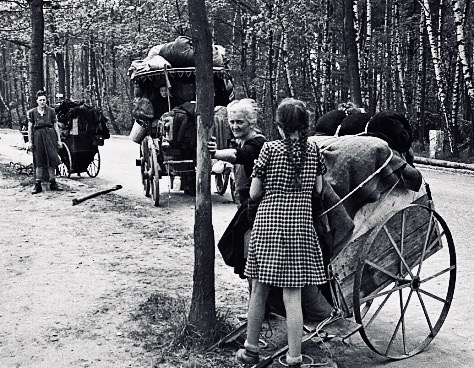
   The next morning Ona, Angele, and the children, Mindaugas, Carmen, and Ramute, loaded their wagon with clothes, blankets, food, and the baby Gema. They hitched two horses to the wagon and tied a cow to the back. “We took milk with us when we left, for Gema, and hoped we would find more when we were gone.” They took whatever they could carry. They left their Sunday buggy behind and let the riding horse, the rest of the cows, and all the pigs and chickens loose. The friend followed them.

   “My aunt let all the animals go. What could we do? The Russians would have just stolen all of them.”

   Ona Kreivenas took all her money and what jewelry she possessed with her in a handbag that she could keep close to the vest. She and the children filled a trunk with her sewing machine, china, vases, and family heirlooms. They lugged it behind the barn, where the remains of months of potatoes thrown down to feed the pigs were piled up.

   They cleared a space, dug a four-foot deep hole, and buried the trunk. They threw potato scraps over the overturned ground. When they were done, they left in two wagons with their friend. They were two women, seven children, and a cow on the move, suddenly homeless in their own homeland.

   “We moved back about fifteen miles.” They went southwest towards East Prussia. “We stopped at a big farm. When we got there, there were already hundreds of people in the fields, with their wagons, and their families. The farmer slaughtered and cut pigs up for us. All the women made food. Everybody was talking about the war, about what to do.”

   There was heavy fighting between German and Soviet troops in the Baltics. As the fighting raged, more than a hundred thirty thousand Latvians escaped to Sweden and Germany. In total, the country lost almost 20% of its population during the war, either dead or gone. The ‘Great Escape’ in Estonia started in the summer and continued through the fall. It is estimated eighty thousand Estonians fled from the Red Army to anywhere else. Almost one hundred thousand Lithuanians joined them, clogging the roads to Poland, Prussia, and Germany.

   Ona Kreivenas crept back to her farm during the week the Panzer divisions were holding their own. The countryside was a ghost town. She discovered the trunk they had buried behind the barn had been dug up and was gone. “There was just a big hole. The Russians took it. They used metal sticks to poke into the ground. Her sewing machine was gone, all gone, everything gone.”

   They slept rough, out of doors, like everybody else. “We slept on blankets on the ground. When it rained, we slept under the wagon and stretched a tarp out to keep the water away.” Every day it got darker. Over the course of September, the length of day in Lithuania rapidly decreases. By the end of the month the daylight is two hours less than it was at the start of the month.

   Their encampment stretched out for six weeks. They dug latrines and filled barrels with water. They picked apples off trees and blueberries from bushes. They took especial care of their horses. They greased the axles of their wagons, making sure the grease bucket was always full of animal fat and tar, and making sure they had a spare axle. Without one a broken axle would be a disaster, bringing them to a standstill.

   The children played games whenever they had idle time. “We played the ring game,” Angele said. “We all sat in a circle and passed around a pretend ring, like a twig or a pebble. Sometimes we passed it, but other times we didn’t. We just pretended to give it to who was next to us. One of us was it, like in tag, who had to guess who had the ring. If they were right, they got a prize, like a pencil. If they were wrong, they had to sing a silly song or do a dance in the middle of the circle.”

   When they finally left, they left in the early evening. They had heard over the radio that morning that the Russians had come closer. They spent the day packing and preparing. It was now or never. “Most of us left, although some stayed. Some of the farmers wanted their land back. They didn’t want to leave.” It was all they had. It was all they had ever known. They were loath to give it up. “My aunt had to go, no matter what. The farm didn’t matter. Her husband had already been taken by the Communists. She knew they would take her, too, if they caught her, send her away to Siberia, and her children would be left behind, orphans or worse.”

   It rained that day and the rest of the night. “The road was crowded on both sides. There were thousands of wagons, wagon after wagon, all going one way. There wasn’t a single car or truck, just horses. We knew the Germans were somewhere ahead of us and the Russians somewhere behind us, but we didn’t see any soldiers anywhere”

   Ona Kreivenas was at the reins of the two-horse team, her seven-year-old daughter Ramute holding the baby, and the rest of the children walking. Most of the refugees were walking, their wagons jam-packed with possessions and provisions. Their friend from Vilnius with her two small children stayed in line behind them.

   Before the war, Lithuania’s population was almost three million. After the war it was closer to two million. Some Lithuanians ended up dead. Many were deported. Others ran for their lives. The displaced were forced to make new lives in different countries all around the world, whatever country they could get to, whatever country would take them, whatever country they could sneak into.

   When the second Soviet invasion of the 1940s happened, some Lithuanians tried to flee across the Baltic Sea to the Nordic countries, but only a few were successful. Patrol boats apprehended them, and they ended up hauled off to labor camps. Most fled west, while others went south to Hungary, Romania, and the Balkans.

   “On the way we met my uncle on the road, Uncle Jankauskas and his family.” Her uncle’s wagon fell into line with them. The progression of wagons stretched as far as the eye could see, ahead and behind. They soon crossed into East Prussia. There were no guards. They had all fled. The borderland was a mess.

   “I was so sad leaving Lithuania,” Angele said.

   Russian warplanes strafed and bombed the column of evacuees several times. The Red Air Force was bombing and strafing at will, both German Army and refugee columns alike. Forest and brush on both sides of the road were set on fire. There was smoke in the sky day and night. Wagons and carts slowly wended their way around rain-filled craters.

   “It was all just wagons. They knew we were refugees They dropped bombs and shot their machine guns. I don’t know why they did that. Whenever we heard airplanes, we all ran and jumped into ditches beside the road. I was afraid, but somehow I knew I wouldn’t be hurt by them.”

   What was called the Baltic Gap had grown so menacing to the Reich that Adolf Hitler moved his headquarters from Berchtesgaden to Rastenburg in East Prussia. The German situation on the Eastern Front was desperate. The fighting was hard. It was a fight to the finish. The hinterland was torn up, abandoned and forlorn.

   “Most of the people on farms had run away. We would go into their houses and find dried fruit, pickles, mushrooms, pork, and wine.” They ransacked barns, pantries, and root cellars. “We took all the food we could find, all of it. It rained most of the time, it was cold, and we walked and walked. Everybody was hungry.”

   The rain and asphalt road were hurtful to their cow. The animal was careful as could be on the poor traction of the wet road, stepping timidly with its rear feet spread wide. It was compensating by walking with an arched back. They finally had to do something. They knew the long miles and pavement weren’t good for it. They thought she might be going lame. Angele’s uncle looked at the cow’s hooves and saw lesions. An ulcer was forming on one hoof.

   “Mindaugas and I found a family that hadn’t run away. We went to their farmhouse and sold the cow to them.” They gave the money to Ona Kreivenas and she hid it on her person with the rest of her money. She had plans for it. Her plans were all about survival.

   One cold night when they stopped to rest her uncle said, “Kids, jump up and down to warm yourselves up.” When Angele stopped jumping, he grasped her under the armpits. “He grabbed me. We were jumping up and down and he dropped me by accident.” She broke her wrist. “It hurt bad, but there were no doctors to help me.” When they got to a town with a railroad station, there weren’t any doctors there, either. The smart and the skilled had already left. Everybody else was hoping against hope. Angele’s wrist had to take care of itself.

   After the New Year the German population of East Prussia, most of whom had not yet cut and run, began to evacuate as the Red Army rapidly advanced. Within weeks it turned into helter-skelter flight as more than two million of the two-and-half million men, women, and children of the enclave bolted into the Polish Corridor heading for Germany. The winter weather was bad, the roads were caving in, and the civil authorities were overwhelmed. There was panic and quagmire and many thousands died, some caught in combat, others swept away in the chaos.

   But before that happened, Ona Kreivenas had already sold their wagon and horses and everything they couldn’t carry and managed against the odds to get passage on a train going to Berlin. The Prussian Eastern Railway connected Danzig and Konigsberg to Berlin. A month later, the last week of January 1945, the last train to Berlin ran the rails. There was no traffic on the line after that.

   “The train was completely full. The corridors were full, too.” They stood clumped together in the corridor. The passenger cars were red and had ten large windows on both sides. They were pressed against one of the windows. Some of the windows were smashed and the passageway was as cold as the outside. “We had a pillow for Gema, who slept on the floor, but we stood that night and the next day.”

   The twin locomotives pulling the long line of passenger cars and baggage cars were in camouflage livery. On their front was painted the Hoheitsadler, an eagle, Germany’s traditional symbol of national sovereignty, holding a swastika in its talons. By the time they crossed Poland and entered Germany, the talons and swastika were obscured by coal soot.

   Lehrter Bahnhof was the Berlin terminus, adjacent to Hamburger Bahnhof, built in the late 19th century just outside of what was then Berlin’s boundary on the Spree River.  It was built in the French neo-Renaissance style, the façade covered in glazed tiles. The station had long been known as a “palace among stations.” But it had been severely damaged by Allied strategic bombing and was near to being a shambles.

   When they finally got off the train in Berlin they were met on the platform by Bishop Brizgys. The clergyman was Ona’s husband’s cousin. Vincentas Brizgys had been the assistant to Juozapas Skvireckas, the archbishop of Kaunas. During the summer of 1944 he and the archbishop and more than two hundred other Lithuanian priests fled the country with several retreating German army divisions. Ona Kreivenas had somehow located him by telephone, and he arranged to meet them at the train station. He was wearing a dark suit and a homburg and carrying a basket of hot buns.

   “He gave one to each of us. I was so happy,” Angele said.

   She was 16-years old, somewhere between childhood and adulthood. She was very tired. In the meantime, hope in tomorrow was the only thing keeping her on her feet.

   The Third Reich’s war economy was on the verge of collapse. The whole country was a sinking ship. There was a shortage of bread, sausage, cabbage, and everything else. When they looked around, the buns the bishop had brought were the only cheer they could see. There wasn’t going to be any traditional roast goose this holiday season.

   Angele looked at the four children and her aunt. She looked up and down the platform. Their friend from Vilnius and her uncle were long gone, lost in the fog of war. Bishop Brizgys led them out of the station into the city. The Red Army numbering over four million men was massing on the Vistula River and along the East Prussian border. Their superiority was ten to one in infantry and twenty to one in artillery and planes. Berlin and its three million residents were already a wreck, the day and night Allied bombing taking a monstrous toll.

   The early afternoon was a gray haze. There was smoke in the sky. It was a kind of darkness at noon. She saw heaps of rubble in the street. When she looked all around she knew in her bones it was going to be a bare-bones winter on German soil. There was no looking back. She walked towards what was left of Berlin.

Ed Staskus posts monthly on 147 Stanley Street http://www.147stanleystreet.com, Made in Cleveland http://www.clevelandohiodaybook.com, Atlantic Canada http://www.redroadpei.com, and Lithuanian Journal http://www.lithuanianjournal.com

A New Thriller by Ed Staskus

Cross Walk”

“A once upon a crime whodunit.” Barron Cannon, Adventure Books

“Captures the vibe of mid-century NYC.” Sam Winchell, Beyond Fiction

Available on Amazon: https://www.amazon.com/dp/B0CRPSFPKP

Late summer and early autumn. New York City. A Hell’s Kitchen private eye. The 1956 World Series. President Eisenhower at the opening game. A killer in the dugout.
The End of Taupa

By Ed Staskus

   When one-time CEO Alex Spirikaitis was arrested on the afternoon of Monday, October 21, 2013, he had been on the run for ninety-some days, accused of embezzling more than $10 million from the Taupa Lithuanian-American Credit Union in Cleveland, Ohio.

   It was almost half of the cash, assets, and member deposits of the small non-profit bank.

   He had changed his appearance by growing hair on his formerly shaved head and shaving his goatee. Despite speculation that he had fled to Europe or South America, he was apprehended in the Collinwood neighborhood on Cleveland’s east side.

   “He was actually walking down the street when we spotted him,” said FBI Special Agent Vicki Anderson. His disguise had only gotten him so far. Although he had left behind multiple semi-automatic weapons and 10,000 rounds of ammunition secreted away at the credit union, he was arrested without incident.

   “He did not put up a fight.”

   Stealing money with a smile and a fountain pen is one thing. Shooting it out with the Federal Bureau of Investigation is another thing. They aren’t the same thing, by a long shot.

   The FBI would not reveal how he been tracked to Collinwood, only that they had “developed information based upon advanced investigative techniques that led to his apprehension,” a brief statement said.

   He was less than three miles from closed down boarded up Taupa Credit Union.

   Modern credit unions date to mid-nineteenth century Germany, where they were conceived as people’s banks leveraging social capital to serve farmers and the working class. The first credit union in North America began operations in 1901 with a ten-cent deposit. Today more than 8000 of them in the United States serve over 90 million members with total assets of nearly $800 billion.

   Managed by their members, most credit unions are not-for profit cooperatives taking in deposits, promoting thrift, and making loans. Unlike banks, individuals combine to manage and control their own money. They are near and far in many shapes and sizes. Credit unions range from corporate entities to community institutions serving local schools and churches.

   When Augis Dicevicius emigrated from the homeland to Cleveland in the early 2000s, he soon opened an account at Taupa. It was in the neighborhood, the employees at the credit union were from the immigrant community, spoke Lithuanian, and over time became more like friends than bankers.

   “It was like loyalty,” he said, describing why he kept an account there.

   “There is a level of trust from both sides of the counter at Taupa because you know who you are dealing with,” said Algis Gudenas, former chairman of the credit union’s board of directors, three years before the National Credit Union Association liquidated it. “I think the slogan of Taupa more or less says it all, save with one of your own.”

   From the 1930s on when the federal government began to charter them, credit unions grew steadily, especially among immigrant groups. They were instrumental in helping establish Poles, Germans, Italians, and the more recent Asian and Hispanic immigrants in their new locales. When creating the Office of Ethnic Affairs in 1976 President Ford cited “the ethnic church, school, and credit union” as fostering “a sense of neighborhood.”

   Wherever Lithuanians have settled in the United States, from coast to coast, they have formed their own credit unions. Founded in 1969, the California Lithuanian Credit Union has assets of $72 million. The thriving Boston Lithuanian Federal Credit Union celebrated its 33rd anniversary in 2013. From its roots in the basement of a church hall in the early 1950s, Toronto’s Parama has grown to become the world’s largest Lithuanian credit unions.

   Already by 1906 in Cleveland the Lithuanian Building and Loan Association, sometimes simply known as the Lit bank, had been established, even though the community numbered less than a thousand at the time. After World War Two it evolved into the Superior Savings and Loan. In the 1980s, when Cleveland was by then home to more than sixteen thousand former Lithuanian natives and their children, Taupa was founded.

   It served the community for almost three decades.

   With approximately 1100 members and $24 million in assets, located a short walk from both their church and the Lithuanian Village cultural center, Taupa was a stable institution, healthy and growing, year after year, even in an economy often troubled by bank failures and recessions.

   At least it was until the evening of July 16, 2013, when police and federal agents surrounded Alex Spirikaitis’s $1.7 million home in Solon, a bedroom suburb 25 miles southeast of Cleveland. It was four days after the decision had been made by the state to liquidate the credit union, determining it was insolvent and had no viable prospect for restoring operations.

   Armed with a warrant for his arrest for fraud, when authorities approached the home they were met by his family, who told them he was inside, but was refusing to come out. He was going to tough it out.

   “Family members left the house with us and we thought, from the information we gathered, that he was not going to willingly come out,” said Special Agent Vicki Anderson.

   The police decided to regroup, the size and layout of the large house playing a big part in their decision to wait for daylight. After a night-long standoff, the neighborhood cordoned off for safety’s sake, and TV news crews at the ready, tactical teams entered the house in the morning.

   But the police came up empty. He was not there. He had run away, fled from the consequences, not that it did much good. “A horse may run quickly but it cannot escape its tail,” is how a Lithuanian proverb puts it.

   Before the first members made their first deposits in 1984, the credit union was just a hope and a dream.

   “We were in our kitchen having coffee one morning, talking about it like we had for months,” recalled Angele Staskus. “That was when my husband suddenly said yes, we were going to go ahead.”

   Believing Cleveland’s Lithuanian immigrants and descendants would be better off banding together for their savings and loan needs, Vic Staskus took his brainchild to an ad hoc committee made up of Vytautas Maurutis, Vacys Steponis, Gintaras Taoras, and Vincas Urbaitis. Taupa was coined as the bank’s name and they were shortly chartered by the state.

   At a meeting at Our Lady of Perpetual Help church attended by fewer than twenty people, they collected $4000.00 in deposits, convinced local Lithuanian attorney Algis Sirvaitis to donate space for an office, and hired Rimute Nasvitiene, who became Taupa’s first employee.

   “At first we did everything by hand,” said Vic Staskus. Later that year the Toronto credit union offered them their old computing machine. “It took four of us to bring it into our office, since it was as big as a table, and on top of that we lost most of our small office space to it.” Fortunately, through a friend at IBM, they were shortly able to secure a more modern system.

   After they purchased their own building from a retiring Lithuanian doctor in 1985, deposits began to pour in.  “That was a problem,” Vic Staskus recalled shortly before his death in January 2011. “We had no loans, so we were earning very little. We asked one of our board members to take out a loan. But he said he didn’t need anything. Every time we asked him, he said no. We were finally able to convince him and he took a loan out for $500, and gradually people began to realize we were lending.”

   By 1990, when Vic Staskus left Taupa, the credit union had nearly $8 million in assets and delivered most of the same services all banks did. “I knew we could offer better rates and interest, and I always believed we could offer as many advantages as banks to our members,” he said. Taupe was on solid footing and growing.

   Alex Spirikaitis joined Taupa in the early 1990s, at first working at the front counter as a clerk, later promoted to assistant manager, and eventually taking on the role of CEO, as the credit union quadrupled its assets in those years.

   “He lived on the same street as we did, in the neighborhood, just down the street from the credit union, when we were children,” said Rita Zvirblis, who served as secretary for Taupa’s board of directors in its early years. “He was a really nice kid, really quiet.”

   Former board director Ricardas Sirvinskas described the new CEO as well liked, especially by older members, because he spoke Lithuanian fluently. “The older generation of Lithuanians, they really liked Alex very much.”

   After he was arrested, U.S. Magistrate Judge Kenneth McHargh unsealed an affidavit revealing the extent of the embezzlement, which was more than $10 million, making it one of the largest cases of fraud against a credit union ever n the country. The largest, involving the St. Paul Croatian Credit Union, was coincidentally also in Cleveland, Ohio.

   The criminal complaint against Alex Spirikaitis was for allegedly making false statements to a credit union from 2011 through 2013.

   “He printed out numbers he wanted to report to auditors and the National Credit Union Association and taped them over the real numbers from the true Corporate One Federal Credit Union bank account statements,” the affidavit states. “Mr. Spirikaitis then photocopied the altered documents resulting in a document that mimicked the appearance of a statement coming directly from Corporate One.”

   The machinations were on the order of “Get Smart.”

   “Everybody accepted the financial statements Alex provided us, and everybody appeared to be happy with them,” said Vincas Urbaitis, a founding member of the credit union who sat on its board for more than 25 years until resigning in 2011.

   “I guess everybody just got duped.”

   During the summer, as Alex Spirikaitis remained on the loose, federal prosecutors seized his wife’s luxury SUVs and moved to take legal possession of his home. Court documents revealed that the down payment for the house, the construction of which took a year, was paid with two checks totaling $100,000 from the former CEO’s personal account at the credit union.

   “All remaining checks, totaling approximately $1,555,132, came from Mr. Spirikaitis in the form of Taupa Lithuanian Credit Union official checks,” court documents said. “While working at the Taupa Lithuanian Credit Union, Mr. Spirikaitis never made in excess of $50,000.”

   The luxury Adirondack-style house on a five-acre lot featured two full kitchens, an indoor swimming pool, entertainment room with big screen and movie projectors, five-and-a-half bathrooms, and an elevator.

   Alex and his wife had a luxury suite at FirstEnergy Stadium for Cleveland Browns football games. They drove one of their nine cars downtown for home games. They celebrated touchdowns with fancy drinks.

   “No Trespassing” signs surrounded the house on all sides.

   “I don’t think anybody from the board of directors knew or anyone within the Lithuanian community knew he was building a house,” said Vincas Urbaitis. “He was not very social. But he was not antisocial, either. He would talk to you about the business aspects of the credit union, but I don’t even know who his close friends were.”

   He was a kind of chameleon. Everybody noticed him, but nobody recognized him. He wasn’t a public man, after all. Ricardas Sirvinskas described Alex Spirikaitis as a quiet person, keeping to himself, and only rarely attending social events in the Lithuanian community.

   Although court documents were not completely clear regarding the final tally of money missing, Vincas Urbaitis was bewildered why examiners had not verified the statements prepared by Alex Spirikaitis.

   “They never went to the bank, Corporate One, and asked independently as to how much money was in the accounts,” he said.

   Vytautas Kliorys, board president of Taupa at the time it was closed and liquidated, also questioned the credit union’s third-party audit firm and examiners. “The board believed that it had all the procedures in place to prevent this sort of event,” he said. “We had received excellent and very good reports from the annual state exams, and we had even gone one step further than required and used an outside CPA firm to perform annual independent audits.”

   Paul Hixon, VP of marketing at Corporate One, had no comment other than to say the National Credit Union Association was investigating. Officials said it would take up to six months to complete a full forensic account process.

   The Lithuanian community reacted to the credit union’s closing with dismay. “For those in Cleveland that have been watching the news for the last few days know that the Lithuanian community in Cleveland has been in the spotlight,” said Regina Motiejunas-McCarthy, co-host of Siaurinis Krantas Lithuanian Radio.

   “Not because of something good but because of a tragedy.”

   The unexpected closure of the credit union affected all of its members, freezing their accounts for several months-and-more, even though they were insured, as well as severely impacting some businesses, including the Lithuanian Community Center.

   “Like many other businesses that have their accounts there, we are all scrambling to open new checking accounts with basically no liquid cash other than from sales over the weekend,” Ruta Degutis, president of the community center, said when news of the closure became official.

   “Alex assumed a public trust when he became CEO of Taupa, to help better the lives of others,” said one of the members. “It was not given to him as an opportunity to satisfy personal greed.” After thirty years Cleveland’s Lithuanian community lost one of the pillars of its community.

   Within days of his arrest U.S. Magistrate Kenneth McHargh found the former bank officer indigent and qualified for a court-appointed public defender. Since a “Go Bag” filled with blank identification cards, mobile phone cards, and stored value cards that could be used in lieu of cash had been found in his office, the magistrate also ruled he be held behind bars without bond. Assistant federal public defender Darin Thompson did not challenge the no-bond ruling.

   The defendant and his lawyer agreed to waive his right to a detention hearing. The case was bound over to a federal grand jury. Alex Spirikaitis left the U.S. District Court in downtown Cleveland as he had entered it, hands handcuffed behind him, a policeman beside him guiding him away.

   In the same courtroom the following year Alex Spirikaitis and Vytas Apanavicious pled guilty to bank fraud. Vytas Apanavicius of VPA Accounting, providing bookkeeping and accounting services, conspired with the group, depositing and transferring funds to hide overdrafts and withdrawals, according to Steven Dettlebach, United State Attorney. Michael Ruksenas of Naples, Florida, and John Struna of Concord Township, Ohio, were subsequently charged for their roles in the conspiracy.

   At the end of the day, Alex Spirikaitis was sentenced to eleven years in prison, not so much a punishment as a consequence, the wages not of sin but of breaking the faith.

A version of this story appeared in Draugas News.

Ed Staskus posts monthly on 147 Stanley Street http://www.147stanleystreet.com, Made in Cleveland http://www.clevelandohiodaybook.com, Atlantic Canada http://www.redroadpei.com, and Lithuanian Journal http://www.lithuanianjournal.com

A New Thriller by Ed Staskus

Cross Walk”

“A once upon a crime whodunit.” Barron Cannon, Adventure Books

“Captures the vibe of mid-century NYC.” Sam Winchell, Beyond Fiction

Available on Amazon: https://www.amazon.com/dp/B0CRPSFPKP

Late summer and early autumn. New York City. A Hell’s Kitchen private eye. The 1956 World Series. President Eisenhower at the opening game. A killer in the dugout.
Independent People

By Ed Staskus

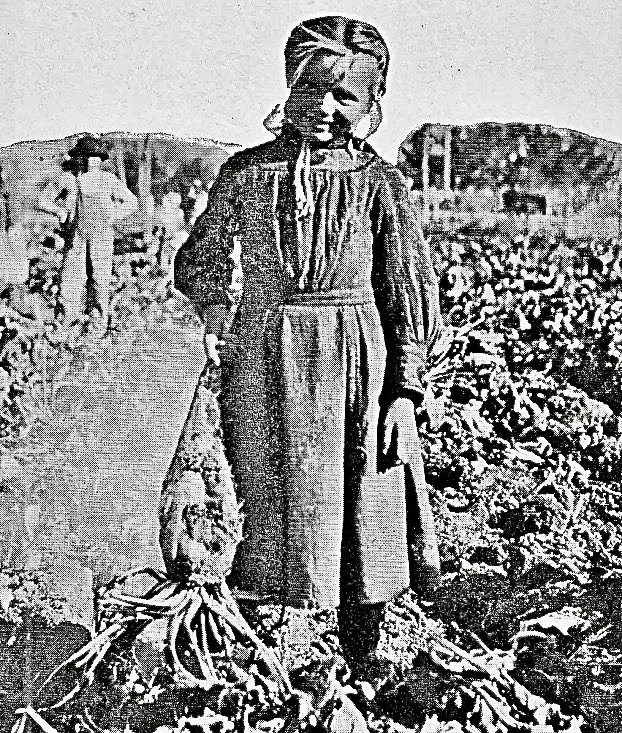
   “I started to help in the sugar beet fields when I was 9 years old,” my mother said. “My sister Irena started helping me two years later when she turned nine.” The year was 1939 when the sisters worked together for the first time. Six years later my mother was in a refugee camp outside of Nuremberg and my aunt was on her way to a slave labor camp in Siberia. My mother was lucky Americans ran the camp she ended up in. My aunt was unlucky Russians ran the camp she ended up in. She was lucky to survive her first year, much less the next decade.

   “We worked with our father, who had a one-row horse-drawn puller.” My grandfather Jonas Jurgelaitis followed on foot behind the puller, picked up the beets, scalping the tops with a small machete, and dropped them behind him as he went. He recycled the heads for animal feed. His daughters brought up the rear, shaking dirt off the beets, and loading them into a side slat cart. When it was full he made his way to Mariampole, the nearest market town, where there was a storehouse and a train station to later take the root vegetables to a sugar beet factory. 

   Their other major crop was cabbage. They could harvest upwards of ten thousand heads an acre. When they cut the cabbage head out of the plant they left the outer leaves and root in the ground. That way they got two crops. Jonas took them to Mariampole, too.

   “My older brothers Bronius and Justinas helped handle the livestock, and they did field work and repairs. Something always needed to be fixed. My younger brothers were still growing up. My father did everything outside the house and my mother did everything inside the house. All of us worked around the clock at harvest time, even the boys.” Most of the food and drink the family of eight ate and drank came from their own fields and pastures, although their sugar beets were grown on land they rented from a neighboring childless widow.

   The farm was in the Naujeji Gizai region hallway between Lake Paezeriu and Mariampole, although it was far closer in spirit to the lake than it was to the city. Some farmers had tractors. Most farmers had draft horses. They preferred tractors, but the Great Depression had put a dent into what they preferred. Some big land owners had cars. Everybody else had a horse and carriage to get the family to church on time on Sundays.

   My grandfather kept cows, pigs, and chickens. “We made our own bread and butter, made cheese, gathered eggs, and collected berries.” There were patches of wild blueberries at the edge of their fields. Although they didn’t have a cellar, my grandmother Julija still canned pickles and beets and stored them in the well. “We raised our own pigs and my father killed them.” When the time came, Jonas selected a pig for slaughter, walked it to a clearing beside the barn, hit the animal hard between the eyes with a club hammer, and cut its throat. With the help of his two eldest sons, he cleaned and skinned the pig with a sharp knife, keeping a knife sharpener at hand.

   Once the skin was separated from the muscle and fat, he cleaned out the guts and sawed the pig’s head off. After quartering the animal, Jonas found the hip joints and slid his knife into them, cutting off the two hams. He did the same thing when cutting off the shoulders of the pig. At the center, where the ribs are, he took whatever meat he could find. They made sausages, bacon, and cured slabs of pork with salt and pepper. Jonas had built a closet around the chimney in the attic of the house, which could be gotten to by ladder. There were no stairs. He smoked the pork in the closet, laying the meat on grates, opening a damper to vent smoke into the closet. “I was scared to death of the upstairs, of the fire up there, although the pig meat was delicious,” my mother said. “When we ran out of food, my father killed another animal. He was a serious man.”

   The dining room was big enough for all of them at once. There were no chairs. There were two long benches. My mother always sat cross-legged when eating. “I was scared that a Jew would sneak under the table.” She was afraid he would bite her legs and suck her blood. “Everybody said the Jews had killed God and they drank the blood of Christians.”

   One of my mother’s chores was killing chickens for dinner. She didn’t like chopping their heads off, so she grabbed them by the neck instead and swung them in a circle around her until their necks snapped. There were barn cats and a watchdog. They chained the dog up at night. There were potatoes and fruit trees. They grew barley and summer wheat, putting in a barnful of hay every autumn. Sugar beets were my grandfather’s number one cash crop, followed by cabbage and hemp. He grew some stalks of marijuana and tobacco behind the barn. He didn’t puff on pot himself. He smoked his homegrown tobacco instead, packed in a pipe, taking a break at the end of a long hard day. 

   “I let the young men smoke their stinkweed and get silly,” he said. My grandfather got silly in a different way. He brewed his own beer and krupnickas. My grandmother didn’t smoke or drink. She kept a close eye on her husband. He kept a close eye on her, never smoking in the house. She had chronic tuberculosis, coughing and running a fever, and wasn’t long for this world.

   Making home brew is the simplest thing in the world. Sumerian farmers brewed beer from barley more than 5,000 years ago. The Codes of Hammurabi, that were the laws during the Babylonian Empire, decreed a daily beer ration to everybody from laborers to priests. Laborers got two liters a day. Priests got five liters a day. In the Middle Ages Christian monks were the artisanal beer makers of the time. Since my grandfather had water, malt and hops, and yeast within easy reach, he had beer within easy reach year-round.

   Krupnikas is a spiced honey liqueur. The Order of Saint Benedict whipped it up for the first time in the 16th century. It can be spiced with just about anything, including cardamon, cinnamon, and ginger. If they had them, farmers added lemons, oranges, and berries. Honey was essential, although not as essential as a gallon or two of 190 proof grain alcohol. There was grain as far as the eye could see, and everybody knew somebody who made moonshine, so making krupnikas full-bodied was never a problem. Lithuanians pour it down on holidays and weddings. Everybody likes a warm snort of it in the dead of winter, whether they have a cold or not.

   Next to the lowlands of central Lithuania, the carbonate soils of the west are the best. That is where my grandfather was. More than half of the country’s land area was farmland. Most of the rest of it was meadow and forest. What was left was where the towns and cities were. The agrarian reform of 1922 promoted farmsteads. Landless peasants got some acres of land, if not a mule. Most holdings, except those Polonized, were between 5 and 40 acres. The Poles were Lithuania’s rural aristocracy. My grandfather had been a landless peasant. He got 10-some acres of his own and rented more of it. During the interwar years more than 70% of the population depended on agriculture for its livelihood. In the 1930s Lithuanians fed themselves and were the source of 80% of the country’s export income. Lithuania is roughly two-thirds the size of the state of Maine. The small country was the sixth-largest butter exporter in the world.

   My grandfather didn’t know anything about the legality of cannabis. He didn’t know it was called “Sacred Grass” three thousand years ago in India. He didn’t know the Romans had used it as medicine. He didn’t know Queen Elizabeth in 1563 ordered all English land owners with 60 or more acres to grow it or face a 5 pound fine. One year later King Philip of Spain ordered cannabis be grown throughout his empire from Spain to Argentina. George Washington cultivated it at Mount Vernon and smoked it when his teeth hurt too much to bear.

   After World War One some nations began to outlaw marijuana. It became seriously illegal in the 1930s. The United States led the way. The plow breaking new ground was “Reefer Madness” and the man behind the plow was William Randolph Hearst. His chain of newspapers ran one article after another demonizing marijuana. There were articles about Mexicans gone crazy after smoking it, running around with a “lust for blood,” and articles about reefer-mad Negroes dancing to voodoo jazz music and raping white women.

   Harry Anslinger, head of the Federal Bureau of Narcotics, turned the nativist, as well as racist, battle against marijuana into a war. “Reefer makes darkies think they’re as good as white men,” he said. He believed it had a bad effect on the weak-minded “degenerate races.” He was especially worried that white women might smoke it at parties and consort with black men. 

   “Most marijuana smokers are Negroes, Hispanics, and Filipinos,” he said. “Their satanic music, jazz, and swing, result from its usage. This marijuana causes white women to seek sexual relations with Negroes, and entertainers, and many others. I consider it the worst of all narcotics, far worse than the use of morphine or cocaine.” The soft drink Coca-Cola contained cocaine from 1894 until 1929. It was why kids could walk five miles to school, both ways, uphill in the snow, jumping barbed wire fences. 

   The town of Gizai is situated at a crossroad. There was a small school, church, police station, hardware store, and a coffee shop in the 1930s. “We went to church every Sunday and my father went to the store whenever he needed a tool or something he couldn’t make himself,” my mother said. “When he took us along he treated us to candy at the coffee shop while he drank coffee and had a slice of lazy cake.”  

   Back on the farm everybody slept on the ground floor of the house. The bedrooms were three side rooms. One was for Jonas and Julija. One was for my mother and her sister. The third room was for the four boys. There was no electricity. The house was lit by kerosene lamps. The dining room was the biggest room. It was lit by a big kerosene lamp that was raised and lowered from the ceiling by a pulley attached to a counterweight. Everybody washed their meals down with tea. My grandfather bought tea from a German smuggler rather than pay the taxes levied on it. In the winter the fireplace was stuffed with wood and turf. The boys had the chore of making sure it never died out November through March.  Once a year a chimney cleaner came with ladders, brooms, and brushes. The sweep used a long rope attached to a weight for pushing out the soot.  

   In Washington, D. C. Harry Anslinger could blow smoke with the best of them. “Under the influence of marijuana men become beasts. It destroys life itself,” he declared. He called for a nationwide ban on the weed. Just in case anybody had missed the point, he added, “Smoking it leads to pacifism and communist brainwashing.” The top pot cop got the Marijuana Tax Act passed in 1937. It effectively made the weed illegal from coast to coast. Other countries worldwide got on the bandwagon. Even the Netherlands criminalized cannabis for a few years. The American law was declared unconstitutional in 1969, but Richard Nixon replaced it with the Controlled Substances Act the next year. Darkies couldn’t catch a break any which way.

   The Nixon administration quickly changed the name of the Controlled Substances Act to the War on Drugs. The next Republican president dragged out the big guns. “I now have absolute proof that smoking even one marijuana cigarette is equal in brain damage to being on Bikini Island during an H-bomb blast,” said President Ronald Reagan. The First Lady consulted advertising executives and her astrologer and they came up with a snappy slogan: “Just Say No!” When asked what she meant she said she wasn’t talking about H-bombs but about marijuana.

   My grandparents couldn’t afford a washerwoman, so my grandmother did all the laundry. She put a tripod inside the fireplace and heated water in a copper kettle. After the clothes were washed she rinsed them in another kettle. She hung some of the clothes on a line in the attic to dry. She used a mangler on other laundry to get the wrinkles out. It was a wooden box with rollers like a wringer that squeezed and smoothed water-soaked clothes. When she was done she didn’t need any marijuana to help her relax. She fell asleep the minute she was done.

   My grandmother Julija died of tuberculosis in 1941. She had been in and out of a sanatorium in Kaunas. When she decided to go home for the last time it was to go home to die. My grandfather built an addition for her, which was a bedroom with a window. He built a new bed and stuffed a new mattress with clean straw. He moved their wedding cask to a corner of the bedroom. When the end was near he stood a coffin up beside the door. She was buried in a cemetery outside Gizai a few months before the German Army suddenly invaded.

   My grandfather Jonas died in 1947 after the Russians took the country over and collectivized everybody’s farms. The authorities told him he could keep one cow and one pig. They didn’t care about his chickens. They told him to stop growing marijuana and tobacco. All his crops had to be delivered to the state and the state would pay him whatever they thought was appropriate. He had differences with them about it, but what could he do? What he did was die soon afterwards of some kind of brain disease. His head probably exploded. Who wants to be a slave of the state? His farm disappeared down the Soviet sinkhole.

   Lithuania criminalized cannabis in 2017, a hundred years behind the times. The country was going against the grain. Almost everybody else in the world outside of China and Russia was decriminalizing it as fast as they could. They were sick of the drug gangs and lost tax revenue and prisons bulging with one-time losers. By then everybody knew marijuana didn’t make anybody sex-crazy or lust after blood. The country pivoted four years later and decriminalized small amounts for personal use. Growing any amount of jazzy stinkweed remains illegal. God forbid a seed in your personal Mason jar sprouts and flowers.

   My grandfather was a simple man with only a handful of overriding concerns, doing what had to be done, leaving the rest to take care of itself. He might have mulled the matter over on his front porch, drawing on his pipe to get it going, but I doubt he would have paid too much attention to whatever monocratic laws the boss men promulgated regarding his farm and crops, unless it was at the point of a gun. 

Ed Staskus posts monthly on 147 Stanley Street http://www.147stanleystreet.com, Made in Cleveland http://www.clevelandohiodaybook.com, Atlantic Canada http://www.redroadpei.com, and Lithuanian Journal http://www.lithuanianjournal.com

A New Thriller by Ed Staskus

Cross Walk”

“A once upon a crime whodunit.” Barron Cannon, Adventure Books

“Captures the vibe of mid-century NYC.” Sam Winchell, Beyond Fiction

Available on Amazon: https://www.amazon.com/dp/B0CRPSFPKP

Late summer and early autumn. New York City. A Hell’s Kitchen private eye. The 1956 World Series. President Eisenhower at the opening game. A killer in the dugout.
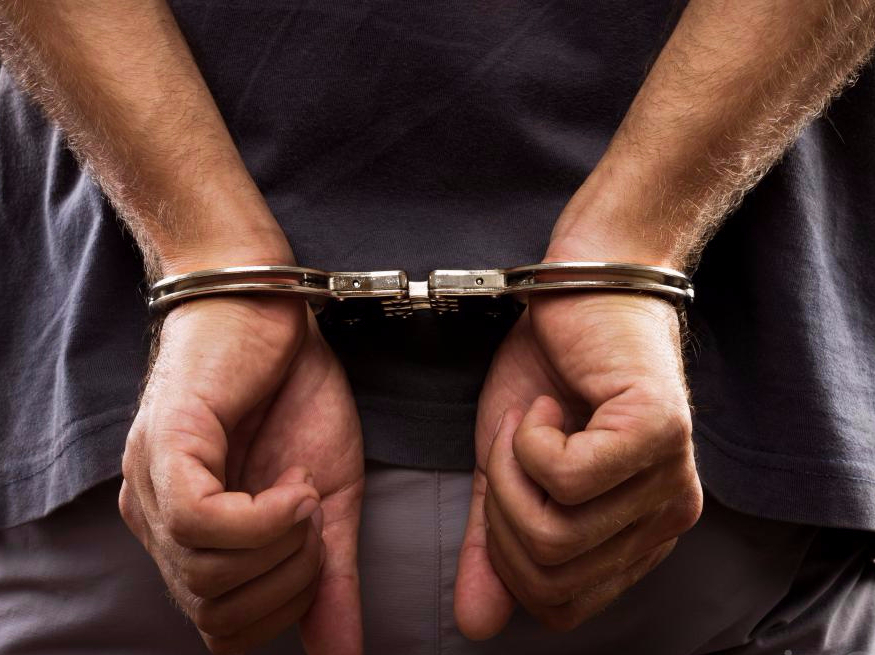
Farm Girl

By Ed Staskus

   When my mother Angele was born it snowed until it got too cold to snow anymore. By the end of the month the thermometer rose to ten degrees below zero. When it warmed up the next month and the snow melted, a half-foot of slush was left behind. The next week there was heavy rain and her father’s fields were left under water. If it froze again there would be acres of ice rink. It froze and everybody went skating.

   “I was born in an area we called the New Farm, in Suvalkija, near Gizai,” said Angele. It was mid-January 1928.

   Suvalkija is the smallest of the five regions of Lithuania. It is girdled by the Nemunas River to the north and Poland to the south. The region’s identity was molded in the 19th century when it was a part of Congress Poland. Suvalkija was an agricultural area, generating substantial sugar beet harvests. Sugar beet yield in Lithuania in the early 20th century was almost half what it was in the United States, even though the country is 151 times smaller than the United States.

   “My father’s name was Jonas Jurgelaitis. My mother’s name was Julija. I had four brothers and a sister. I was so happy when my sister was born. We lived on a small farm. It was three or four miles from Marijampole.”

   Marijampole is in the far south of Lithuania, bordering Poland and Kaliningrad. Lake Vistytis is nearby. The town was a center of book spreaders and freedom fighters in the long struggle leading to the country’s independence in 1918. Speaking Lithuanian was forbidden, but they did it anyway. Reading Lithuanian books was forbidden but they read them anyway. Many of them ended up in Russian prisons, where they spoke Lithuanian among themselves.

   Their farm was 10-some acres. The nearest neighbors were out of sight, even though they were nearby. Small woodlands of Scots Pine and Norway Spruce were scattered along the periphery of their land. Her father kept a pair of horses, three to four cows, lots of chickens, and a sounder of swine. Every week he loaded 10-gallon 90-pound milk cans into his wagon and took them to a local dairy. He rented croplands from a childless widow. The ground was devoted to sugar beets, a cash crop, harvested in early autumn.

   Suvalkija has less forest than any other part of Lithuania. It had long since been brought to bear for tillage. Kazlu Ruda, a large forest, nearly 230 square miles of it, is in Suvalkija, but it is on sandy soil that doesn’t work for farming. Rye, wheat, and barley have been cultivated in Lithuania for two thousand years. Potatoes got rolling three hundred years ago. The country has always been able to sustain itself with foodstuffs. After gaining home rule from the Russians, land reforms in 1922 turned over ground suitable for the plow to tens of thousands of new landowners. Two years later the Academy of Agriculture was established to oversee land exploitation and management.

   “My mother was tall and thin.,” Angele said. “She was pretty. She looked like a Romanian, even though she was born near where we lived. I didn’t look like her, at all. I looked like my father.” Her mother gave birth to eleven children in less than twenty years. Six of them survived infancy. Five of them survived World War Two, the forty-six-year subsequent Soviet occupation that happened next, and lived to see Lithuania regain its independence.

   Justinas was the oldest boy, born in 1919. “Justinas and my other older brother Bronius would invite their friends, and all the girls, to our house in the summer for dancing, before he joined the army.” Irena and the boys Sigitas and Jozukas were the youngest. Jozukas, the tenderfoot of the family, was two years old in 1938.

   Julija started suffering chest pains that year, losing her appetite and losing weight. She was diagnosed with tuberculosis, a major killer in the 19th and early 20th centuries. Almost ninety years later tuberculosis is still prevalent in Lithuania, one of the most highly TB-burdened countries in the world.

   “She went to the sanitorium in Kaunas the next year and got better.” When family responsibilities and the family’s finances called her back, she got worse. Angele helped with the housework and cooking. She kept up her schoolwork, kept up her chores, and with her two older brothers nursed their mother.

   “Irena and I went to a school in Gizai, which was less than a mile from our house. In the winter, when it was snowy, my father hitched one of the horses to a sled and took us there. I went for six years.” The family farm wasn’t far from Marijampole. It was forty miles southwest of Kaunas, the country’s second largest city. Vilnius, the largest city, home to nearly a half million, was eighty miles away. It might as well have been a million miles away.

   “Even though my father did everything, we all had to work, since we were poor.” There were no hired men or seasonal laborers. “I mixed feed for the pigs and fed them. We earned our money by growing sugar beets. Irena and I helped, but Sigitas and Jozukas were too small. We pulled them out of the ground in the fall and used a big knife to cut the leaves away. We threw them in a cart and when we had enough to fill our wagon, my father hitched a horse and took the beets to Marijampole.”

   The family home was a frame house, clapboard siding painted green, two stories, although the second story was an attic for storage and for smoking pork. “We had a barn, but we had another small house, too, a small barn where we kept wood for the fireplace.” They sawed and split their own cordwood. “On the second floor, up a ladder, there was rye and barley for bread. Justinas and Bronius slept in a room beneath the loft.” A brick-lined jumper duct fed heat from the house fireplace to the barn. Still and all, all winter long the young men gathered their blankets and warmed them up at the fireplace before going to bed. In deep winter in the Baltics the nights are 16 hours long. The stars twinkle but they are icy.

   Lithuania is a flat fertile country overlooking the Baltic Sea. The summers are mild, and the days are long, but the winters are longer. They are cold and dark. Temperatures often drop well below freezing. The ground is ice and snow-covered from mid-December to mid-March.

   “We had a dog, in a dog house next to the barn, whose name was Sargis.” Saugotis in Lithuanian means beware or watch out. “He was our guard dog, always tied up at night, who barked whenever a stranger came near. We had cats, too, who killed the mice and rats who ate our grain. We never let them into the house, though. They were only for the outside.” Barn cats lead a rough life, hunting vermin in outbuildings and fields. They sleep where they can, stay warm if they can. Living feral, they don’t live long. Whenever they could they snuck into the small, heated barn and slept under the blankets next to the two brothers.

   The family knew everybody in their neck of the woods. Everybody was wary of strangers. Although they had no immediate neighbors, her mother’s father, a tailor, lived nearby, and her father’s mother also lived within walking distance. “Whenever my mother made potato pancakes, she would give me a platter of them, and I took them to grandma’s house.” Her grandmother lived on the other side of the woods, with one of her father’s older sisters.

   After her mother got sick, from about the time she was ten years old, Angele did the cooking for the family. “My oldest brother Justinas helped me until he went into the army, and then Bronius helped.” She cooked pork logs, made soup, and served bread and butter every day. She washed the pots and pans and dishes and utensils twice a day.

   Justinas was apprenticed to a tailor, and learning the trade, but joined the army in the late 1930s. Every country cousin knew war was coming. “He became a cavalryman and was stationed near Marijampole. He rode home a few times, on his horse, in his uniform. He was so handsome.” He had just turned twenty-one. He didn’t know his horse was going to be useless in the coming war.

   When the Red Army invaded the Baltic states in June 1940, their troops numbering some fifty divisions, supported by armor and an air force, they swept the Estonian, Latvian, and Lithuanian forces aside in a matter of days. Justinas spent the rest of the war feeding his horse, and sewing and mending clothes, first under the thumb of the Russians, then the Germans, and then the Russians again.

   A woman whose husband had died and who lived nearby helped Angele learn to bake bread in their brick-lined oven. They made a half-dozen loaves at a time, kneading up to ten pounds of dough at a time, baking the free-standing loaves loosely arranged in front of a smoldering pile of coals that had been left burning for several hours. They kept the coals pushed to the back of the oven. They added wood as they needed it, shifting the fire from side to side. “We always had bread. We always had tea and sometimes coffee. When times were hard we collected herbs and had herbal tea.”

   The house did not have electricity or indoor plumbing. They had oil lamps and an outhouse and a well. There was a sink with a pump handle in the kitchen. “The outside well had a pulley and a bucket until we finally got a hand crank.” In January 1940 a bitter cold wave enveloped Lithuania, driving temperatures down to 40 degrees below zero Fahrenheit. The next month it crashed to 54 degrees below zero, the coldest in 160 years. The cats didn’t leave the small barn for weeks. The well froze. The Baltic Sea iced over. Some people froze to death and more than 10,000 throughout the Baltics were severely frostbitten, losing fingers and toes.

   When Julija had a relapse, she went back to the sanitorium in Kaunas, but returned home soon afterwards. “A taxi brought her back. My mother said she had to be with her children.” She was not fully recovered. When winter bore down again, she became run down and became bedridden. Jonas built an addition with a window, putting down rough planks over the packed dirt floor. He moved a free-standing cast iron furnace into the room. His wife died in her bed, the head of the bed facing the window, early the next spring. She was forty-three years old.

   Angele’s father re-married four months later. “He needed a woman to take care of Sigitas and Jozukas, my baby brothers.” Jonas had decided to ask the nearby widow with the farm, the woman who had helped Angele bake bread, but by then she was spoken for by another man. He found a single woman in Gizai and didn’t waste any time proposing.

   “Gizai was where we always went. My school was there, and there was a church, a police station with a policeman, and a hardware store that had everything. Whenever we had a coin we bought candy at the coffee shop there.”

   Jonas’s new wife was younger than Julija had been and healthy as a horse. She had a daughter a year older than Angele, even though she had never been married. The wedding was in early September. It wasn’t long after the move-in before Angele realized she couldn’t stay. “My new mother and my father started arguing. She loved the younger ones, and she loved her own daughter, but they started arguing about me. My father stood up for me, but he needed a wife. I don’t know what I was thinking, but one day I left.”

   It was late September. She packed a loaf of bread, some cold pork, what clothes she could carry, and a picture of her mother. She set off on foot in the morning for Alvitas, for her aunt’s house. Ona Kreivenas was her mother’s sister. Her aunt’s husband, a police captain, had been deported to Siberia by the Russians that summer, leaving her with three children and pregnant with a fourth. She could use a hand around the house.

   “I knew life wasn’t going to be any easier in Alytus, but I had to go,” Angele said

   Even though two German army groups smashed into the country in late June that summer, ousting the Russians, by then it was too late for Jonas Kreivenas, who didn’t come back from a slave labor camp in Siberia for nearly fifteen years, and when he did, found out his wife wasn’t in Lithuania anymore. She had fled post-war Europe. She was living in Philadelphia, in the United States.

   Alvitas is about fifteen miles from Gizai. It took Angele most of the day to walk there. She passed a prisoner of war camp crowded with Soviet soldiers captured by the Wehrmacht. One of them asked her for bread but she turned her head away. His war had amounted to little and ended in nothing. When she got to her aunt’s farm the sun was close to setting. 

   “I lived with my aunt for the next three years, until the Russians came again, and we had to run to Germany. I never went back home, except to visit, as a guest. I loved my father, and my brothers and sister, but I couldn’t go back.” When Angele woke up early the next morning, she had a new home and a new mother. “She was my parent now. They were my family.” She helped her aunt make breakfast. There was strong black tea at the table. The first frost wasn’t far away, but that morning was an Indian summer morning.

A version of this story appeared in Draugas News.

Ed Staskus posts monthly on 147 Stanley Street http://www.147stanleystreet.com, Made in Cleveland http://www.clevelandohiodaybook.com, Atlantic Canada http://www.redroadpei.com, and Lithuanian Journal http://www.lithuanianjournal.com

A New Thriller by Ed Staskus

Cross Walk”

“A once upon a crime whodunit.” Barron Cannon, Adventure Books

“Captures the vibe of mid-century NYC.” Sam Winchell, Beyond Fiction

Available on Amazon: https://www.amazon.com/dp/B0CRPSFPKP

Late summer and early autumn. New York City. A Hell’s Kitchen private eye. The 1956 World Series. President Eisenhower at the opening game. A killer in the dugout.