Tag Archives: Lithuanian Journal

No Place Like Home

By Ed Staskus

   Sigitas Kazlauskas didn’t know J. Edgar Hoover from the man in the moon. He didn’t necessarily want to make his acquaintance, either. He wanted to go home, even though he knew he didn’t have nearly the funds for the passage. The passage was across the Atlantic Ocean and over the North Sea. His home was far away in Lithuania. He didn’t know the Justice Department man was going to be his ticket back.

   Sigitas was living in Cleveland, Ohio in 1919, where it was Thanksgiving week. He had left home in late 1914, dodging forced conscription into the Russian Army. He knew being drafted meant the meat grinder. He also knew his socialist views were hazardous to his health. The Czar didn’t brook his kind of man. He made his way to the United States on a tramp steamer. He was living in Dope Town, a neighborhood west of East 9thSt. and north of Superior Ave. Suicide Pier on the Cuyahoga River was down one end of the street and the town dump was down the other end of the street. Lake Erie was on the north side and Little Poland was on the south side. 

   None of his friends called him Sigitas. Everybody called him Dave. When he asked why, they laughed and said, “David and Goliath, like in the Bible.” They didn’t bother with his surname since they weren’t his kith and kin. They were Eastern Europeans like him who had ended up in Cleveland for the same reason as him, which was opportunity. His opportunity had come and gone, which was why he was living in Dope Town. It was the only place he could afford a furnished room. The wrist a Cleveland policeman had broken with a truncheon during the May Day Riot six months earlier hadn’t helped, making him unemployable for three months and draining his savings.

   Since then, he had been living on bread and homemade beer. When the beer was ready he called his Polish friends, “Hey Polska, come get your right piwo.” He was well-known for his beer, attracting friends who were as friendly with his brew as they were with him, maybe more. They sang, “In Heaven there is no beer, which is why we drink it here.” He was hoping somebody would invite him to their turkey feast on the big day. He needed a square meal with his suds.

   Cleveland was going strong in 1919. It was the fifth largest city in the country. Iron and steel dominated the economy. Foundries and machine shops were everywhere. Skyscrapers were being built. The population was nearing one million. A third of the population was foreign born, working in the steel plants and garment factories. They worked long hours for low pay, but it was better than where they had come from, where they worked longer hours for even less pay.

   More than a quarter million Lithuanians left the Russian controlled Baltics between 1900 and 1914. When World War One broke out all immigration from Europe to the United States was brought to a stop. The new labor force that came into being was from the American South. There had been fewer than 10,000 Negroes in Cleveland in 1910. Ten years later there were nearly 40,000. There was enough work for everybody, though. Commercial construction was booming. The problem Sigitas had wasn’t finding work. The problem he had was keeping the work he found.

   He was a socialist, which was his problem. He believed in social ownership of the means of production. He didn’t believe in private ownership of it. The word socialism comes from the Latin word “sociare” which means to share. The modern use of the word was coined by the London Cooperative Magazine in 1827. The First International was founded in 1864 in Great Britain. After that it was off to the races. The Second International was founded in 1889. Anarchists were banned as a practical matter. Socialists didn’t want bomb throwers in their ranks, if only because bombs can be unpredictable about who they blow up.

   The May Day Riot in Cleveland on May 1, 1919 pitted trade unionists and socialists against police and military troops. The city was bursting at the seams with blue-collar foreign-born laborers. The activist Charles Ruthenberg got it into his head to organize a mass demonstration on Public Square on International Workers’ Day. He had run for mayor on the Socialist Party ticket two years earlier, polling nearly a third of the vote. He was well-known among the disaffected. He marched at the head of the assembly.

   Sigitas and his friends heeded the call. They joined the more than 30,000 men and women who showed up for the demonstration. They marched from Acme Hall on Upper Prospect to Lower Prospect to Public Square. The marchers wore red shirts and waved red flags. A parallel procession of army veterans in full uniform clashed with the socialists. Fights broke out and the police were called, who then quickly called for reinforcements and mounted forces. Harry Davis, the city’s mayor, called for the National Guard, who mustered in front of a beer hall before going into action with fixed bayonets. Tanks led the way, even though the socialists were unarmed. When Sigitas’s wrist was broken, a lady standing beside him used the 8 inch ivory hatpin holding her hat to her hair bun to stab the policeman in the chest. It was how Sigitas managed to break loose and not get arrested. 

   Several marchers were killed, nearly a hundred were injured, and many hundreds more were arrested. The Socialist Party headquarters at Acme Hall was ransacked by a “loyalist” mob. The next day all of Cleveland’s newspapers blamed the marchers for the riot, labelling them as “foreign agitators” even though most of them were native-born or naturalized citizens. The fourth estate demanded their deportation. The Immigration Acts of 1921 and 1924 later restricted immigration of “undesirable” Southern and Eastern Europeans, whether they were socialists, or not.

   It was at Thanksgiving dinner with his friend Teodor Wojcik and his family that his friend hatched a plan about how to get Sigitas out of the United States and back to Europe. Agnieszka was Teodor’s wife. They had two children and were moving up in the world. Teodor went by Teddy and Agnieszka went by Agnes. They weren’t socialists, but didn’t argue with Sigitas about it. They believed the United States was a free country where everyone was free to believe what they wanted. They weren’t silly enough, however, to say so in public.

   “There’s a man at the Justice Bureau who is heading up the new Radical Division,” Teddy said. “He’s already gone after the Negroes.” J. Edgar Hoover was the new man. He was after what he called “terroristic and similar classes.” He was a District man born and bred. He was a law and order man schooled in bigotry. “Something must be done to the editors of Negro publications as they are beyond doubt exciting the darkie elements of this country to riot,” he said in the summer when white soldiers and sailors rioted in the District, killing more than a dozen men and women, after a rumor spread that a Negro man had raped a white woman. The rumor was false. The Negro deaths were real.

   J. Edgar Hoover turned his attention to anarchists and communists at the end of summer. He got busy sending the notorious Emma Goldman back to Russia. He helped engineer the arrest of more than a thousand radicals in early November, with the intent of deporting them. “The Communist Party is a menace,” he said. He meant to send them all back to where they had come from.

   “What does this new man have to do with me?” Sigitas asked.

   Agnes brought a plate of paczek to the table. They were deep-fried pastries filled with jam, caramel, and chocolate. The outer layer was sprinkled with powdered sugar and dried orange bits. They drank coffee the Polish way, which was strong with full-fat cream.

   “What you have to do is forget about socialism and become a communist,” Teddy said. “Join the Communist Party. Volunteer for the dirty work. Become a firebrand. Make yourself known to the Radical Division. Make enough trouble and you should be on a boat on your way back to Lithuania in no time. It won’t cost you a penny for the fare and they will feed you during the voyage, too, so by the time you get home you’ll be back to your old self.”

   “They won’t shoot me?”

   “Probably not.”

   “They won’t throw me in jail?”

   “They probably will for a month-or-so, but they don’t want to keep anarchists and communists in jail. They don’t want them here. They want to send them somewhere else, anywhere else, which will be easy enough in your case since you were never naturalized.” Sigitas had never forgotten Lithuania and had never become a full-fledged American.

   Becoming an official communist was easy as pie. Charles Ruthenberg had split from the socialists after the May Day Riot and joined several splinter groups to form Cleveland’s Communist Party. They allied with the Communist Party of America. The woman who had saved him during the May Day Riot was a close associate of Charles Ruthenberg’s. She put in a good word for him. He was brought into the circle of fellow travelers. He was given a revolver but no bullets. He gave the gun back. J. Edgar Hoover’s Radical Division had numerous informers and inside men. They put Sigitas on their list soon enough. He didn’t have to wait long for the Palmer Raids.

   Seven months earlier the anarchist Carlo Valdinoci had put a bomb on the doorstep of newly appointed Attorney General A. Mitchell Palmer’s house in Washington, D. C. When the bomb went off no one inside the house was hurt, although the anarchist mishandled the explosive and blew himself up, as well as the front of the house. Across the street where Franklin and Eleanor Roosevelt were sleeping the blast shook them out of bed. The attack was coordinated with  attacks in eight other cities on judges, politicians, and policemen. The Attorney General had his eye on the White House. He got to work hyping the Red Scare. He put J. Edgar Hoover in charge of identifying and arresting as many socialists, anarchists, and communists as he could and deporting them as fast as he could.

   The first raids in December filled a freighter dubbed the “Red Ark.” It sailed out of New York City bound for Russia. Its passengers were foreigners and suspected radicals. A month later the Justice Department went big. A series of further raids netted 3,000 men and women in 30 towns and cities in 23 states. Search warrants and habeas corpus were an afterthought. Sigitas was one of the communists swept up in the net.

   Once everybody was locked up in holding facilities, J. Edgar Hoover admitted there had been “clear cases of brutality” during the round-up. His admission was beside the point. His point-of-view was guilty until proven innocent. Not everybody agreed. “We appear to be attempting to repress a political party,” said the U. S. Attorney for the Eastern District. “By such methods, we drive underground and make dangerous what was not dangerous before.” A. Mitchell Palmer answered that he couldn’t arrest radicals one by one to treat an “epidemic” and claimed fidelity to constitutional principles. The Constitution didn’t necessarily see it that way, but it was just a piece of paper.

   Sigitas knew it was all hot air. He knew letting the cat out of the bag was easier than getting it back in. After he was arrested he couldn’t wait to be frog-marched onto a boat bound for the Old World. The New World wasn’t for him anymore. There was too much capitalism and double-dealing.

   He had been rousted out of bed in his furnished room in the middle of the night by two uniformed Flying Squad men and a Justice Bureau man. “Are you the Hoover men?” he asked. “The only Hoover here is the vacuum cleaner kind,” one of the policemen said. “We’re here to get you into the bag. You got one minute to throw some clothes on.” A minute later he was in the back seat of their Buick Touring squad car.

   More than a week passed before Teddy was allowed to visit Sigitas at the Champlain Avenue Police Headquarters, The complex of offices, jail cells, and courtrooms was overdue for replacement. A new Central Station was already on the drawing boards. “The moment the new station at E. 21st St. and Payne Ave. opens for business, the ancient Champlain Avenue mausoleum of crime, rats, and malodors which has been functioning as a police headquarters for perhaps twenty-five years too long will start to crumble before the wrecking engines,” is what the Cleveland Plain Dealer said.

   “How are you doing?” Teddy asked. “They do anything bad to you?”

   “No, except the food is terrible, which is bad enough. There’s no beer, either.”

   “They tell you what is going to happen?”

   “They are taking me to New York City on the train tomorrow. They made it sound like I will be on a boat soon after that.”

   “That’s what you want, right?”

   “That’s what I want, yes. I want to go home.”

   “Home isn’t just a place, Dave” Teddy said. “It’s a feeling. It’s where the heart is.”

   “There’s no place like home,” Sigitas said. “That’s where I feel the best. It’s my second chance.”

   “You’re taking a chance,” Teddy said. “The Russians are gone now, sure, but the new Lithuania doesn’t like socialists any more than they do here. Socialism is no good. Sooner or later, you run out of other people’s money.”

   “Capitalism is no good, either,” Sigitas said. “Sooner or later all the money has been sucked up by the tycoons.”

   “Good luck,” Teddy said.

   The next day Sigitas was taken to the New York Central depot. He was handcuffed to a police detective who rode with him the full day it took to get to Grand Central Station. A day later, in a courtroom deciding his fate, was the only time he ever saw J. Edgar Hoover, who was sitting with the prosecutors, but never said a word. 

   He was younger than Sigitas had imagined him, maybe in his mid-20s. His short hair was shaved even closer at the temples. Sigitas was five foot eight and trim. J. Edgar Hoover was slightly shorter and just as trim. He was a lifetime District man and a Freemason, although Sigitas didn’t know that, or anything else about the man. He looked him in the face repeatedly, but the Radical Division man never made eye contact with him. He left before the proceeding was over. He knew what the verdict was going to be before it was announced. 

   A week later Sigitas was on board a refitted troop carrier. It was a leaky old tub. It took twenty eight days to get to Finland. The deportees were assigned cabins in pairs. Sentries stood at the cabin doors day and night. Sentries patrolled the deck for the one hour every day they were allowed to walk in the outside air. Once they got to Finland everybody was taken to a special train, guarded by U. S. Marines and Finnish White Guards. They were put thirty men to an unheated boxcar fitted with benches, tables, and beds. Each boxcar had seven boxes of army rations, which included bully-beef and hard bread. They were taken to Terijoki, about two miles from the Russian border. Most of the men were being dumped into Russia like so much garbage. Sigitas was the only deportee going to Lithuania. The Russians dumped him out like garbage, too.

   He took a train from St. Petersburg to Riga, Latvia, and from there he hitched a ride on a sugar beet truck across the border to Lithuania. Sigitas walked the fourteen miles to the farmlands outside of Kursenai. It felt good to stretch his legs. He found his family home without a problem, as though he had never left. “Labas, mamyte,” he said when he stepped through the front door and saw his mother peeling potatoes at the kitchen table. After the kissing and crying, after he had sat his mother back down, and his brothers and sisters were peppering him with questions, he knew he had made the right decision in returning to the Old World.

   The worst feeling in the world is homesickness. Sigitas felt like a new man. He had shed all his theories on board the troop carrier. He could no longer determine which political way was the more bad way. Ideologies were full of lies. “Eik i velnius” was all he had to say about the matter. If he had still been in the New World it would have come out of his mouth as “Go to hell.” Lithuania was a free country again after more than one hundred years. The Russians were good and gone, except when they weren’t. They were grabby and unpredictable

   Sigitas worked on the family farm for twenty years. He harvested hay starting on St. John’s Day. He raised his own pigs and brewed his own beer. He always had enough to eat and drink, at least until before the Russians came back in force in 1944. The politics of the 20th century caught up to him. The Russians weren’t school style idealogues. They were barrel of a gun idealogues. Either you believed in them, or else. He fought them first with the Territorial Defense Forces and later with the Forest Brothers. They engaged the Russians in guerilla warfare in the woodlands surrounding their homes. Sigitas Kazlauskas was shot and killed in the Dainava Forest in late January of 1945. His body was abandoned on the battlefield and decomposed in the spring. He slowly sank into the bloom until there was nothing left of him.

Ed Staskus posts monthly on 147 Stanley Street http://www.147stanleystreet.com, Made in Cleveland http://www.clevelandohiodaybook.com, Atlantic Canada http://www.redroadpei.com, and Lithuanian Journal http://www.lithuanianjournal.com

“Cross Walk” by Ed Staskus

“Captures the vibe of mid-century NYC, from stickball in the streets to the Mob on the make.” Sam Winchell, Beyond Fiction

Available on Amazon: https://www.amazon.com/dp/B0CRPSFPKP

Late summer and early autumn. New York City, 1956. Jackson Pollack opens a can of worms. President Eisenhower on his way to the leadoff game of the World Series. A brainwashed assassin waits in the wings. A Hell’s Kitchen private eye scaring up the shadows.

A Crying of Lot 49 Publication

Sign of the Times

By Ed Staskus

   Ever since the Russians were forced out of Lithuania in the early 1990s, the many signs that they were there for half a century have been cancelled, one after the other. It has been slow but sure. Whenever a Russian statue or display or signage disappears, it is not coming back, unless it is by force of arms. One-time colonized countries rarely if ever welcome their former colonizers back with open arms.

   Eight years ago, four Russian statues were removed from the Green Bridge in Vilnius, the capital of the Baltic country. The statues depicted workers, farmers, students, and soldiers in Soviet-era heroic fashion. The soldiers marched with guns and the workers marched with the tools to make the guns. The students marched with their propaganda primers and the farmers looked far afield at grain they believed was theirs to take. Dalia Grybauskaite, the President of Lithuania, said she was “glad they are gone.”

   The statues weren’t holiday gifts from Moscow. They were Trojan Horse gifts. They were status symbols and markers of significance. They said in no uncertain terms that Russia was in charge and Lithuanians had to bring up the rear, even if it was their own homeland. The Russians were the boss men. They had the soldiery. They went about their business with the proposition that power grows out of the barrel of a gun.

   The mayor of Sovetsk in Kaliningrad, next door to Lithuania, said he was willing to take the statues. “If these sculptures aren’t needed in Vilnius, that means we’ll have them here.” However, his city didn’t have any money to pay for the goods. They were broke. Now that their fiefdoms were free lands, Moscow had gotten stingy. Vilnius’s mayor, Remigijus Simasius, suggested the statues could be exchanged for stolen historical artifacts in Russia’s possession. Lithuania’s Culture Minister Sarunas Birutis was skeptical about Russian cooperation. “We can dream,” he said. “Sometimes dreams come true.”

   One-time archaeologist turned entrepreneur Pavelas Puzyna is one Lithuanian who doesn’t think Soviet-era imagery being made to disappear is necessarily a good thing. It’s not that he thinks Russians are good guys and deserve a break. Far from it. “My opinion on the Soviet Union and the Soviet occupation of Lithuania is very bad,” he said. “Russia has been an imperialist invader for centuries. Like Ayn Rand said, ‘Russia is the most ugly country on earth.’ Everybody says that the USA is bad but they never talk about Russia occupying and influencing half of Europe in the 19th and 20th centuries. The Baltic countries should have been left alone by Russia.”

   The issue he has is he doesn’t believe the baby should be thrown out with the bath water. “Most of the art pieces, murals, and signs being taken down have nothing to do with ideology,” he said. “They are logos. They are shop signs and restaurant signs. They have nothing to with Communism. We should preserve them. They are a memory thing.”

   Lithuania is an old country. Its history goes back to settlements founded 10,000-some years ago. The first written record of its name goes back to 1009. It has plenty to remember. “If an older person sees an old sign that’s been restored, he’ll be really glad to see it,” Pavelas said. “He’ll think, that’s where I used to shop when I was young. A teenager might look at a strange logo and wonder, what the hell is that? He gets curious. That kind of thing makes our place more interesting.”

   Storefront signs have been around a long time. The Romans got “OPEN” going first thing in the morning thousands of years ago. Their signs were by and large visual, leading the way to eateries and shops on the street and government offices like the Questor’s, who collected taxes. The taxman’s signs were bigger than everybody else’s. The signs were visual because hardly anybody knew how to read. They were hand-carved and featured bright colors. The Industrial Revolution sped up sign making. They could be mass produced instead of being made entirely by hand. When light bulbs were invented in the late 19th century one of their first uses was illuminating displays. When plastic was invented signs could be made even faster and cheaper and before long everybody had their own town crier above the door. Today, signage manufacturers generate more than $50 billion in revenue.

   “Say there is a nowhere village somewhere outside of Vilnius, only five or ten residents, and only one or two people ever visit the nowhere village,” Pavelas said. “Nobody wants to go there. How do we make it popular? We could do what a faraway Russian village did. They made up a fairy tale character. It was supposed to be a beautiful woman, although it turned out to be ugly. But it made the silly village popular. Everybody started making up memes about the statue.”

   In spite of what Communism say, business rules the roost. China is the biggest communist state, by far. It is also the biggest capitalist state, by far. Russia pretends the socialist ideal is the ideal of their state. Behind the bright shining lie is the fact that in Russia it is every man for himself and God against all, no matter what the Kremlin and Orthodox Church poohbahs say. Karl Marx has been rolling over in his grave for nearly a hundred years. The revolution didn’t work out the way he thought it would.

   Anything that is a sign of some kind is a signifier. It means they are indicators. They are symbols, images, and sounds that represent an underlying concept or meaning. For example, all linguistic signs are composed of two elements, the sensible sound image, which is the signifier, and the intelligible concept, which is the signified. 

   “All Soviet ideological monuments and Russian writers who don’t have anything in common with Lithuania should be removed,” Pavelas said. They have no meaning anymore. There is nothing signified anymore. “Those monuments are like a millstone. They are like a rock around our necks that says ‘Russia Was Here.’ Signs and art pieces that don’t have anything to do with Soviet ideology, like old shop signs, brutalist architecture, and folklore art pieces should be left in place.”

  After World War Two almost everything for sale in Lithuania had its own shop. If you needed shoes, you went to a shoe store. If you needed milk you went to the milk store. If you needed meat, you went to a butcher shop. If you needed blue jeans you waited for your relatives in North America to send you a pair. “There were some so-called universal shops, but there were no supermarkets,” Pavelas said. 

   “They all had their own signs. The old signs were fashioned to fit the building and the space around it. They defined their space. The signs were like an art gallery. All the old signs were hand-made. They were made of metal. They had authors. Today they are just stamped out. There are no authors anymore. Everything is made of plastic. Are they going to be worth preserving one day? Not really, is what I think.”

   Pavelas is a many-faceted young man. One of his many facets is tour guide. He tends to work in historical areas. He seeks them out. Signs are history, he says. “If we take down all the old signs, the old places become dull and forgotten. Most prewar Polish signs are gone. A lot of Soviet-era signs and art pieces are being destroyed. It’s tragic. I talk to old people all the time. They want to see the signs and murals remain.”

   Lithuania is no different than most other Eastern European countries that were taken over by the Soviet Union after World War Two. Forty five years of Russian despotism didn’t make them many friends from the Balkans to the Baltics. The symbols of Soviet occupation had to go after Moscow lost control of the lands they had occupied. It was necessary if not inevitable. Nobody wants to wear the down-presser man’s old clothes.

   Statues of Lenin, Stalin, and Dzerzhinsky were the first to go. They started to come down soon after 1991. Monuments of Russian tanks and soldiers were removed. The red star and the hammer and sickle were sent away to the garbage dump. Even some Russian-inflected statues in graveyards were removed. Violeta Davoliute, a professor at the Institute of International Relations and Political Science at Vilnius University, has a different take on how to deal with symbols from the past. “Is it just a wreath or are there other symbols? If they don’t symbolize Soviet military power, then they should be left standing,” she said.

   Gvidas Rutkauskas, who is the Chairman of the Lithuanian Union of Political Prisoners and Deportees, doesn’t agree that everything has to go, despite having been born in Siberia where both of his parents were deported. “After all, it’s part of our history,” he said. He drew a line in the sand, however. “If there is a Soviet tank or symbols with the Soviet star on an important square in a city, then they should be removed,” he said.

   Russia’s invasion of Ukraine in early 2022 has sped up the process of Desovietisation. “The Ukraine war has changed everything,” Pavelas said. In December 2022 the Lithuanian Parliament passed a law banning the promotion of “totalitarian and authoritarian regimes and their ideologies” in public places. The law provides a legal basis for removing “Soviet-era monuments, memorials, street names, and other objects from public spaces.” The law doesn’t apply to libraries and museums. Flea markets still sell Soviet-style memorabilia, from pioneer pins to military antiques.

   “It’s sad how everything is disappearing,” Pavelas said. “A nine-story building with three 1970s stylized seagulls on it was recently being renovated. The art piece was non-ideological. When the renovation was done the art piece was gone. When I asked around, nobody seemed to know what had happened to it.” He said it made him angry, although there wasn’t anything he could do about it.

   “One of my favorite streets in Vilnius is Volunteer St.,” Pavelas said. “There were lots of Soviet-era factories on the street and around the neighborhood. The Elfa factory had a beautiful thunderstorm logo. The Sparta factory was the biggest stocking manufacturer in the Baltics. They had a large mural there from 1965 of three women working at knitting wheels. There was zero Communism in the mural. It was done in a graphite technique by scratching the image into the concrete wall. When you are making it, If you mess it up, there’s no going back.”

   The building was slated for demolition. “The demolition men promised to save the mural but it’s difficult to do. I knew it was probably going to be taken down. Even though they promised, the whole wall is disappearing.” Once it disappears there will be no bringing the past back. When it’s gone the present becomes like a tree without roots. It is a sign of the times. “In some ways, Vilnius is getting more and more dull,” Pavelas said.

Ed Staskus posts monthly on 147 Stanley Street http://www.147stanleystreet.com, Made in Cleveland http://www.clevelandohiodaybook.com, Atlantic Canada http://www.redroadpei.com, and Lithuanian Journal http://www.lithuanianjournal.com

A New Thriller by Ed Staskus

Cross Walk”

“A once upon a crime whodunit.” Barron Cannon, Adventure Books

“Captures the vibe of mid-century NYC.” Sam Winchell, Beyond Fiction

Available on Amazon: https://www.amazon.com/dp/B0CRPSFPKP

Late summer and early autumn. New York City. A Hell’s Kitchen private eye. The 1956 World Series. President Eisenhower at the opening game. A killer in the dugout.

Not Fade Away

By Ed Staskus

   I hadn’t been to a funeral in several years, but when we got the news that my wife’s uncle Romas Bublys had died, we made a point of going. Even though I am not a faithful churchgoer, I go to church for weddings and funerals. When grieving, obsequies are a way to create connection and acceptance about something beyond our control, and a way to begin moving forward. The ritual inspires catharsis, helping everybody, especially the immediate family, feel better. 

   Even if you didn’t know the deceased very well, going to a funeral to support a friend or a family can be the best reason of all. Funerals are one of the few times when saying “I’m sorry” doesn’t mean “I apologize.” It means “I understand.” It means you understand it is a difficult time. We are all in our own boat but everybody is in the same ocean.

   The requiem mass was at the Church of Gesu in University Hts. next to the campus of John Carroll University. Romas was a life-long devout Catholic. The church is a Jesuit church, one of only 60-some in the United States, and the university is a Jesuit school. Jesuit parishes are guided by the Spiritual Exercises of St. Ignatius Loyola, encouraging adherents to ponder their experiences and search for God’s presence in their lives. 

   I didn’t know Romas Bublys well. Even though we both lived in northeastern Ohio, we travelled in different circles. I might have met him face-to-face and spoken to him for the first time the day I got married in the Lithuanian church on the east side of Cleveland. Some of his daughters, my wife’s cousins, and nieces were in our wedding party. I knew them slightly, although I knew their mother, Ingrid, well enough through her unceasing work in the ethnic community.

   Romas was born in Taurage, Lithuania in 1936. The small city is on the Jura River not far from the Baltic Sea. Most of it was destroyed by fire in 1836 and again during World War One. After the war it was rapidly rebuilt, industrializing with new up-to-date factories. A revolt against the national authorities broke out there in 1927 but was suppressed. His family fled the country when the Red Army invaded in 1944. Romas was six years old. After five years of treading water in displaced person camps, the family emigrated to the United States.

   The funeral wasn’t standing room only, but it was close. There were 400-some mourners in attendance, almost filling the large church. There was a line snaking out the door to get inside when we got there. While we inched forward more cars crept into the parking lot and more people got in line. Even though I assumed most of everybody at the service was Lithuanian American like me, most of them were strangers to me.

   Romas grew up in Detroit before relocating to Cleveland, Ohio. He served in the US Army with the 82ndAirborne Division. He earned a master’s degree from Cleveland State University and an MBA from Baldwin Wallace University. He went to work for TRW. It was a systems and  aerospace company. They built spacecraft, including the Pioneer series. His professional life revolved around engineering.

   The Church of Gesu is spacious and almost regal. It isn’t new, built in 1958,  but it looks new. The superstructure is steel so there are no interior pillars. By the time we got in we were lucky to find a pew in the back. We sat with my brother-in-law’s family. The service was conducted by Fr. Lukas Leniauskas, the son of somebody I grew up with. He was 20 years old when he left Cleveland and went to Lithuania where he entered the Jesuit Novitiate. He professed perpetual vows two years later and was ordained a priest in 2015.

   Romas’s eldest daughter gave the eulogy. I wasn’t sure if she ever got to the end of it, or not. She choked up and seemed to cut it short. She said her father loved to travel and read. He was proud of his children. He believed in faith, family, and the homeland. He loved life. He was wise and funny, a family man as well as a businessman. She said their father taught the five children in the family how to be successful. “One thing he always said was dress for success. He never wore blue jeans.” The burly man in the pew in front of us was wearing a blazer with gilt buttons and blue jeans. He didn’t seem to take her remark the wrong way.

   Romas was big on keeping Lithuania alive in the hearts of his compatriots who had emigrated to the New World. He was on the National Board of Directors of the Lithuanian American Community. He was the Director of the Lithuanian Club in Cleveland and its Chairman for six terms. He didn’t sit on the sidelines. He got involved and stayed involved.

   Two more of Romas’s daughters spoke. A cellist played “Ave Maria.” There is a hymn sung at many Protestant funerals called “The Day Thou Gave Us Lord is Ended.” It wasn’t sung at the Jesuit church, although the sense of it hung in the air. Romas had a good voice and had performed with the Cleveland Male Octet. He would have done the song justice.

   The service ended with a homily and prayer of commendation. Two men guided the coffin from one end of the nave to the other end and into the narthex. They were accompanied by the priest, a cross-bearer, and the altar girls. In my day it was a boy’s club. One of the girls swung a thurible burning incense. She swung it forward and back in time with her steps. What I could smell of the smoke was pungent.

   I had been an altar boy and served at many funerals at St. George Catholic Church. The funerals were usually on Thursday and Friday afternoons. After the final blessing we always finished with a recessional, no matter how few or how many were in attendance. If there were many people, and I had my hands on the thurible, whenever I saw a friend of mine in a pew, as I passed by, I swung my thurible sideways so my friend would get a good whiff of the smoke. My passing was always marked by coughing in the pews. 

   When Romas’s coffin came to rest in the narthex, two unformed US Army servicemen draped an American flag over it. One of them saluted, holding the salute for several minutes. The other one said a few words. When they were done they ceremoniously folded the flag. The funeral was over when they were done.

   Everybody was invited to the parish hall in the basement. I exchanged small talk with some grown-ups and bantered talk with my brother-in-law’s kids until I noticed a man I thought I recognized. I stepped over to his table where he was alone. He was Arunas Bielinis, somebody from the east side ethnic crowd back in the day. He had made a career as a lawyer, so after we established our bona fines, he asked me twenty questions about myself. He told me his friend Kestutis Susinskas and he used to borrow books from me when we were teenagers. “We liked that you were always reading books by James Michener and Leon Uris,” he said. “I’m not sure we returned all of them to you.” I told him it was water under the bridge.

   The Lithuanian Club catered the food and drink. Vic Stankus, a long-time local dentist, and long-time friend of Romas Bublys, was eating when something went down wrong. He started choking. A man stepped up and applied the Heimlich maneuver. Standing behind the dentist he placed a fist slightly above Vic’s navel. Grasping his fist with the other hand he shoved his fist inward and upward. The deadly morsel stuck in Vic’s throat went pop and flew out of his mouth. 

   Romas wasn’t going to be buried in the All Souls Cemetery in Chardon, where many of Cleveland’s Lithuanians are buried. My father is buried there. My mother is going to be buried there. Anatanas Smetona, the President of Lithuania during the inter-war years, is buried there. Romas was going to be buried in Luksai, not far from where he was born. A year removed from passing away, his relatives will visit him, spending the day, cleaning his grave, and leaving flowers.

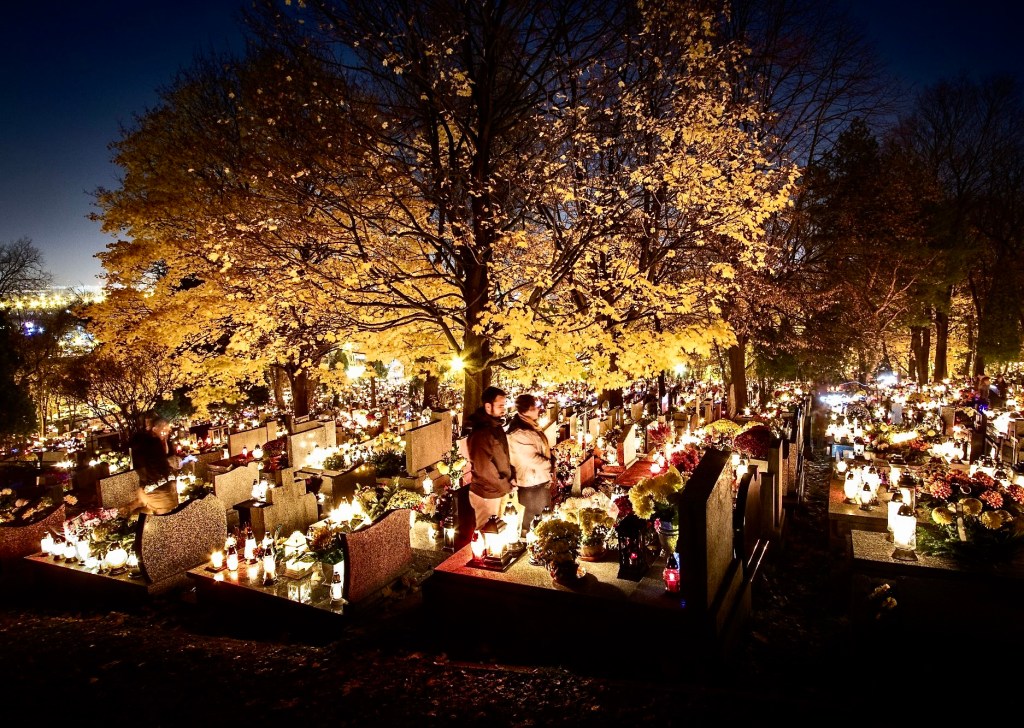
   The 31st of October is Halloween. The 1st of November is All Saint’s Day. The 2nd of November is All Souls Day, or Velines, in Lithuania. It has nothing to do with trick or treating. It has everything to do with not fade away. It is the Day of the Dead. Shops and schools close on the first day of November for a couple of days. Everybody heads to their cemeteries to visit those who have given up the ghost. 

   All Souls Day, also called Commemoration of All the Faithful Departed, is a day of remembrance. Families visit gravesites, lighting candles on the tombs of loved ones, and soliciting for their well-being. Many cemeteries become a sea of candles at night. It is one of the most important holidays on the Lithuanian calendar. Some people pray for those they suspect are in purgatory and try to win indulgences for them.

   Velines is a Catholic observance, even though some Lithuanians who get into the spirit of it on that day are not Catholic or even identify as the same. “Vėlinės has overflowed the banks of the church,” is how one churchman has described it. All Souls Day got started in the year 933 at Cluny Abbey in France when Pope Gregory V proclaimed November 2nd as a day to pray for the departed. Lithuanians were pagans at the time and didn’t pay any attention to the news bulletin. They had their own Day of the Dead. They called it Liges. It wasn’t just one day, either. It lasted three days and nights as soon as all the crops were harvested. Life is for the living and the living need bread.

   Lithuanians were the last Europeans to abandon paganism. The cemeteries of Kernave, the one-time pagan capital of Lithuania, had always been bereft of crosses. The Grand Duchy finally gave up and accepted Christianity near the end of the fourteenth century. During the centuries they were holding out, families gathered food and gathered in their boneyards in mid-autumn. Wine and honey mead were sprinkled on graves. It was a flock together as well as an observance. Romas had always enjoyed his cocktail hour. Although a modern man, he might have approved of some ancient pagan practices, although he wasn’t the kind of man to waste a drop of distilled spirits.

   Fresh farm eggs painted red and black were left on graves as good luck charms for next year’s crops. Tables were set up. Black bread and black pudding were served. Whatever was left over was given to the poor in return for their prayers. When the three days of Liges were over, branches were culled and thrown into a bonfire while everyone sang songs for the souls of the departed. They drank whatever wine and honey mead was left over.

   Returning to one’s birthplace to spend eternity is a promised land kind of return. When Romas Bublys went back to where it all started, he was rounding a circle that is not often unbroken. Very few are afforded a resting place that is the same place where they came to life. Promised lands lie on the other side of wilderness lands.

   After the post-funeral gathering at the Church of Gesu, when I thought about memory and remembrance, about what is between the saints and the deep blue sea, I thought if there is a promised land for me on the other side of time, I will probably be the last to know. I won’t mind as long as there is a candle to light my way.

Ed Staskus posts monthly on 147 Stanley Street http://www.147stanleystreet.com, Made in Cleveland http://www.clevelandohiodaybook.com, Atlantic Canada http://www.redroadpei.com, and Lithuanian Journal http://www.lithuanianjournal.com

A New Thriller by Ed Staskus

Cross Walk”

“A once upon a crime whodunit.” Barron Cannon, Adventure Books

“Captures the vibe of mid-century NYC.” Sam Winchell, Beyond Fiction

Available on Amazon: https://www.amazon.com/dp/B0CRPSFPKP

Late summer and early autumn. New York City. A Hell’s Kitchen private eye. The 1956 World Series. President Eisenhower at the opening game. A killer in the dugout.

Duck and Cover

By Ed Staskus

   Lithuania has lots of historical show-and-tell. There is the Ninth Fort, Trakai Island Castle, and the Hill of Crosses. The capital city Vilnius has the Gates of Dawn, the Palace of the Grand Duke of Lithuania, and the Bernardine Cemetery. The cemetery can be hard going, though. The dead get restless when it rains. After heavy rainfall old bones from ancient  graves tend to float to the top. They stick out of the ground and trip up passers-by.

   Gothic, Renaissance, and Baroque buildings are extant all around the city. There are 16th and 17th century churches. Narrow winding streets characterize the oldest stretches of Vilnius. The historic center was designated a UNESCO World Heritage Site in the early 1990s, soon after the country threw out its Russian overlords. They went back to Moscow, scouring the map for other countries to oppress.

   There are dozens of tour groups in the country, from Baltic Holidays to Discover Lithuania to Vilnius with Locals. There are hundreds of tour guides who can guide you to places both in plain sight and off the beaten path, brimming with anecdotes and history. They also have the know-how of when and where to stop for a cup of coffee or cold beet soup.

   Pavelas Puzyna, a native of the city, got his start in the heritage business while studying archaeology at Vilnius University. When he was a student he dug up something new. It was a small rusty metal box. “I was at the market and saw a box with the Sigma logo on it,” he said. “Inside the box was the flash for a camera. They made cameras and the first Lithuanian computers. Finding the box was like a drug to me. I immediately started to research Soviet-era factories and got interested in the history of industrial Vilnius. I’m a big fan of the city. I thought it would be a good idea to make a tour.”

  He had already been having second thoughts about archaeology. “There are some job problems with it,” he said. Never underestimate the cold feet of an empty piggybank. Pavelas put his mind to discovering ways to fund his new plans.

   The Age of Discovery led to the Age of Colonialism, when European countries went far and wide to Asia, Africa, and the Americas, trading, conquering, and controlling natural resources, while benefitting themselves strategically and economically. They created sugar plantations in the West Indies and rubber plantations in the East Indies. They commanded herds of elephants to explore and exploit India. When they found oil anywhere they pumped it out of the ground as fast as they could.

   The world was their oyster. It was tasty, but it was hazardous work, no matter that they were playing the natives for suckers. Caravan routes thousands of miles long were plagued by bandits and ships routinely sank in storms or were pirated, their treasures gone for good. It wasn’t a swords, sandals, and babes movie.

   That wasn’t for the Russians. “Why bother?” the czars said, chain-smoking and downing their strong coffee. “We’ll just go next door.” They sent their conscripts, whose military service was for life, or the end of the conscript’s life, to the Ukraine, the Khanates, and the United Kingdom of Poland Lithuania. The faceless minions of the Russian Empire followed, sucking the life out of whatever the Imperial Army had won.

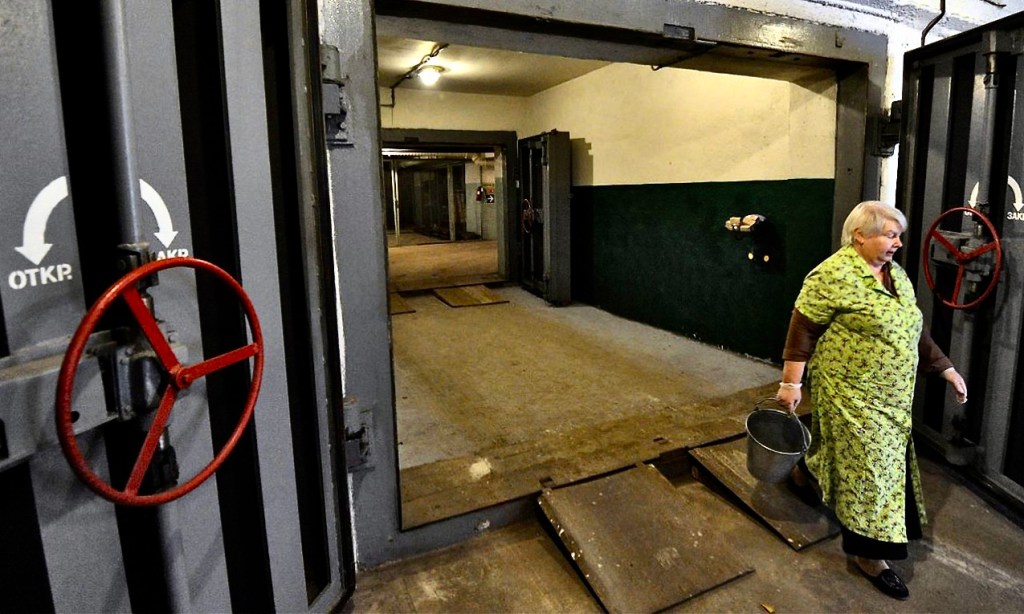
   The Iron Curtain got drawn over the window of Eastern Europe in 1945. When the curtain encircling Lithuania got to be full of holes, and after the Russians were pushed out once and for all in 1991, they left most of their relics behind. Some of the things they left behind, besides a bad taste, were zavody, which are Eastern Bloc factories. Even though Pavelas went looking for zavody, the first thing he found was a 1975-built civil defense bunker underneath a communist sweat shop in Naujamiestis, a former industrial district next to Naujaninkai, the district where he lives.

   “The bunker was underneath a factory that used to make sliding electric garage doors,” he said. “It was all trashed out. I thought maybe I could talk to the person in charge and offer to look after it. Small enterprises were renting space in the former factory and one of them, a car repair shop, gave me the phone number of the owner of the place.”

   He called and was able to get through. “He’s a real millionaire, a Lithuanian guy, and I was able to talk to him. I told him your bunker is a mess, can I maybe look after it, clean it up, be like the overseer?” Although he didn’t expect an answer that very minute, the man on the other end of the line said yes. 

   “It was bizarre but after that I was like a little kid on Christmas.”

   The Russians started building bomb shelters in Lithuania in the early 1950s, underneath schools, apartment complexes, government buildings, railway stations, and smokestack enterprises. “There was an all-important rule then, that big factories had to have a bunker,” Pavelas said. They were equipped with steel doors, filtered ventilation, food, water, and medical supplies. Participation in civil defense training was compulsory for all able-bodied men and women. 

   “If World War Three had started, like the Russians were afraid of, people would have had to live there.” 

   Nobody said anything about what they were going to do in their bomb shelters after a rocket from the tombs had wiped Lithuania off the map. When I was in grade school in Cleveland, Ohio we had a safety drill once a week. It was called Duck and Cover. We crawled under our desks and stayed there for a few minutes until our teacher nun sounded the all-clear. It was never clear to us what exactly was going on, although we knew well enough it was scary.  

   Nuclear weapons in the Iron Curtain days blasted holes in the ground 200 feet deep and 1,000 feet in diameter, blowing everything within a half mile to smithereens. Only skeletal remains would have been left within three miles of impact. After a month-or-two of radiation decay it might be safe enough to go outside, except it wouldn’t be safe.

   There wouldn’t be any power for light, heat, or refrigeration, no running water, no sanitary systems, millions of unburied dead, and an ecological balance thrown out of whack. Stress, malnutrition, and damaged immune systems would be fecund ground for the contraction and transmission of disease among survivors.

   Pavelas took rags, brooms, and candles to the bunker. “The place didn’t have electricity. It was dark, but I cleaned it” He came back with a tool box and light bulbs. He restored the electricity. He came back with curtains for the no-window windows. A year later he was conducting his first tours of the bomb shelter.

   Tour guides escort people on sightseeing excursions, cruises, or through public buildings, art galleries, and native places of significance. They describe points of interest and respond to questions. Many of them research topics related to their site, such as history and culture.  

   “What’s special about our shelter is it’s almost all authentic, just like from the Soviet times,” Pavelas said. Some bunkers had been transformed into Cold War museums, but he played it close to the vest. “Ours is original, what you would have seen in those days. It’s the only one in Vilnius like it.”

   A year after his first tour he teamed up with Albertas Kazlauskas to form Gatves Gyvos, which means Streets Alive, and Albertas bought the bunker. “He was working for a bank and when the Litas was being converted to the Euro, he thought it would be an opportunity to make a tour company. He’s the owner, a great guy, and a great friend. I’m the main tour guide and main handyman.” They upgraded the bunker tour and made it a success, at least until the viral pandemic brought it to a standstill.

   “We did non-stop tours,” said Pavelas. “I was working nine in the morning until ten at night. The bunker was a money maker although it also eats money.” Despite his success, or perhaps because of it, he expanded his tours to include Soviet-era factories located in the Naujamiestu and Zirmunu districts. “They used to make everything, from vodka to electronics. After learning a lot about Soviet Lithuanian factories, I thought people would be interested in them, too.” His favorite is the former ELFA factory.   

   When the Russians occupied Lithuania during World War Two, the country was largely agricultural. To communize it, they industrialized it. From 1940 to 1959 industrial production in Lithuania increased nine times, while in Russia itself it increased only half as much. Much of the industry was in tools, metal processing, and automobiles, and most of it was exported to the Union of Soviet Socialist Republics. The home folks drove old East German automobiles.

   It was full speed ahead in 1963, with plans on the books to build more than seven hundred new factories, including a synthetic materials factory in Kaunas, a refrigerator plant in Ukmergė, and a glass factory in Panevėžys. A furniture factory in Vilnius was going to be one of the largest in the USSR. Some of it got built. Some of it was a Potemkin Village.

   “At the time the Soviet Union collapsed all the factories were owned by the government, by Moscow,” Pavelas said. “It became like a race after independence, about who could take over the factories first. ELFA was bought and sold and bought again until the last CEO standing, who wasn’t that great of a person, shut it down. There’s still a small office on the fifth floor, but it doesn’t exist anymore.”

   After the USSR went belly up Lithuania suffered a significant recession, as well as a corrective inflation. It was a mess. There were major trade disruptions because the Russians had been the country’s main trade partner. Radical privatization didn’t helpsince much of it was out and out thievery, resulting in a 40% drop in GDP in the first half of the 1990s.

   “The ELFA factory produced electric motors for fridges, washing machines, and drills. They made reel to reel tape recorders and record players, by the millions a year. They were crappy compared to Japanese and American production but in Soviet terms the quality was as good as it got.”  

   The Lithuanians who worked there worked at what was in effect a company town. Entire families were employed in the factories, fathers and mothers and their progeny. “It was son, father, and grandpa,” Pavelas said. Some of the factories had their own campgrounds, on their own lakes, and sponsored soccer teams and singing chorales. When a conductor’s baton wasn’t enough the Russians led sing-a-longs with their special batons. Chin music was the consequence of being out of tune.

   “The complex takes up about 5 hectares of space and had more than five thousand workers, many of them women. The most memorable item they made is the ELFA-001 reel to reel machine. It cost thousands and only fifty of them were ever made. Another is a small and very powerful windshield washer motor made for Soviet submarines. Subs have a tower and towers have windows. The windows needed wipers like in a car.”

   Another of his favorites is the Sparta plant. “Their name means speed and fast work,” he said. “Their main product was socks, which they made millions of year after year. Now the factory is being demolished. I’m glad I had the opportunity to save some items, like stained glass from the canteen.”

   Albertas makes traditional tours of the Old Town, his wife Victoria leads tours for children, mixing entertainment with snippets of history, and Pavelas makes what he calls non-traditional tours, both on the job and privately. “My main goal is to research industry in Vilnius, its economics mostly during the Soviet times, why and what it was doing here,” he said. “I’m also interested in the industrial history of Lithuania, from the end of the Industrial Revolution, through the inter-war years and into today.”

   The onset of the viral pandemic in 2020 threw businesses of every kind everywhere for a loop, although if anyone needed to isolate, an underground bunker built with two-foot-thick reinforced concrete walls might have been the ideal place. In the meantime, waiting for vaccination efforts to ramp up and results to happen, Pavelas sat it out.

   “My guess is that if not for the pandemic our bunker would be one of the famous places in Lithuania,” he said. “What we have is the only one in Vilnius and the very first. We have had many different people come and see it, from deaf people to many foreigners. The bad days came when the lockdown started.” 

   During the second lockdown in Lithuania the sightseeing business was declared out of business for the duration. “We didn’t get any money, and we just tried to survive, but now that it’s over, people are going to be pouring back in. Our site is unique, in a class by itself.”

   He felt they were on the tip of something big. It doesn’t always pay to call it a day. The smart money is usually on history repeating itself, which it usually does. The sticks and stones from a long time ago is an unbroken line to today’s masters of war and their bomb shelters. Pavelas was putting his money on walking that immemorial line.

Ed Staskus posts monthly on 147 Stanley Street http://www.147stanleystreet.com, Made in Cleveland http://www.clevelandohiodaybook.com, Atlantic Canada http://www.redroadpei.com, and Lithuanian Journal http://www.lithuanianjournal.com

“Cross Walk” by Ed Staskus

“A Cold War thriller that captures the vibe of mid-century NYC.” Sam Winchell, Beyond Books

Available on Amazon: https://www.amazon.com/dp/B0CRPSFPKP

The end of summer, New York City, 1956. Stickball in the streets and the Mob on the make. President Eisenhower on his way to Ebbets Field for the opening game of the World Series. A torpedo waits in the wings. A Hell’s Kitchen private eye scares up the shadows.

A Crying of Lot 49 Publication
Bad to the Bone

By Ed Staskus

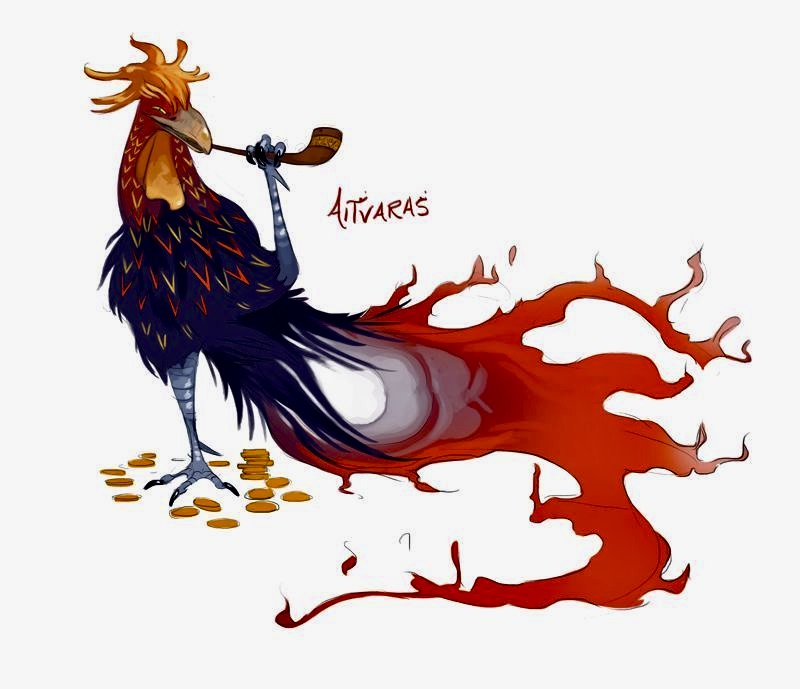
   The first time Oliver saw the Aitvaras it was sauntering through their family kitchen. When it got to the sliding door leading to the patio it walked right through the screen door without opening it. The screen wasn’t torn or fazed. Once on the patio it transformed into a black dragon and flew away, its tail glowing like a comet.

   Oliver, who was the Unofficial Monster Hunter of Lake County,  poured himself a glass of apple juice and went upstairs, walking into his father’s home office. His father was an electrical engineer. Ever since the 19 pandemic he split his time working in his Beachwood office and working remotely at home. He was home today, blinking at his laptop, scratching his head, and taking notes.

   “Dad, did you and mom invite a rooster over?”

   “No, we didn’t bud,” his father said. “Why do you ask?”

   “I was just in the kitchen when a rooster with blue legs and a fiery red tail walked in. It went out on the patio, changed into a dragon, and flew away.”

   “Was it smoking a pipe?”

   “I think so,” Oliver said.

   “That’s an Aitvaras. They’re from the homeland, from Lithuania. If you see it again don’t let it in the house. If you see it in the house, kick it out. If you’re outside and it has shapeshifted into a dragon, be careful. He will roast you with his fiery breath at the drop of a hat. On top of everything else, his breath is as bad as a tar pit.”

   “OK,” Oliver said going back to the kitchen to put his glass away.

   His mother was the German side of the family. His father was the Lithuanian side of the family. Oliver and his sister Emma were 100% birds of a feather. The Aitvaras was 100% Baltic pagan. What he was up to was not a mixed bag. Whatever he was up was bad.

   Oliver crept into Emma’s room in the middle of the night and shook her awake. She was his right-hand man. She was a heavy sleeper. Oliver, on the other hand, always slept with one eye open. He knew full well one too many monsters knew where he lived.

   “Do you hear that?” he asked. There was a scratching noise downstairs followed by a pecking noise.

   “What is it?” Emma asked.

   “I think it’s the rooster.”

   They snuck downstairs, Oliver leading the way with his flashlight and Emma gripping her jackknife. It was a special operations operation. They skipped the step near the bottom that creaked. They were quiet as worms.

   The most secretive Lithuanian Special Operations Force units are squadrons that go by the codename Aitvaras. Nobody knows who they are. Sometimes even they don’t know who they are. They carry out top-secret classified missions.

   There wasn’t anything downstairs except an extra toaster on the kitchen counter. They didn’t know Aitvarai can shapeshift to resemble household objects. A line of crumble feed on the floor led from the kitchen past the bathroom down a hallway and into the garage. When they turned the garage light on, they were taken by surprise by the sight of it filled with stolen goods. There was Tommy One Shoe’s bike, Jimmy the Jet’s best skateboard, their next-door neighbor’s Cooper Mini, and somebody’s brand new Sabre gas grill.

   Back in the kitchen they decided not to tell their parents anything until morning. It started raining. Suddenly the extra toaster morphed back into the Aitvaras. It went through the closed window above the sink and turned into a serpentine-bodied dragon. The window stayed where it was. The dragon opened its mouth and started drinking the rain. Soon all the rain for miles was flowing their way and going down the gullet of the beast.

   “That thing will cause a drought if it stays that thirsty,” Emma said.

   There were more than a dozen nurseries and fruit farms around their hometown. If the Aitvaras drank all the rain, all the showers and thunderstorms, they would end up in big trouble. Besides that, Oliver and Emma would be out of fresh fruit. They both ate at least one apple a day.

   In the morning their mother called the Perry police department about the stolen goods while their father made a list of the hot stuff and took pictures of everything. “Aitvarai are born thieves,” their father said. “They can turn themselves into black crows and black cats. But if that happens Sly will take care of it.” Sly and the Family Stone was the family’s guard dog cat. “This one is probably living in the forest and wants to be our family guardian. That’s how they trick you. We can’t let that happen. We would become his slaves. Sneaking in is one thing, but once we invite him in it will be almost impossible to get rid of him. They are beasts that bring good fortune by ill means.”

   “It was a toaster last night,” Oliver said.

   “They like to lay low behind stoves,” his father said. “We’ll leave him an omelet every morning, so he doesn’t get his dander up in the meantime. If we mess with him too much when he’s in the house, he will infest all of us with lice.”

   Emma started scratching herself in spite of herself. Oliver chewed on his thumb. He was trying to come up with a plan. Emma turned the TV on. “Ollie, look,” she shouted pointing at the flat screen. “It’s that lawyer boss man from the White House, the Rudy man. He’s on ‘The Masked Singer.’ He’s dressed up in a rooster costume and he’s singing ‘Bad to the Bone.’”

   The next morning, after their father dad had gone to his office in Beachwood, and their mother was at the grocery store, Emma whipped up a special omelet in an eight by two cake pan. It was loaded with Valerian root. She would only be nine years old in a month, but she handled herself in the kitchen like an old pro. She covered the cake pan with aluminum foil to keep it warm. Jimmy the Jet put on oven mitts. He was going to carry it into the forest and tempt the Aitvaras out of the woods.

   “Don’t forget, stay ahead of him and don’t let him catch you until you’re back here in our backyard,” Oliver said. “I want him on the stone patio.”

   “I brought my longboard instead of my skateboard,” Jimmy said. “He won’t catch me.” Longboards go faster than skateboards. It’s because they have larger and softer wheels than skateboards so they can go over gravel and twigs easier. Their bearings are higher quality, too, allowing for faster speeds.

   “Why do you want him on the patio?” Jimmy asked.

   “Because they can heal themselves by digging their spurs into earth, but not stone. I want you to leave the cake pan on the picnic table there.”

   Ten minutes later Jimmy the Jet burst out of the forest like a bat out of hell with the dragon from hell hard on his heels. Jimmy serpentine zig zagged to keep the beast away from him. When he got to the patio, he threw the cake pan down and raced away for his life. The dragon skidded to a stop and sunk his snout into the omelet.

   Valerian root is an herb but it’s a drug, too. Once it gets into your brain it makes you sleepy. There was enough Valerian root in the omelet to make all of their hometown go to sleep all at once. The dragon was out like a light before it took a half-dozen bites. It plopped down on the sandstone patio pavers and was soon gurgling like a baby.

   Oliver had run a wire from a lightning rod he stuck in the middle of the field behind their house to the patio. He wrapped his end of it around the dragon’s gnarly big toe. The rooster was snoring like an old geezer.

   Aitvarai are born from falling meteorites. They come to life as sparks when the meteorite burns up in the atmosphere. It started to rain. A thunderstorm was rolling in off Lake Erie. Oliver and Emma slipped inside the kitchen. The sky got inky dark. Lightning bolts boomed and flashed over the roof. When one of them hit the lightning rod the Aitvaras lit up like the 4th of July and exploded. All that was left of him was a single spark.

   Oliver ran outside and nudged the spark into one of his mom’s Ball jars. He screwed the top down tight and wound electrical tape around it. The jar got as bright as a bonfire. They could hear the spark squeaking.

   “What are you going to do with it?” Emma asked.

   “I’m going to ask dad to mail it to the Devil’s Museum in Kaunas,” Oliver said.

   That’s what he did in the morning and it was where his father sent the Aitvaras, back to the homeland, where he was displayed in a bulletproof glass case, and became the star of the show.

Ed Staskus posts monthly on 147 Stanley Street http://www.147stanleystreet.com, Made in Cleveland http://www.clevelandohiodaybook.com, Atlantic Canada http://www.redroadpei.com, and Lithuanian Journal http://www.lithuanianjournal.com

A New Thriller by Ed Staskus

Cross Walk”

“A once upon a crime whodunit.” Barron Cannon, Adventure Books

“Captures the vibe of mid-century NYC.” Sam Winchell, Beyond Fiction

Available on Amazon: https://www.amazon.com/dp/B0CRPSFPKP

Late summer and early autumn. New York City. A Hell’s Kitchen private eye. The 1956 World Series. President Eisenhower at the opening game. A killer in the dugout.

Tough as Nails

By Ed Staskus

   My grandmother hit the deck pretty as a prayer book the day she was born. She didn’t come into the world tough as nails. She wasn’t that way as a girl, a young woman, a schoolteacher, a newlywed, or a wife and mother. But that was the way she was when World War Two ended and she was waking up to her second year in a Siberian prison camp. She survived by being that way for more than ten years, in the middle of nowhere, slaving away. She stayed alive, somehow. It was no way of life stuck in the Soviet dark ages.

   She was born near the tail end of the Gilded Age, although it wasn’t anywhere near anything gilded. She missed out on the mischief of the robber barons. She was born in Russia during the fin de siècle. She missed the debates convulsing Europe at the time concerning the moral responsibility of art. Even if she had heard the arguments, it’s doubtful she would have cared. She missed the Boxer Rebellion, the Second Boer War, and the Philippine-American War. When the pea shooters of those conflicts were put away, she got to live through the blitzkrieg of World War Two.

   Growing up she had an inkling most Lithuanians hated Muscovites, for taking over their homeland, forbidding the native language, and exploiting everything they touched. By the time she was grown and gone to Lithuania she knew for sure Russia was feared and distrusted on all its borders.

   My grandmother Antonina met my grandfather Antanas when he was stationed in Saransk. It is in the Volga basin where the Saranka and Insar Rivers meet. The garrison was four hundred miles east of Moscow. Antanas Staskevicius was a Lithuanian officer in the Russian Imperial Army. He was more than a thousand miles from home. My grandmother came from a nearby small town. She earned her teacher’s certificate in Saransk. She was teaching kids their Cyrillic ABC’s.

   The whistle-stop was founded as a fort, on the left bank of the Isar River, at the crossroads of Moscow and the Crimea. Before World War One its commercial life revolved around honey, meat, and leather. After the war its factories stayed closed for more than ten years when there weren’t any available fuels or raw materials.

   “My father was trained as an officer and sent to serve there with an infantry regiment,” my father said. “It was a hard post for him, because back then they used to say drinkers go to the navy and dimwits go to the infantry.” The Imperial Army had more than a million men in uniform, most of them conscripted, most of them peasants. There were a quarter million Cossacks, too. Only the Cossacks knew what they were doing.

   Antanas courted Antonina and they got married sooner than later. They had a daughter, Eugenia, in 1917. They called her Genute. Another daughter, Gaile, was born the next year. My father was born six years later, in 1924, in Siauliai in the north of Lithuania. He was named after King Vytautas the Great. His mother called him Vytas. His sisters called him many things, including the little prince, the pickle prince, and the rotten prince.

   Siauliai is home to the Hill of Crosses, which is a hill less than ten miles from the town. It is covered with tens of thousands of wooden crosses, crucifixes, and statues. It was after Tsarist forces crushed the November Uprising of 1831 when the first of them appeared.

   By 1918 Lithuania had been missing from the map for more than a hundred years, having been disappeared after the Partition of Poland. Since that time, it had been under the thumb of the Russian Empire. Late that year, when the war finally ended, and Russia was being convulsed by its Bolshevik revolution, Antanas and his new family went home to a newly independent country.

   “Lithuania didn’t have many officers when they formed their own army,” my father said. “Most of them were men who had been conscripted into the Imperial Army before the war.” Most of them burned their Russian uniforms as soon as they could. “My father fought in the post-war battles around Klaipeda and after that he served in the secret service in Kaunas, which was the capital.”

  Lithuania had declared independence in February 1918 and for almost three years fought Soviet Russians, West Russians, and Poles for their homeland. Finally, in 1920 they formed their own government, although they later lost Vilnius to the Poles, with whom they remained officially at war with little blood spilled. In September 1939 Poles found out they were in the frying pan. Vilnius was suddenly off the menu.

   After the fighting my grandfather was awarded land for serving his country. The family had a house in town but lived on a farm most of the time. They spoke Russian at home. Except for what he picked up among his friends, so that he had a sprinkle of street cred, my father spoke little Lithuanian until he started school.

   During World War One most of Siauliai’s buildings were destroyed and the city center was obliterated. Since its founding in the 13thcentury, it had burned down seven times, been struck by pandemics seven times, and World War Two was the seventh war that wrecked it. It was a winsome town between the disasters.

   “When my father became the governor of the district, we moved to the city there,” Vytas said. It is a royal town founded in the early 16th century on the plain of the Nevezis River, about fifty miles east of Siauliai. During the interwar years Lithuania was divided into 24 districts and each district had its own governor. Antanas was the governor of Panevezys until 1938.

   Vytas went to grade school and high school there, but then his father was made governor of Zerasai, which was more-or-less a summer resort. In 1834 Zerasai had burned down and been rebuilt. Two years later it was renamed Novoalexandrovsk, in honor of Tsar Alexander’s son, but after the war to end all wars was over and done with the name was thrown out the window.

   “No sooner was my father made governor, my mother didn’t want to move there, since it was far from where we lived, so I stayed with her,” Vytas said. “But I didn’t get along with the other students in town. It was a strict school, and everybody had to dress nice. On my first day of high school, I was dressed too nice, like I was going to a wedding, with a tie and everything, and everybody laughed at me. ‘Where are you from, the sticks?’ they all said. I didn’t make any friends there.”

   He told them, “I’m going to Zerasai.” He moved there in 1939 and lived with his father. “We always studied a second language in school, and since my mother was Russian, studying that was easy for me. But when I got there, I found out they only had English as a second language. My father had to hire a tutor to help me.” He soon spoke Lithuanian, Russian, and English.

   All during the 1930s the world had been changing fast. It changed a lot faster the last year of the decade. Father and son moved back to Siauliai. “The Russians came in 1940. All the high officials were let go and they selected new people who they wanted in the driver’s seat. They said they didn’t run the country themselves, we Lithuanians did, but it was the Lithuanian Communists who were in charge, so it was the Russians.”

   The family spent more and more time on their farm, renting out their house in Siauliai. “It was only a few miles from our farm to town. I used to walk or bicycle there. But the mood was bad. Everybody was on edge. Everybody thought something terrible was going to happen.”

   The Russian invasion of Lithuania was completed by the late summer. Businesses were nationalized and collectivization of land began. As the Soviet presence expanded the family discussed leaving the Baltics. “Why don’t we go to Germany?” Antonina asked. She wasn’t a fan of her Muscovite kith and kin. She had an insider’s track making judgment calls about them.

   “We had a chance to leave the country and go somewhere else. My mother wanted to go. We talked about it often.” But my grandfather didn’t want to leave his native land. “I have never done anything wrong that they would put me in jail,” he told his family. “I have always been good to people. They aren’t going to put me in jail.”

   In the fall of 1940, a company of Red Army infantry commandeered their house and farm for several days. “They didn’t do anything crazy, or mistreat us, but they hadn’t washed in months. They stunk and they rolled their cheap tobacco in newspaper. They smoked all the time. It took us a week to air out the house.”

   The family stayed on the farm through the winter. Then, as the mass arrests and deportations of more than17,000 Lithuanians began in June 1941, my grandfather was picked up by NKVD plainclothesmen. “He was gardening in our yard, wearing a shirt, old pants, and slippers when they drove up, a carload of Russians, and stopped, saying there was something wrong with their engine,” Vytas said. “I’ll help you out, my father said. He walked over to the car with them. They pushed him into it and drove away.”

   Vytas was in school taking his final exams that morning. “My mother called the school and told me my father had been taken. I ran out of class and went home right away on my bike.” His mother packed up clothes, socks and shoes, and soap for her husband. They went to see him the next day.

   “The man who was running the jail was a Jewish fellow. He had grown up with us and was a friend of our family, but when my mother asked him to help us, he said times have changed.” The old order was out. There was a new order. Asking for help meant getting nowhere.

   “He was a Communist and had been in and out of jail because of it. He was always in trouble. My father always let him go after a few days, telling him to not get involved in politics anymore. Just be a nice boy, he would tell him, but then the next thing we knew he would be in jail again. He wouldn’t help my father when he was arrested. Everything’s different now, he said.”

   My grandfather, who had once commanded the local police, stayed stuck in his jail cell. “They didn’t let my mother talk to my father,” Vytas said. “We went there several times, but they didn’t let us see him. We never saw him again.”

   Antanas Snieckus, the top dog of the Lithuanian Commies, supervised the mass deportations. He decided who was an “Enemy of the People.” Teachers, priests, policemen, civil servants, politicians, anybody who was a member of the Nationalist Union or the Rifleman’s Union, and landowners were on the list. Tens of thousands of them were deported. When they checked their tickets, they discovered the deportations had no expiration date.

   My grandfather was taken to Naujoji Vilnia and shoved into a boxcar. The train left Lithuania on June 19, 1941. Four days later, at the Battle of Raseiniai, the 4th Panzer Group, part of the first phase of Operation Barbarossa, the German invasion of Russia, wrapped up the complete destruction of Red Army armor and air forces in Lithuania. Within a week the Nazis were the feet on the ground.

   The Russians transported my forefather to a forced labor camp near Krasnojarsk in Siberia. He was put to work sawing down trees all that winter. He starved to death the next winter of 1942. Anton Chekhov, a noted Russian short story writer, once wrote that Krasnojarsk was the “most beautiful city in Siberia.”

   “The morning after my father was arrested, I drove our horse and wagon to school to finish my exams,” Vytas said. “I had to deliver milk to my teacher’s family, too. But when I stopped at his house, he ran out with his family and said, please take us to the railroad station. I said OK and they all got into my wagon. It was him and his wife and their two children. I took them to the station. After that I never saw them again. The next day one of our neighbors told me the secret police had come to the teacher’s house that same afternoon looking for him. Anybody from an educated family, the Russians were worried about all of them. They were afraid all the high-class people were against them.”

   When the NKVD began mass arrests of Lithuanians, Soviet officials seized their property, and there was widespread looting, especially by the body politic. It was every man for himself and God against all, unless you were a dyed in the wool comrade. “If you were a Communist then you were all right. The father of one of my friends was a metal worker. He didn’t even know how to read and write, but the Russians made him the mayor of Siauliai because he was a Communist.”

   My father’s mother Antonina, sister Genute, and he stayed on the farm after the Nazi takeover. His sister Gaile was living in Vilnius. There was an uneasy peace. “The day the Russians left and before the Germans came, I was in Vilnius,” Vytas said. “Everybody rushed to the food warehouses and broke into them. It wasn’t that we were robbing them, but everybody was doing it, since there was no food. Gaile and I went, too. We filled up our bags with bread and pork, all kinds of food, and took everything home. When the Germans arrived, they put a stop to it.”

   He stayed in Vilnius for several months, but then decided to go home before the end of summer. The family farm had to be cared for, but first, he had to get a travel permit. “I couldn’t get to see a single German to apply for a permit, but finally I talked to somebody who had known my father and got an appointment. The officer told me they weren’t issuing any for the time being and to come back, but after we talked about my father a little, he said all right, and wrote one out for me.”

   He took a train north and walked home, but when he got there, he discovered a company of Wehrmacht had taken over the farm. “They were there three weeks, more than seventy of them. I couldn’t even get into our house since the officers had taken it over. But those Germans were good men. They didn’t do our farm any harm. They had their own tents and their own mess. I made friends with some of them. We drank beer together at night.”

   His father’s practice had been to have a foreman run the farm. The foreman hired three men and three women every spring. Although the farm had chickens and pigs, and draft horses to do the heavy work, it was mostly a dairy farm with more than twenty cows.

   “When I came back, my sister Genute was there, but she wasn’t interested, so she didn’t do any work. I started taking care of things, even though I didn’t know anything. I knew the cows had to be milked and the milk had to go to the dairy. But about growing crops, and the fields, I didn’t know anything. But I did everything as though I knew what I was doing.”

   That fall he sent farmhands out to till the ground in a nearby field. When his nearest neighbor saw them working, he ran across the road towards them.

   “What the hell are you doing?” he shouted waving his arms.

   “I told him we were preparing the ground for next year. He said, you’re ruining this year’s seed and you won’t have any grass next year. We stopped right away. I learned what to do.”

   A year later he was on a horse-drawn mower cutting hay when he saw storm clouds gathering. He thought he would be better served walking the horses, so they could pull the mower faster, and jumped down from his seat. “As I hopped down, I stumbled and fell on the blades of the mower. The horses stopped. My hand was almost cut off. The boy who was helping me ran over. When he saw what happened, and saw my injured hand, he passed out.”

   While the war dragged on across Europe, he had problems keeping the farm going. He had only partial use of his impaired hand and farmhands everywhere were deserting the land. “I went to the prisoner-of-war camp where I knew the Germans gave Russians out. They gave me five of them. They were nice guys, worked hard, and sang at night while they got drunk. One morning I woke up and there wasn’t one of them left. They were all gone. I had to go back to the Germans and ask for five more. My God, how they yelled about it. One officer exploded, shouting that I hadn’t looked after them, shouting that I needed to lock them up at night, and shouting that they weren’t going to give me anymore. In the end I said, I need five more, so they gave me five more. I kept them locked up after that and they were still there when the Russians came back.”

   In 1944 the Red Army stormed back into Lithuania. My father escaped with a mechanized company of Wehrmacht, whisked up by them as they passed. They had been stationed near the prisoner-of-war camp. They told him he had five minutes to decide whether he was coming with them as they retreated.

   “An officer said the Russians were on the other side of the Hill of Crosses.” The hill was on fire. “They were in a big hurry. I only had time to fill a bag with a few clothes, a little money, and photographs of my parents.” It was time to go, come hell or high water.

   His sister Genute, not on the farm that day, fled separately. She got across the border into East Prussia, and later into Germany. His sister Gaile didn’t make it out. “She had a problem at the border. The Russians had taken that area, so she was forced to stop in a town there. She had her daughter and her husband’s mother with her. After the war she finished trade school, became a nurse, and never told anybody where she was from. The Communists never found out anything about her.”

   In July the Red Army captured Panevezys. Later that month they took Siauliai, inflicting heavy damage on the city. Two months later the counterattacking German 3rd Panzer Army was destroyed and for the next nearly fifty years Lithuania became part of the Union of Soviet Socialist Republics.

   “I was glad to get out of Lithuania in 1944,” my father said.

   He found out his mother, my grandmother, had been deported. “Somebody complained and informed on her. We had land, 160 acres, so we were considered capitalists. We weren’t rich, but we weren’t poor, either. There was no real reason that I ever found out about for why they took her. She was sent to a prison camp.”

   Between the tail end of World War Two and 1950 more than 87,000 Lithuanians were deported, forced to work in logging and gold mines, forced to live in barracks with leaky roofs and drafty windows, if there were any windows. More than a third of them died. Some of them resigned themselves to their lot. A few escaped into the wild.

   My grandmother was released from the Gulag in the early 1960s, one of the last deportees to be let go. She was not allowed to return to her home in Siauliai. She was forced to relocate to Silute, to an aboveground bomb shelter-style apartment. She was still on somebody’s shit list. 

   Silute is to the west of Marijampole, in the south of the country. The Nemunas River floods there almost every year, soaking the lowland pastures. Migrating birds call it home away from home because of the delta and all the water. A large part is forested and home to more than three hundred villages.

   My mother’s family, none of whom escaped the country during the war, lived near there. When my mother and sister visited Lithuania in the early 1980s, they made plans to visit Antonina. They kept their plans close to the vest. The scheme was for there to be three of our uncles, three wives, my mother and sister, and some of our cousins in three cars. “My mother would be in one of the cars, I would be in another, and the third car would be a decoy, if it came to that,” my sister Rita said.

   The secrecy was necessary because they weren’t allowed to go anywhere except within the city limits of Vilnius, where they were staying. When they asked about Silute and Siauliai, they were told they were out of bounds. Every place outside of Vilnius was out of bounds. The Intourist official at the front desk of the Gintaras Hotel leaned forward and told my mother it was because of missile installations.

   “Are there missile installations in every town in the whole country?” she asked.

   “I know sarcasm from naïve American when I listen to it,” the official sneered.

   Their convoy didn’t get far the first day of the familial excursion. They were stopped by a roadblock on the outskirts of Vilnius. The police were waiting for them. “They knew,” Rita, my sister, said. “Somebody had overheard something. Somebody talked. They waved us off the road.”

   The police glanced at my Uncle Justinas’s papers and told him to go back. They went to the second car. Everybody had to show their papers. My mother was the best dressed of everybody in all three cars. She was decked out. They asked her where she lived.

   “The Gintaras Hotel.”

   “Turn around, fancy lady, go back to the hotel.”

   They went to the third car. My Uncle Sigitas and his wife Terese showed their papers. Rita was sitting in the back with our cousins. They showed their papers. When it was Rita’s turn, she said, “You’ve seen their papers. I live in the same place.”

   “What’s your name?”

   “Jurgelaitis, just like them,” she lied.

   He asked her something in Russian. She didn’t understand a word of it and glared at him. The stare-down between Soviet cop and American gal took a few minutes. It was a stalemate at the end of the staring contest.

   “The next time I see this one she is going to have to answer,” the policeman warned my uncle. it was bluster until he said, “Turn back.”

   They turned around and the convoy went back to Vilnius.

   Undaunted, a few days later, a day before leaving the USSR, Rita was picked up by Uncle Sigitas before dawn before breakfast at the back of the hotel for an end run to Silute. She skittered into the car, and they sped off. The streets were empty in the autumn gloom.

   “He was a crazy driver, always yelling, ‘Somebody’s following us!’ He stayed off the highway, and the main roads, instead going up and down different ways. I thought the drive was going to take two hours, but it took much longer.” It took five hours on empty stomachs. It was worse than the Aeroflot flight from Moscow, which had been bad enough. Rita had slipped their bad food tray under her seat in mid-flight.

   They were stopped several times, but every time Uncle Sigitas was allowed to stay the course. The roadblock police didn’t explain why. They just waved him onward. When they got to Silute they asked around and found the house where Antonina was living.

   “She lived in a two-room apartment, in a rectangular four-unit building, almost like a concrete log cabin, that looked like it was built hundreds of years, before there even was concrete,” said Rita. She had a low-tech security system, a rusty nail she used to lock the front door. There wasn’t a back door. There was no running water or indoor plumbing. The windows needed caulking. The roof was long overdue.

   She was in her late 80s. She had gone through tough times, but she still had a lot of life in her. She had seven grandchildren in the United States. Rita was the first one she ever saw. She gave my sister a big smile and a big hug, even though she was a small woman and had to reach up. She was barely five feet tall.

   She wasn’t the Man of Steel, like the ringleader who squashed her and the Baltics under his thumb, but he was dead and gone, a downspout memory, and she still had plenty of what it takes. How you start is how you finish. They had lunch, cold beet soup, potato dumplings, and mushroom cookies with strong tea. It was a roots buffet on a beat-up wood table. Rita didn’t slip anything under her chair.

   “How did you like it?” Uncle Sigitas asked on their way back to Vilnius.

   “It’s the best food I’ve had in Lithuania so far,” Rita answered.

   Antonina passed away in 1985. She didn’t die of anything special. She died in her sleep. She was in her early 90s. She had fought tooth and claw to survive in a no mercy Siberia and was worn out. Even the toughest nails one day become the last nail in the coffin. Her time was up on this earth.

   When she died my father bought a mass for her at our Lithuanian American church in Cleveland, Ohio. He had been raised a Catholic and was still a true believer. I wasn’t on the same page, but I wasn’t going to slam the good book shut in anybody’s face that day. When my turn came to say a prayer, I said a prayer for the dead, asking God to grant my grandmother peace and quiet. I was sure where she was going it was a sure thing, not like the third planet from the sun she was leaving behind.

Ed Staskus posts monthly on 147 Stanley Street http://www.147stanleystreet.com, Made in Cleveland http://www.clevelandohiodaybook.com, Atlantic Canada http://www.redroadpei.com, and Lithuanian Journal http://www.lithuanianjournal.com

A New Thriller by Ed Staskus

Cross Walk”

“A once upon a crime whodunit.” Barron Cannon, Adventure Books

“Captures the vibe of mid-century NYC.” Sam Winchell, Beyond Fiction

Available on Amazon: https://www.amazon.com/dp/B0CRPSFPKP

Late summer and early autumn. New York City. A Hell’s Kitchen private eye. The 1956 World Series. President Eisenhower at the opening game. A killer in the dugout.

700 Years Later

By Ed Staskus

   Vilnius is the capital of Lithuania, although it wasn’t always the capital. As recently as the decades between the last century’s two world wars, the second-largest city Kaunas was the capital. Vilnius was controlled by Poland. After the Second World War it became the capital again, although Lithuania wasn’t exactly a country for the next 45 years. It was an SSR, like the rest of Eastern Europe, locked up tight behind the Iron Curtain. The Russians were masters of the land. Vilnius might as well have been Cell Block #1.

   “The first time I went to Vilnius was in 1992,” Kristina Dambrauskas said. “I had never been there before. It was dismal.” It was two years after Lithuania declared its independence. They had repudiated the Brezhnev Doctrine in 1990 and said, “Russians go home!” They were the first of the Soviet SSR’s to do so. The Russians demanded they renounce their home rule claims. The Lithuanians said, “Go to hell!” A year later the Russians sent in tanks. They might as well have not wasted their time and firepower. By the end of 1991 the Soviet Union ceased to exist and the Iron Curtain went the way of the town dump.

   Kristina lives in South Bend, Indiana with her dog Toto. She is a foreign language teacher at the nearby Mishawaka High School, specializing in Spanish and German. She often travels to Italy, Germany, and Switzerland. She spent two weeks in Cuba in 2016. Her mother and father were born and bred in Lithuania. They landed in the United States after World War Two made them refugees.

   “I was living and doing a work study in Germany in the early 90s when I got a chance to go to Lithuania,” Kristina said. She flew from Frankfurt to Riga, Latvia. There were no direct connections. She was met by a cousin who lived in Vilnius. They drove back there. It was slow and slower going on the beat-up roads. “The city was dreary, full of decrepit Soviet stuff.” Everything was gray from one end of town to the other. “The trolleys were old, crawling along. There were potholes everywhere. Everything was run-down and rickety. The Russians were all about patchwork whenever anything broke.”

   There were settlements in the vicinity of Vilnius from the Middle Stone Age onward. It became the capital of the Grand Duchy of Lithuania in 1323. King Gediminas built a castle on top of a hill. Germany’s Teutonic Knights were upset about it and attacked the castle several times, failing to capture it. They burned the city down in 1365, 1377, and 1383. They wanted their revenge, no matter what shape it took. Late in the century England’s Henry IV threw his support and army of longbow archers behind the Teutonic Knights, to no avail.

   When the Crimean Tatars started attacking Vilnius in the early 16th century the powers-that-be threw up defensive walls, including nine sturdy gates and three fortified towers. The Tatars didn’t accomplish much. They finally went back to Ukraine where they could drink their coffee in special cups called fildjan and read the Koran in peace.

   After the Polish-Lithuanian Commonwealth was created by the Treaty of Lublin in 1567, the city grew and flourished. Vilnius University was established in 1579. Craftsmen and tradesmen poured into the city. Jewish, Orthodox Slav, and German communities established themselves within the walls. Vilnius became the social, political, and economic hub of the region.

   “Almost everybody seemed to be wearing hand-me-downs,” Kristina said. “There wasn’t enough food. They had to make do. There was a lot of begging, borrowing, and stealing. The stores were like flea markets. Everybody accepted it because they had no choice.” Most of the cars were Tatra’s, Dacia’s, and SMZ’s. They were among the worst built and ugliest cars in the world. The SMZ looked like a dumpster and had the aerodynamics of a cinder block. “Those cars went about as fast as lawnmowers,” Kristina said. No sooner did Lithuania gain its freedom than Lithuanians began racing to Germany and snapping up used BMW’s and Mercedes.

   “My mother’s cousin Juozukas drove me to the Hill of Crosses,” Kristina said. His car was a Lada, an East German model. In its time it sold at the budget end of the market, in a market where the best cars were mediocre. “He was still married to Crazy Danute, so only the two of us went.” The Hill of Crosses is a stark memorial at the best of times. It was wintertime. It was even more stark under heavy clouds and near-zero temperatures. “It was a hill outside Siauliai with thousands of crosses. There was nothing else to see.” It got rough-hewn when the wind picked up.

   Two weeks later Kristina went back to Germany. “Even though it was drab in Lithuania, I had a ball meeting my relatives.” The next time she went was in 1999. She was living in Cologne and working for an agency that catered to international students. She took a bus directly to Vilnius. The roads were more ship shape. “Everybody was friendlier than seven years before. The city was brighter. There were renovations going on everywhere. I spent a lot of time in Gizai, from where my mother came. My relatives drove me all over the place. They celebrated New Year’s while I was there. Everybody got as drunk as could be. They had a bonfire at midnight. It was a ton of fun.” As the clock ushered in the new millennium, she saw substantive changes all around her. There were fewer hand-me-downs. New shops and stores were opening all over. There were hardly any more crappy Soviet cars. There was plenty of food. The flood of natives emigrating somewhere else looking for a better life had slowed to a leak.

   Vilnius was swept by flame in 1610. Everything was by-and-large built of wood. When the fires died down the city had to be rebuilt. In 1655 Russian siege engines appeared and Vilnius was eventually taken. Czar Alexis’s scorched earth policy was put into play. It was not a fun time. The city was pillaged, burned, and the population massacred. The death toll was more than 20,000. The Kremlin has never over-valued anybody else’s life. It took a long time for the city to get back on its feet.

   When Kristina returned to Vilnius in 2012 she went with her sister Daiva and mother Ramute. They flew from Chicago by way of Copenhagen, getting to the homeland in 12 hours. She was astonished. “It was a world apart from what it had been,” she said. The country had joined both NATO and the European Union. The Parliament banned all displays of Soviet symbols. The Russians huffed and puffed. The decade since had been a robust one of economic growth. The average person finally had money in his wallet and her purse. The price of Big Macs went down until they were 40% less than the eurozone average. Big Mac lovers in Vilnius celebrated by dressing up like Ronald McDonald.

   “There were as many new rental cars at the airport as there are back home,” Kristina said. “We rented a car, went all over, and stayed for two weeks. There was a lot of building going on.” When times are bad is as good a time to reinvent yourself as any. Lithuania may not have been reinventing the wheel, but it was busy realigning all four wheels at the same time.

   “Oh, wow,” is what Kristina’s mother said after their first day there. She had fled Lithuania in 1944 as a child. Ramute, three siblings, her mother, and a cow tied to the back of their wagon made it to East Prussia, then to Bavaria, and finally to the United States a few years later, although the cow got left behind. Ramute’s father, a policeman, had been deported to Siberia in 1941, where he stayed and somehow survived for almost fifteen years. The last time Ramute had seen Lithuania it was a mess, the sky filled with bombs and smoke.

   “The difference between winter and summer in Lithuania is the weather,” Kristina said. “Winter is cold and dark. We went in summer. It was warm. Everything was sunny and bright. I stayed with my dad’s cousin, Aldona, for a few days. She had a son who bought an old plantation the Russians left behind just outside of Vilnius. He revived it. There were almost no signs of Sovietness anymore in the country.”

   Vilnius is old, very old, and new as can be. It has repeatedly brought itself back after acts of God and man-made disasters. There are 30 museums rich in its long past. The Old Town made the UNESCO World Heritage List in 1994. It features more than 1,500 medieval buildings. The Public Library is one of the oldest in Europe. Vilnius became a UNESCO Creative City of Literature in 2015. The city’s Tech Park is the newest and largest ICT hub in the Baltics.

   It is a cosmopolitan city with plenty of diverse lifestyles. There is vibrant street art and sparkling nightlife far into the night. Vilnius was named a European Capital of Culture in 2009. It is known for its farm markets, hot air balloon rides, and music scene. In 1995 the first bronze statue in the world of the American musician Frank Zappa was installed near the center of the city. “My aesthetic is anything, anytime, anyplace, for no reason at all,” is what Frank Zappa always said. His statue reportedly winks at passers-by.

   Vilnius is renowned as the City of Churches. It is a center of the Polish Baroque style of shrine. An early 17th century icon of the Virgin Mary, Mother of Mercy, is in a chapel at the Gate of Dawn. The city was once known as the Jerusalem of the North because of its large Jewish population and intense study of the Torah. There were more than 100 synagogues in 1900. That came to end in 1944 near the end of World War Two, after Germany’s Einsatzgruppen and Lithuanian collaborators slaughtered nearly every Jew in the country. Today less than half a percentage point of the population is Jewish.

   The last time Kristina visited Vilnius was in 2018, again with her sister Daiva, and Daiva’s husband. “I stayed with one of our cousins. My sister stayed in a fancy schmancy hotel in the middle of town. It was beyond nice.” There were no more listening devices in the rooms. The phones didn’t make mysterious clicking sounds. The lights routinely turned on when switches were flicked on. Breakfast was continental and there were no more slices of tongue headcheese. Among other things, 2018 was the 100th anniversary of Lithuania’s earlier liberation from Moscow, which was gained in 1918. On top of that there was going on a Sokiu Svente, which is a dance festival, and a Dainu Svente, which is a song festival. 

   “We walked everywhere unless it was too far. That was when we called Uber. There were parties every night. I’m serious, every single night.”

   Kristina went back to the Hill of Crosses before leaving for home. North American Lithuanians had raised money for a signature cross. She wanted to see it. “It was a big hoop-dee-da.” What she saw was a Hill of Crosses kept spic and span by independent people. There was a blessing and dedication of the new cross. There was a choir lifting their voices in sacred song. The hill was the same, but all around it there was newness. “There was a new visitor’s center, a new chapel, and a new parking lot. Busses were coming and going. There were even souvenir stands and a restaurant.”

   However big the parties were in 2018, they were forgotten in 2023 when Vilnius passed out party hats to celebrate its 700th anniversary. A Festival of Lights kicked off the jubilee. The National Museum hosted an exhibition about the history of the city. The National Opera and Ballet Theatre reconstructed the first opera performed in Vilnius in the 17th century. The Biennial of Performance Art took performance art outdoors. There was rock ‘n roll, jazz, and classical music galore in the city’s parks. Hot air balloons hovered at the top of the world. Nobody did any mosh pit diving from the gondolas.

   Every restaurant and watering hole in town stayed open around the clock to keep everybody’s strength up. Gastro expeditions popped up to find the best cold beetroot soup and craft beer. They weren’t hard to find. Vilnius is the capital of Europe for cold beetroot soup and craft beer. Some restaurants created historical cuisines, like Nelson’s zrazy and Jerusalem kugel. Diners were entertained with wild stories about the food.

   Nobody who was there got much shuteye, but everybody who was there started making plans for the city’s 1000-year anniversary in 2323. They were sure it was going to be nothing short of a lalapalooza, something to remember forever. All they had to do was take their anti-aging vitamin pills and hold on until then.

Ed Staskus posts monthly on 147 Stanley Street http://www.147stanleystreet.com, Made in Cleveland http://www.clevelandohiodaybook.com, Atlantic Canada http://www.redroadpei.com, and Lithuanian Journal http://www.lithuanianjournal.com

A New Thriller by Ed Staskus

Cross Walk”

“A once upon a crime whodunit.” Barron Cannon, Adventure Books

“Captures the vibe of mid-century NYC.” Sam Winchell, Beyond Fiction

Available on Amazon: https://www.amazon.com/dp/B0CRPSFPKP

Late summer and early autumn. New York City. A Hell’s Kitchen private eye. The 1956 World Series. President Eisenhower at the opening game. A killer in the dugout.

Spoiling for a Fight

By Ed Staskus

   Even though Ukraine wasn’t Ukraine in the 14th century lots of folks called it that so that is what it was. The word itself means borderland. The Lithuanians visited every summer. They did it for their health, if not for the health of the natives. When they did they had good times marauding and looting and drinking too much whenever the devil got the better of them. They didn’t control the land so much as take advantage of it. The less governance the better is the way they saw it. “We do not change old traditions and do not introduce new ones,” they said.

   They were freebooters who became empire builders. The boyars rode fast horses, big and fit, were outfitted in chain mail, wore conical metal helmets, were armed with lances, swords, and knives, and carried a black shield emblazoned with the red emblem of the Columns of Gediminas. They weren’t draftees or recruits. Those who were, walked and died where they stood. The boyars were tough men who could be dangerous in the blink of an eye. The Golden Horde warned would-be enemies of them, “Beware the Lithuanians.” That was all they ever said.

   They had to be rough and tough. When they went to war they didn’t launch cruise missiles and kill their enemies at great distance, checking the body count with drones. They hacked their enemies to pieces with long swords face to face and watched them bleed to death in the mud at their feet.

   By the end of the 14th century the Grand Duchy of Lithuania was the biggest country in Europe. Today it is one of the smallest countries in Europe. When they were growing fast and furious they didn’t do it by being soul brothers or good trading partners. They did it by getting on their horses and taking what they wanted. They didn’t bother explaining.

   The Grand Duchy got started in the early 13th century when Prince Mindaugas united his Baltic forest clans, swamp tribes, and fiefdoms into a feudal state. They were desperate times. The Teutonic Knights were on a rampage. They wanted to incorporate all of Lithuania into the Teutonic Order. They never stopped trying. Between 1305 and 1409 they launched 300-some military campaigns. They slaughtered more peasants than anything else. The Lithuanians beat them back time and again. Finally, in 1410, at the Battle of Grunwald the Lithuanians and Poles destroyed the Teutonic Knights. Most of the order’s leadership was killed or taken prisoner. The Grand Master ran away. They never recovered their former power. When the carnage was over, the Lithuanian-Polish alliance became the dominant political and military force in the region.

   When I was a kid almost everybody called the Ukrainians Russians. We didn’t call them that because we knew what was up with the Reds. They had done the same thing to Lithuania, enslaving the country, and reaping something anything everything for nothing. Both of my parents came from there after WW2, so we knew what was up. We didn’t have to read between the lines of whatever Washington and Moscow were forever saying.

   Even though Ukraine didn’t become a nation-state until 1991, after getting their feet wet for a few years after WW1, it was extant in the 14th century, and well before that. We all knew about the Ukrainians when I was growing up, The first Ukes came to Cleveland, Ohio in the 1880s. They settled in the Tremont neighborhood. Their idea was work hard in the factories of the industrial valley, get rich, go back home, buy some land, and live happily ever after. Between the world wars lots of former freedom fighters came. They were goners if they had stayed. Stalin was itching to get his hands on them. Most of them settled in Parma, a southwest suburb, where they built churches, schools, and started their own aid associations and credit unions.

   We didn’t live in Parma, but on the east side along the lake. Nevertheless, among the Poles, Hungarians, Croatians and Slovenians, and anybody else who could sneak into the country when the Statue of Liberty wasn’t looking, there were some Ukrainian families in our neck of the woods. One of them operated a gas station on St. Clair Ave. not far from where we lived. One of their handful of sons who was our age messed around with us summers, when we had three no-school months to mess around in. His name was Lyaksandra. It sounded like a girl’s name, so we called him Alex.

   We played pick-up baseball at Gordon Park, from where we could see Lake Erie. We once asked him, taking a break in the action, what he thought about the Russians. He growled, made an obscene gesture, spit sideways, and said, “There are lots of Russki’s in Ukraine. They are liars about everything. They aren’t all bad, but they all hate themselves. We hate them, too.”

   Ukraine is the second-largest country in Europe. It is bordered by Russia and Belarus, as well as Poland, Hungary, and Romania, among others. It has coastlines along the Black Sea and the Sea of Azov. It has its own language. Most people speak Russian, as well. The Muscovites are always trying to convince them to drop the Uke talk and speak only Russian.

   “We don’t talk that Russki talk anymore,” Alex said. “Not here, no way.”

   In the Middle Ages Ukraine, which is about the size of Texas, was the epicenter of East Slavic culture. It was, at least, until the Kievan Rus was destroyed by Mongol invasions in the 13th century. Somebody is always trying to beat up on Ukraine. From then to the 20th century Ukraine was variously ruled by the Lithuanian-Polish Commonwealth, the Ottoman Empire, the Austrian Empire, and the Tsars of Russia. Everybody wanted to be the boss of the Ukes. It’s a miracle they have prevailed and are still prevailing, facing the long odds of going against the vaunted Red Army.

   The Russians are finding out what it is like to go toe to toe with somebody who is not afraid of them and has the up-to-date American rockets and artillery to back up their bravado. The Ukrainians are fighting an existential battle. Their backs are against the wall. They have nowhere to fall. The Red Army is fighting to save its skin and make it home alive for Defenders of the Fatherland Day. The soldiers throw their uniforms into the nearest sewer when they desert.

   When I was a boy I played with toy soldiers. There wasn’t any such thing as a Lithuanian mounted  boyar toy soldier, so I pretended that anybody on a horse was a Lithuanian knight. They were always the good guys. They won every fight battle and war. They were my heroes. I didn’t know what sons of bitches they must have been. They weren’t any different than anybody else in power back then. They were all sons of bitches, including the Holy Roman Church, whose popes ruled by the sword whenever the pen wasn’t convincing enough. 

   In the early 16th century Pope Julius I, the Fearsome Pope, imported Swiss Guards to be his personal bodyguards. He strapped on armor and led the Papal State armies against the Venetians, the French, and the Spanish. His armor plating covered every inch of him just in case the grace of God didn’t get it done, including a helmet made to look like a miter. Everybody on his side was allowed to join the Holy League. Everybody else was badmouthed and excommunicated.

  After Pope Julius died a rumor had it that if he was denied entrance at the Pearly Gates, there would be hell to pay. He would storm them, St. Peter or no St. Peter, and never mind his set of silver and gold keys. It was every man for himself and God against all.

   Until the end of the 14th century Lithuanians didn’t give a damn what the Vatican did. They were pagans. They were the last pagans in Europe. The word “Lithuania” is first mentioned in 1009, in an account of the murder of Saint Bruno by “pagans on the border of Lithuania and Rus.” He was trying to convert them. That was a mistake. Their headman, whose name was Dievas, ruled the universe from his kingdom in the sky. He didn’t like anybody popping up with new ideas about Heaven and Hell. Perkunas, the god of thunder and lightning, was his right-hand man and enforcer. The holy fires were guarded by Vaidilutès, the Lithuanian equivalent of Vestal Virgins. They buried their dead with food and household goods. The last pagan grand duke was buried with his hounds, horses, and falcons.

   When they finally joined the God-fearing club it was a political move. They were doing a dynastic union with Poland, and one of the conditions the Poles laid down was that the Lithuanians had to convert to church-going and dump their veneration of the forces of nature. It didn’t change their business plan in Ukraine, other than to make them more organized. They transitioned from frat parties to fancy dress balls.

   The Grand Duchy of Lithuania had controlled Belarus for some time and when they went after Ukraine they got it, extending their control to the open steppe and eventually to the Black Sea. The Ukes learned to “Beware the Lithuanians.” When they started to get what they wanted they left their freebooting days behind and started building castles to keep their loot secure. It was  a ten-day ride from Vilnius to Kiev. Why not ditch the seasonal exploitation and make the most of the four seasons?

   It wasn’t their land, but it is finders keepers. They meant to keep what they had subjugated. The Ukrainians didn’t have a say in the matter. They told the Ukes, “We may not be perfect but we’re Lithuanians so it’s almost the same.” The Ukes said, “We promise not to laugh when your oven is on fire.” The Lithuanians weren’t offended. They just said, “Show us the goats.”

   They built the Lutsk Castle, which later became a museum. They built the Olyka Palace, which later became an insane asylum. They built the Kremenets Castle, which later fell into ruins after the Cossacks sacked the city at the bottom of the hill. In the meantime, the boyars lived the high life. They started with red borscht, green borscht, and cold borscht. They feasted on holubtsi, cabbage leaves stuffed with minced meat, rice, and stewed in tomato sauce. They ate slabs of kholodets, a cold jellied meat broth. They drank vodka between courses. Ukrainians to this day drink more vodka than beer. When they were done with dinner they went to bed, snoring and cabbage farting in their sleep.

   Even though the Lithuanians always said the Ukrainians welcomed them with open arms, they built their castle-fortresses on high hills with steep inclines, the rockier the better, fitted with one main gate and plenty of towers, arrow slits, battlements, and dungeons. They kept big rocks and hot oil handy to toss down on door-to-door salesmen. If you ended up in the dungeon you found out soon enough they weren’t playing Dungeons and Dragons.

   Imperialism is never cozy and consensual. It’s more like assault and battery. The movers and shakers of power politics don’t get thrown in jail until long after they are dead. My friend Alex had never heard of Lithuanians living it up in Ukraine. He was surprised to hear they had once been a super power. He was chagrined to find out there were more invaders of his homeland than he had realized.

   “How come the Lithuanians push us around back then?” he asked. Most of us playing ball at Gordon Park were second generation Lithuanian Americans. We weren’t even teenagers, yet. None of us had a good answer, much less a sensible answer of any kind.

   “Somebody always wants to be the top dog,” Kesty said.

   “No, that wasn’t it,” Arunas said. “They just wanted to have somebody else do all the work, like make dinner and clean the toilets.”

   “It was the Ukrainian girls,” Romas said. “Ukrainian girls are hot.”

   Romas was over-sexed, and everybody knew it. Nobody had any other ideas. We went back to playing ball in the summer sun. When we got overheated we walked to the shore and sat on the edge of a cliff in the breeze. Lake Erie was in front of us, the water rippling, the tips of the waves white.

   “Can we see Ukraine from here?” Alex asked.

   “No, it’s that way,” Arunas said pointing over his right shoulder. When we looked all we could see was Bratenahl, where rich people lived in mansions. They made the rules, for what they were worth. Our grade school class practiced duck and cover once a month, just in case the Russki’s dropped an atomic bomb on Cleveland. We brought our own lunches every day but wondered where our next lunch was going to come from if all the food stores got blown up. Many of the Bratenahl bluebloods had their own fallout shelters. They didn’t worry overmuch about starving.

   All good things must come to an end. The Lithuanians were strong in Ukraine for several centuries, but the deal they made with Poland reaped a better harvest for their next-door neighbors than my ancestors. The Poles say, “A good appetite needs no sauce.” By the mid-16th century Lithuanians were sauce. Their goose was cooked. The dynastic link was changed to a constitutional one by the Union of Lublin in 1569. Ukraine was set free of the Lithuanians but was annexed by Poland the next day.

   The more things change the more they stay the same, until they don’t. The new would-be colonialists calling the shots in the Kremlin are finding that out, to their discomfiture. They make a wasteland and call it New Russia. They have been looking grim lately. The once-mighty boyars are rolling over in their graves, their visions of conquest and glory gone sour, their iron fists gone rusty. Lithuania has gone egalitarian, joined NATO, and gotten out of the plunder and pillage business. 

Ed Staskus posts monthly on 147 Stanley Street http://www.147stanleystreet.com, Made in Cleveland http://www.clevelandohiodaybook.com, Atlantic Canada http://www.redroadpei.com, and Lithuanian Journal http://www.lithuanianjournal.com

A New Thriller by Ed Staskus

Cross Walk”

“A once upon a crime whodunit.” Barron Cannon, Adventure Books

“Captures the vibe of mid-century NYC.” Sam Winchell, Beyond Fiction

Available on Amazon: https://www.amazon.com/dp/B0CRPSFPKP

Late summer and early autumn. New York City. A Hell’s Kitchen private eye. The 1956 World Series. President Eisenhower at the opening game. A killer in the dugout.

No Man’s Land

By Ed Staskus

   My grandmother was a Russian, a schoolteacher in Saransk, when my grandfather met her before the start of World War One. He was a Lithuanian. The town and the garrison were in the Penza, four hundred miles southeast of Moscow. It was somewhere but in the middle of nowhere. Antanas Staskevicius was an officer in the Russian Imperial Army, not that he wanted to be, but the Muscovite landlords of the Baltics demanded it.

   Saransk later became the capital city of the Republic of Soviet Monrovia, but long before that happened my grandfather had returned to Lithuania. Native soil is always better than the Saransk’s of the world. Home is where the heart is, but not necessarily where the heart is forcibly relocated.

   The town in the Volga Basin was founded as a fort, on the left bank of the Isar River, at the crossroads of Moscow and the Crimea. Before the First World War its commercial life revolved around leather, meat, and honey. After the war its factories were closed for more than ten years when there weren’t any available fuels or raw materials. In the meantime, the Kremlin stayed stocked with vodka and caviar.

   “My father was trained as an officer and sent to serve there in the Czar’s army with an infantry regiment,” my father, Vytas Staskevicius, said. “It was a hard post for him, because back then they said drinkers go to the navy and dimwits to the infantry.” The Imperial Russian Army had more than a million men, most of them conscripted, and most of them dirt-poor peasants. There were a quarter million Cossacks, too. Only the Cossacks knew what they were doing.

   “He met and courted my mother, Antonina, and they got married. They had my older sister, Eugenia, in 1917. We called her Genute. My sister Gaile was born the next year.” Vytas was born six years later, in 1924, in Siauliai. “My father named me after King Vytautas the Great.” His mother called him Vytas. His sisters called him many things, including the little prince and the rotten prince.

   Siauliai is home to the Hill of Crosses, a hill where there had once been a fortification less than ten miles from the town. It is covered with tens of thousands of crosses, crucifixes, and holy statues. It was after Czarist forces crushed Lithuania’s November Uprising of 1831 when the first of them appeared.

   By 1918 Lithuania had been missing from the map for more than one hundred years, having been disappeared after the Partition of Poland. Since that time, it had been under the thumb of the Czars. In late 1919, when the Bolshevik Revolution had become a Civil War, Antanas Staskevicius went home to a newly independent Lithuania.

   “Lithuania didn’t have many officers when they formed their own army,” said Vytas. “Most of them were men who had been conscripted into the Imperial Army before the war. My father fought in the post-war battles around Klaipeda and after that he served in the secret service in Kaunas, which had been made the capital.”

   Lithuania declared independence in February 1918 and for almost three years fought Russians, West Russians, and Poles for their land. Finally, they formed their own government, although they lost Vilnius, their historic capital, to the Poles, with whom they remained officially at war with no warfare after 1920. “After the post-war fighting with the Poles my father got some land for serving his country, near Siauliai. We lived on a farm.”

   During World War One most of Siauliai was destroyed and the city center was obliterated. Since its founding in the 13thcentury, it had burned down seven times, been struck by plague seven times, and World War Two was the seventh conflict that wrecked the town. It was rebuilt after every catastrophe.

   “We lived there for several years, but then my father became the governor of the Panevezys district and we moved to the city there.” Panevezys, a royal town founded in the early 16th century, is on the plain of the Nevezis River, about fifty miles east of Siauliai. During the years between the world wars Lithuania was divided into 24 districts and each district had its own governor. My grandfather was the governor of Panevezys until 1938.

   Vytas went to grade school and high school in Panevezys, but his father was later transferred to Zerasai, a place that was a summer resort. In 1834 Zerasai had burned down and been rebuilt. Two years later it was renamed Novoalexandrovsk, in honor of Czar Alexander’s son, but after the Great War the name was expunged. There was no love lost between the Baltics and the East Slavs.

   “When my father became the governor of Zerasai, my mother didn’t want to move there, since it was more than seventy-five miles from where we lived, so I stayed with her. But I didn’t get along with the students at the high school there. It was a strict school and everyone had to dress nice. On my first day of classes I was dressed up too nice, like I was going to a wedding, with a tie and everything, and everybody laughed at me. Where are you from, they all said. I didn’t make any friends there.”

   He told everyone, “I’m going to Zerasai.” He moved there in 1939 and lived with his father. “We always studied a second language in school, and since my mother was Russian, studying it was easy for me. But when I got to Zerasai I found out they only had English as a second language, no Russian. My father had to hire a tutor to help me.”

   All during the 1930s the world had been changing fast. In 1940 the Lithuanian world changed even faster. Father and son moved back to Siauliai. “The Soviets came that year. All the high officials were let go and the Russians selected new people who they wanted to run the country. They said they didn’t run the country themselves, we Lithuanians did, but it was the Lithuanian Communists who were in charge, so it was actually the Rus.”

   The family went to their farm, while renting a house in Siauliai, dividing their time between town and country. “It was only a few miles from our farmhouse to town. I used to walk or bicycle to Siauliai. But the mood was bad, very bad. Everybody thought something terrible was going to happen.”

   The Russian annexation of Lithuania was completed by the late summer of 1940. Businesses were nationalized and collectivization of land began. As the Russian presence expanded the family discussed leaving the Baltics.

   “Why don’t we go to Germany?” my grandmother asked.

   “We had a chance to leave the country then and go somewhere else.,” my father explained. “My mother wanted to go. We talked about it often, about going to Germany.”

   But my grandfather didn’t want to leave Lithuania. “I have never done anything wrong that they would put me in jail,” he told his family. “I have always been good to people. They aren’t going to put me in jail.” He stopped short of laughing it off.

   In the fall of 1940, a passing troop of Russian infantry commandeered their farm for several days. “They didn’t mistreat us or do anything bad,” my father recalled. “They stunk bad, though. They hadn’t washed in months. They rolled their Bulgarian tobacco in newspaper. They smoked all the time. It took a week to air out the house.” The tobacco came from the infertile fields of the Rhodope mountains, which were suited to little else other than tobacco.

   The family stayed on their farm through the winter. Then, as the mass arrests and deportations of almost 20,000 Lithuanian policemen and politicians, dissidents, and Catholics began in June 1941, my grandfather was picked up by NKVD plainclothesmen. It was a mild cloudless day.

   “He was gardening in our yard, weeding the cabbages, wearing a shirt, old pants, and slippers when they drove up, a carload of Russians, and stopped, saying there was something wrong with their engine. ‘I’ll help you out,’ my father said. He walked over to their car with them. They shoved him into the back seat and drove him to jail. He never came back.”

   Vytas was in school in Siauliai taking his final exams that morning. “My mother called the school and told me my father had been taken. I ran out of class and went home right away on my bike.” His mother packed clothes, socks and shoes, and soap for her husband. She went to see him the next day.

   “The man who was running the jail was a Jewish fellow. He had grown up with us and was a friend of our family, but when my mother asked him to help us he said the old days were over.” There was a new boss in town. There was a new order.

   “He was a Communist and had been in and out of jail because of his political activities. He was always in trouble. My father usually let him go after a few days, telling him to not get involved in politics anymore. ‘Just be a nice boy,’ he would tell him, but then the next thing we knew he was in jail again. He wouldn’t help my father when he was arrested. ‘Everything is different now,’ he said. Times had changed. Everybody was looking out for themselves, only themselves.”

   The man who had once commanded the local police stayed in stir. “They didn’t let my mother talk to my father. We went to the jail several times, but they never let us see him. We didn’t ever see him again.”

   Antanas Staskevicius was taken to Naujoji Vilnia and loaded onto a boxcar. The train left Lithuania on June 19, 1941. Four days later, between June 23 and 27, at the Battle of Raseiniai, the 4th Panzer Group, part of the first phase of Operation Barbarossa, the German invasion of Russia, effected the almost complete destruction of Russian armored forces in Lithuania. Within a week Nazi Germany seized all of Lithuania.

   My grandfather was transported to Russia’s far east to a labor camp near Krasnojarsk in Siberia. He was put to work logging in the thick forests and starved to death in the winter of 1942. Anton Chekhov, a noted Russian short story writer, once wrote that Krasnojarsk was the most beautiful city in Siberia. My grandfather was never able to catch the tour bus there.

   “The morning after my father was arrested, I drove our horse and wagon to school to finish my exams. I had to deliver milk to my teacher’s family, too. But when I stopped at his house, he ran out with his family and said, ‘Help take us to the railroad station.’ I said OK and they all got into my wagon, his wife and he and their two children. I took them to the station. After that I never saw them or ever found out what happened to them. The next day one of our neighbors told me the Russians had gone to the teacher’s house that same afternoon looking for him. Teachers, lawyers, anybody from an educated family, they were worried about all of them. They were afraid high-class people were against them.”

   When NKVD men began mass arrests of Lithuanians, officials seized their property, and there was widespread looting by Lithuanians among themselves. It was every man for himself, unless you were a Red. “If you were a Communist then you were all right. The father of one of my friends was a metal worker. He didn’t even know how to read, but the Russians made him the mayor of Siauliai because he was a Communist.”

   Antonina, Genute, and Vytas stayed on the farm after Antanas’s arrests arrest. Gaile was living in Vilnius. When the mass arrests intensified, they became alarmed. “We were determined about leaving the farm. It was dangerous everywhere. We went into the forest. But then my mother told me to go to Vilnius and tell Gaile our father had been arrested. She wanted her to know to be careful. I took a train to Vilnius, but as soon as I got there, I got a phone call saying my mother had been arrested. When I got back to Siauliai, I found out she was being deported. Somebody probably complained and informed on her. We had land, 160 acres, so we were considered capitalists. We weren’t rich, but we weren’t poor, either. There was no real reason that I ever found out about for why they took her. I went to the train station but didn’t see her anywhere. She was sent to a prison camp.”

   His mother was released from the Gulag in 1956, after Stalin’s death, but not allowed to return to her home in Siauliai. The Communists didn’t want her stirring up trouble, even though they were stirring the pot. “My God, you’ve gotten older,” was the first thing Antonina said when she saw her son again in 1979, come from the United States to behind the Iron Curtain. It was thirty-eight years after she had been transported.

   After his mother’s arrest and exile my father, not yet 17-years-old, left Siauliai and moved to Vilnius, staying with his sister Gaile and her husband. At the time almost everyone living in Vilnius was either Polish or Jewish. Lithuanians in the former capital city of Vilnius were relative strangers in their own land.

   “The day the Russians left and before the Germans came, everybody rushed to the food warehouses and broke into them. It wasn’t that we were robbing them, but everybody was doing it, since there was no food. Gaile and I went, too. We filled up our bags with bread and pork, all kinds of food, and took as much as we could home. When the Germans arrived, they put a stop to it.”

   He stayed in Vilnius for several months, but then decided to go home before the end of summer. The family farm had to be cared for, but, first, he had to get a travel permit. “I couldn’t get in to see a single German to apply for a permit, but finally I talked to someone who had known my father and got an appointment. The officer told me they weren’t issuing any for the time being and to come back, but after we talked about my father a little more, he said all right, and wrote one out for me.”

   He took a train back to Siauliai and walked to the farm, but when he got there, he discovered a company of Wehrmacht had taken over the  homestead. “They were there about two weeks, more than seventy of them. I couldn’t even get into our house since the officers had taken it over. Those Germans were good men. They didn’t do our farm any harm. They had their own quarters and their own mess. I made friends with some of them. We drank wine together at night.”

   His father’s business practice had been to have a foreman run the farm. The foreman hired three men and three women every spring. Although the farm had chickens and pigs, and draft horses to do the heavy work, it was mostly a dairy farm with more than twenty cows.

   “It was a model farm,” said Vytas. “Every summer students from the agricultural academy would tour our farm. When I came back, my sister Genute was there, but she wasn’t interested, so she didn’t do any work. I started taking care of things, even though I didn’t know much, which was almost nothing. I knew the cows had to be milked and the milk had to go to the dairy. But about growing crops, and the fields, I didn’t know anything. But I did everything as though I knew what I was doing.”

   That fall he sent his hired hands out to till the ground in a nearby field. When his nearest neighbor saw them working, he ran across the road towards them, waving his arms.

   “What in the hell are you doing?” he yelled.

   “I told him we were preparing the ground for next year. He said, ‘You’re ruining this year’s seed and you won’t have any grass next year.’ We stopped right away. I learned what to do.”

   A year later he was on a horse-drawn mower cutting hay when he saw storm clouds gathering. He thought he would be better served walking the horses, so they could pull the mower faster, and jumped down from his seat. “As I hopped down, I stumbled and fell on the blades of the mower. The horses stopped right away. My hand was almost cut off. The boy who was helping me ran over. When he saw what happened, he passed out.”

   While the war dragged on across Europe, he had problems keeping the farm going. He had only partial use of his injured hand and farmhands everywhere were deserting the land. “I went to the prisoner-of-war camp where I knew the Germans used to give Russians out. They gave me five of them. They were nice guys, worked hard, and sang at night. One morning after a month I woke up and there wasn’t one of them left. They were all gone. I had to go back and ask for five more. My God, how they yelled about it. One officer shouted that I hadn’t looked after them, shouted that I needed to lock them up at night, and shouted that they weren’t going to give me anymore. In the end I said, I need five more, so they gave me five more. I kept them locked up after that and they were still there when the Russians returned.”

   In 1944 the Red Army stormed back into Lithuania. My father escaped with a mechanized company of Germans, whisked up by them in their vehicles as they passed. They had been stationed near the prisoner-of-war camp. They told him he had five minutes to decide whether or not he was coming with them as they retreated.

   “They told me the Russians were on the other side of the Hill of Crosses. They were in a big hurry. I only had time to fill a bag with a few clothes, a little money, and photographs of my parents.”

   His sister Genute, not at the farm that day, fled separately. She got across the border into East Prussia, and later into Germany. His other sister, Gaile, wasn’t able to escape Lithuania in time. “She had a problem at the border and didn’t make it. The Russians had taken that area, so Gaile was forced to stop in a little town there. She had her daughter and her husband’s mother with her.” In the end the three of them were compelled to remain where they were.

   “She stayed there after the war and finished a trade school, became a nurse, and never told anyone where she was from. The Communists never found out anything about her. If they had, it would have been the end of her.”

   In July the Red Army captured Panevezys. Later that month they took Siauliai, inflicting heavy damage on the city. Black smoke filled the sky. Two months later the counterattacking German 3rd Panzer Army was destroyed and for the next nearly fifty years Lithuania became part of the Union of Soviet Socialist Republics.

   “I was glad to get out of Siauliai in 1944,” my father said. He fled to the German border and landed in Hamburg. “There was no future in Lithuania anymore. I was very glad to get out in time.”

Ed Staskus posts monthly on 147 Stanley Street http://www.147stanleystreet.com, Made in Cleveland http://www.clevelandohiodaybook.com, Atlantic Canada http://www.redroadpei.com, and Lithuanian Journal http://www.lithuanianjournal.com

A New Thriller by Ed Staskus

Cross Walk”

“A once upon a crime whodunit.” Barron Cannon, Adventure Books

“Captures the vibe of mid-century NYC.” Sam Winchell, Beyond Fiction

Available on Amazon: https://www.amazon.com/dp/B0CRPSFPKP

Late summer and early autumn. New York City. A Hell’s Kitchen private eye. The 1956 World Series. President Eisenhower at the opening game. A killer in the dugout.

Never Look Back

By Ed Staskus

   The blitzkrieg that started World War Two in 1939 won the Third Reich most of Europe and substantial parts of Russia. Five years later the Red Army was poised to take revenge on its enemy. When the Wehrmacht on the Eastern Front tried to weather the storm and fight out of encirclements, the Russians did what the Germans would have done, fed armor into the attack, maintaining mobility, and forcing the issue deep into rear areas, faster than the enemy could respond. Their M4A2 Sherman tanks, built by the United States, could be replaced when destroyed faster than German factories could take a breath. “Gute trauer” was all they could say.

   “The Russians came fast,” Angele Jurgelaitis said. “We listened to the radio every day. We could hear booming in the distance, the bombs and cannons. The Germans were all over the roads. The Russians were to the north and the east of us. Everybody knew they were coming.”

   The baby of her aunt’s family, the family Angele was child minding near Alvitas, in southeastern Lithuania, didn’t know, but everybody else in the Baltics knew the Red Army was coming back and there was going to be hell to pay. “Everybody was worried and unhappy.” Most Lithuanians had sided with the Germans. There were centuries of enmity between Vilnius and Moscow. The Russians were imperialists.

   It was in the summer of 1944 that Muscovite forces went on the offensive. The Germans were pushed back on a shifting front. Armored tank columns from both sides advanced on Vilkaviskis, four miles away from where Angele was. If it wasn’t for land mines she could have walked there in an hour. The Russian 33rd Army entered the town a few days later and then secured the rail depot at Marijampole. The Third Panzer Army mounted a counterattack, but after several grim tank battles was finally forced to retreat to Kybartai, rolling back to a last-ditch defensive line. Neither the Germans nor the Russians listened to a single Lithuanian who said the land wasn’t their land to fight over.

   “It was one day in the afternoon that a lady, a teacher, who was one of my aunt’s friends, with two kids, a small boy and a small girl, came to our farm from Vilnius,” Angele said. The woman and Angele’s aunt, Ona Kreivenas, had studied and graduated together from a teacher’s college. She was in a horse drawn wagon with her children and what chattels and valuables she could  carry. She had come from Vilnius in a rush. She told them there was Russian armor hiding in the woods on farm tracks.

   The next morning Ona, Angele, and the children, Mindaugas, Carmen, and Ramute, loaded their wagon with clothes, blankets, food, and the baby Gema. They hitched two horses to the wagon and tied a cow to the back. “We took milk with us when we left, for Gema, and hoped we would find more when we were gone.” They took whatever they could carry. They left their Sunday buggy behind and let the riding horse, the rest of the cows, and all the pigs and chickens loose. The friend followed them.

   “My aunt let all the animals go. What could we do? The Russians would have just stolen all of them.”

   Ona Kreivenas took all her money and what jewelry she possessed with her in a handbag that she could keep close to the vest. She and the children filled a trunk with her sewing machine, china, vases, and family heirlooms. They lugged it behind the barn, where the remains of months of potatoes thrown down to feed the pigs were piled up.

   They cleared a space, dug a four-foot deep hole, and buried the trunk. They threw potato scraps over the overturned ground. When they were done, they left in two wagons with their friend. They were two women, seven children, and a cow on the move, suddenly homeless in their own homeland.

   “We moved back about fifteen miles.” They went southwest towards East Prussia. “We stopped at a big farm. When we got there, there were already hundreds of people in the fields, with their wagons, and their families. The farmer slaughtered and cut pigs up for us. All the women made food. Everybody was talking about the war, about what to do.”

   There was heavy fighting between German and Soviet troops in the Baltics. As the fighting raged, more than a hundred thirty thousand Latvians escaped to Sweden and Germany. In total, the country lost almost 20% of its population during the war, either dead or gone. The ‘Great Escape’ in Estonia started in the summer and continued through the fall. It is estimated eighty thousand Estonians fled from the Red Army to anywhere else. Almost one hundred thousand Lithuanians joined them, clogging the roads to Poland, Prussia, and Germany.

   Ona Kreivenas crept back to her farm during the week the Panzer divisions were holding their own. The countryside was a ghost town. She discovered the trunk they had buried behind the barn had been dug up and was gone. “There was just a big hole. The Russians took it. They used metal sticks to poke into the ground. Her sewing machine was gone, all gone, everything gone.”

   They slept rough, out of doors, like everybody else. “We slept on blankets on the ground. When it rained, we slept under the wagon and stretched a tarp out to keep the water away.” Every day it got darker. Over the course of September, the length of day in Lithuania rapidly decreases. By the end of the month the daylight is two hours less than it was at the start of the month.

   Their encampment stretched out for six weeks. They dug latrines and filled barrels with water. They picked apples off trees and blueberries from bushes. They took especial care of their horses. They greased the axles of their wagons, making sure the grease bucket was always full of animal fat and tar, and making sure they had a spare axle. Without one a broken axle would be a disaster, bringing them to a standstill.

   The children played games whenever they had idle time. “We played the ring game,” Angele said. “We all sat in a circle and passed around a pretend ring, like a twig or a pebble. Sometimes we passed it, but other times we didn’t. We just pretended to give it to who was next to us. One of us was it, like in tag, who had to guess who had the ring. If they were right, they got a prize, like a pencil. If they were wrong, they had to sing a silly song or do a dance in the middle of the circle.”

   When they finally left, they left in the early evening. They had heard over the radio that morning that the Russians had come closer. They spent the day packing and preparing. It was now or never. “Most of us left, although some stayed. Some of the farmers wanted their land back. They didn’t want to leave.” It was all they had. It was all they had ever known. They were loath to give it up. “My aunt had to go, no matter what. The farm didn’t matter. Her husband had already been taken by the Communists. She knew they would take her, too, if they caught her, send her away to Siberia, and her children would be left behind, orphans or worse.”

   It rained that day and the rest of the night. “The road was crowded on both sides. There were thousands of wagons, wagon after wagon, all going one way. There wasn’t a single car or truck, just horses. We knew the Germans were somewhere ahead of us and the Russians somewhere behind us, but we didn’t see any soldiers anywhere”

   Ona Kreivenas was at the reins of the two-horse team, her seven-year-old daughter Ramute holding the baby, and the rest of the children walking. Most of the refugees were walking, their wagons jam-packed with possessions and provisions. Their friend from Vilnius with her two small children stayed in line behind them.

   Before the war, Lithuania’s population was almost three million. After the war it was closer to two million. Some Lithuanians ended up dead. Many were deported. Others ran for their lives. The displaced were forced to make new lives in different countries all around the world, whatever country they could get to, whatever country would take them, whatever country they could sneak into.

   When the second Soviet invasion of the 1940s happened, some Lithuanians tried to flee across the Baltic Sea to the Nordic countries, but only a few were successful. Patrol boats apprehended them, and they ended up hauled off to labor camps. Most fled west, while others went south to Hungary, Romania, and the Balkans.

   “On the way we met my uncle on the road, Uncle Jankauskas and his family.” Her uncle’s wagon fell into line with them. The progression of wagons stretched as far as the eye could see, ahead and behind. They soon crossed into East Prussia. There were no guards. They had all fled. The borderland was a mess.

   “I was so sad leaving Lithuania,” Angele said.

   Russian warplanes strafed and bombed the column of evacuees several times. The Red Air Force was bombing and strafing at will, both German Army and refugee columns alike. Forest and brush on both sides of the road were set on fire. There was smoke in the sky day and night. Wagons and carts slowly wended their way around rain-filled craters.

   “It was all just wagons. They knew we were refugees They dropped bombs and shot their machine guns. I don’t know why they did that. Whenever we heard airplanes, we all ran and jumped into ditches beside the road. I was afraid, but somehow I knew I wouldn’t be hurt by them.”

   What was called the Baltic Gap had grown so menacing to the Reich that Adolf Hitler moved his headquarters from Berchtesgaden to Rastenburg in East Prussia. The German situation on the Eastern Front was desperate. The fighting was hard. It was a fight to the finish. The hinterland was torn up, abandoned and forlorn.

   “Most of the people on farms had run away. We would go into their houses and find dried fruit, pickles, mushrooms, pork, and wine.” They ransacked barns, pantries, and root cellars. “We took all the food we could find, all of it. It rained most of the time, it was cold, and we walked and walked. Everybody was hungry.”

   The rain and asphalt road were hurtful to their cow. The animal was careful as could be on the poor traction of the wet road, stepping timidly with its rear feet spread wide. It was compensating by walking with an arched back. They finally had to do something. They knew the long miles and pavement weren’t good for it. They thought she might be going lame. Angele’s uncle looked at the cow’s hooves and saw lesions. An ulcer was forming on one hoof.

   “Mindaugas and I found a family that hadn’t run away. We went to their farmhouse and sold the cow to them.” They gave the money to Ona Kreivenas and she hid it on her person with the rest of her money. She had plans for it. Her plans were all about survival.

   One cold night when they stopped to rest her uncle said, “Kids, jump up and down to warm yourselves up.” When Angele stopped jumping, he grasped her under the armpits. “He grabbed me. We were jumping up and down and he dropped me by accident.” She broke her wrist. “It hurt bad, but there were no doctors to help me.” When they got to a town with a railroad station, there weren’t any doctors there, either. The smart and the skilled had already left. Everybody else was hoping against hope. Angele’s wrist had to take care of itself.

   After the New Year the German population of East Prussia, most of whom had not yet cut and run, began to evacuate as the Red Army rapidly advanced. Within weeks it turned into helter-skelter flight as more than two million of the two-and-half million men, women, and children of the enclave bolted into the Polish Corridor heading for Germany. The winter weather was bad, the roads were caving in, and the civil authorities were overwhelmed. There was panic and quagmire and many thousands died, some caught in combat, others swept away in the chaos.

   But before that happened, Ona Kreivenas had already sold their wagon and horses and everything they couldn’t carry and managed against the odds to get passage on a train going to Berlin. The Prussian Eastern Railway connected Danzig and Konigsberg to Berlin. A month later, the last week of January 1945, the last train to Berlin ran the rails. There was no traffic on the line after that.

   “The train was completely full. The corridors were full, too.” They stood clumped together in the corridor. The passenger cars were red and had ten large windows on both sides. They were pressed against one of the windows. Some of the windows were smashed and the passageway was as cold as the outside. “We had a pillow for Gema, who slept on the floor, but we stood that night and the next day.”

   The twin locomotives pulling the long line of passenger cars and baggage cars were in camouflage livery. On their front was painted the Hoheitsadler, an eagle, Germany’s traditional symbol of national sovereignty, holding a swastika in its talons. By the time they crossed Poland and entered Germany, the talons and swastika were obscured by coal soot.

   Lehrter Bahnhof was the Berlin terminus, adjacent to Hamburger Bahnhof, built in the late 19th century just outside of what was then Berlin’s boundary on the Spree River.  It was built in the French neo-Renaissance style, the façade covered in glazed tiles. The station had long been known as a “palace among stations.” But it had been severely damaged by Allied strategic bombing and was near to being a shambles.

   When they finally got off the train in Berlin they were met on the platform by Bishop Brizgys. The clergyman was Ona’s husband’s cousin. Vincentas Brizgys had been the assistant to Juozapas Skvireckas, the archbishop of Kaunas. During the summer of 1944 he and the archbishop and more than two hundred other Lithuanian priests fled the country with several retreating German army divisions. Ona Kreivenas had somehow located him by telephone, and he arranged to meet them at the train station. He was wearing a dark suit and a homburg and carrying a basket of hot buns.

   “He gave one to each of us. I was so happy,” Angele said.

   She was 16-years old, somewhere between childhood and adulthood. She was very tired. In the meantime, hope in tomorrow was the only thing keeping her on her feet.

   The Third Reich’s war economy was on the verge of collapse. The whole country was a sinking ship. There was a shortage of bread, sausage, cabbage, and everything else. When they looked around, the buns the bishop had brought were the only cheer they could see. There wasn’t going to be any traditional roast goose this holiday season.

   Angele looked at the four children and her aunt. She looked up and down the platform. Their friend from Vilnius and her uncle were long gone, lost in the fog of war. Bishop Brizgys led them out of the station into the city. The Red Army numbering over four million men was massing on the Vistula River and along the East Prussian border. Their superiority was ten to one in infantry and twenty to one in artillery and planes. Berlin and its three million residents were already a wreck, the day and night Allied bombing taking a monstrous toll.

   The early afternoon was a gray haze. There was smoke in the sky. It was a kind of darkness at noon. She saw heaps of rubble in the street. When she looked all around she knew in her bones it was going to be a bare-bones winter on German soil. There was no looking back. She walked towards what was left of Berlin.

Ed Staskus posts monthly on 147 Stanley Street http://www.147stanleystreet.com, Made in Cleveland http://www.clevelandohiodaybook.com, Atlantic Canada http://www.redroadpei.com, and Lithuanian Journal http://www.lithuanianjournal.com

A New Thriller by Ed Staskus

Cross Walk”

“A once upon a crime whodunit.” Barron Cannon, Adventure Books

“Captures the vibe of mid-century NYC.” Sam Winchell, Beyond Fiction

Available on Amazon: https://www.amazon.com/dp/B0CRPSFPKP

Late summer and early autumn. New York City. A Hell’s Kitchen private eye. The 1956 World Series. President Eisenhower at the opening game. A killer in the dugout.