
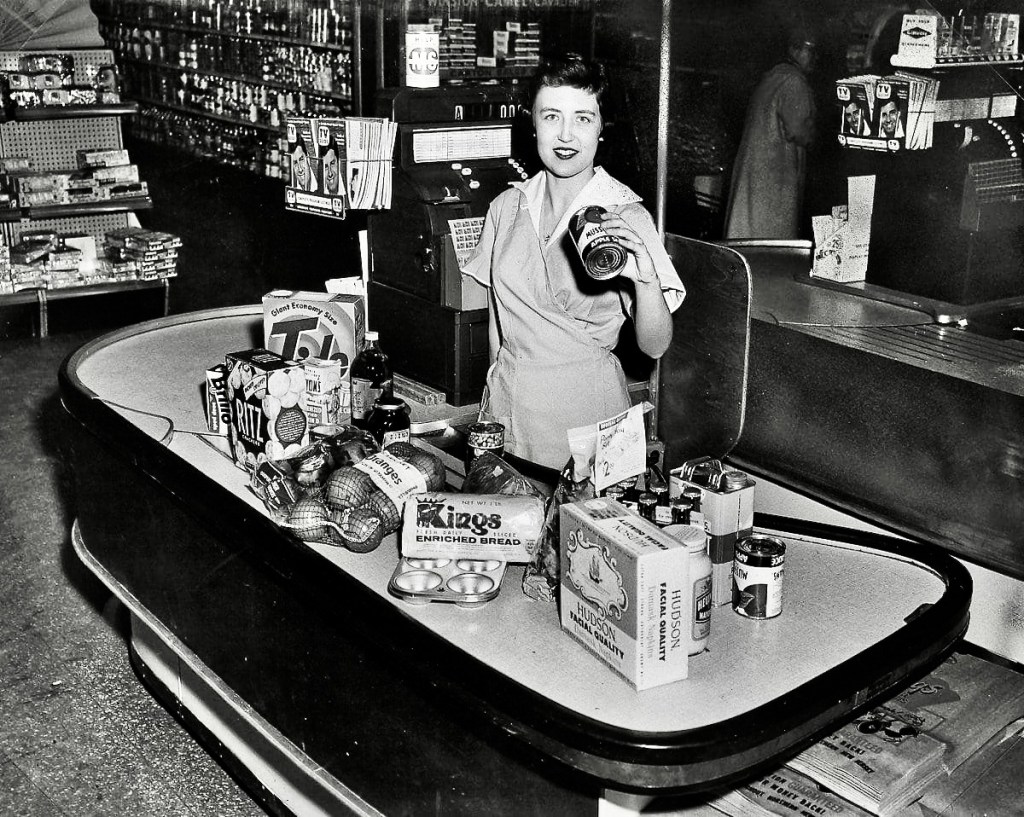
By Ed Staskus
My mother started working at Pick-N-Pay when my sister was 7 years old and had reached the age of reason. It was 1964. My brother and I were a few years older than our sister, but listening to my mother anybody would have thought we were still trying to catch up to her in smarts. We told our mother we knew our way around.
She was mending a skirt. She put her needle down and said, “Boys, the young know everything, the middle-aged are suspicious of everything, and the old believe everything. I’m not young but I’m not old, either. Do you understand what I’m saying?”
“Come on mom, we’re not stupid.”
“Good,” she said.
The next day we found out what she was saying when we asked an older student at school what she was saying.
“What she’s trying to tell you is, she suspects everything, especially you two,” he said, walking away and shaking his head.
“Oh, right, that’s what we thought,” my brother improvised.
We were living in a two-family house in the St. Clair-Superior neighborhood. The house had been built in 1903. There were tornado doors leading into the basement from the backyard and an out-of-date coal room. The anthracite chute had been bolted shut. There was a sweet gum tree in the backyard. It was where we played William Tell with rubber arrows. We attended St. George’s Catholic School, taking two city buses there in the morning and two city buses back home in the afternoon.
“Every day Vytas drove to work and the kids went to school,” my mother said. “I was left all alone. Most of my friends worked, helping provide, but Vytas said under no circumstances did he want me to go to work outside of the house. We didn’t agree about that. One day after I learned how to drive I thought I would try to find a job in a bank. I looked in the newspaper. There was an ad for a new bank opening on Noble Rd. in Cleveland Hts. Vytas didn’t know I was going, but I went.”
By that time we had moved to North Collinwood and were living east of E. 185th St. The bank’s main office was on Rockside Rd., 25 miles away. She had yet to drive five miles in any one direction. It took her an hour to get there. She didn’t get the job, but there were Pick-N-Pay offices in a building next door. She saw a sign saying they were hiring cashiers for a new store on the same Noble Rd. as the bank.
Pick-N-Pay got started in the 1920s when Ed Silverberg opened a dairy store in Cleveland Hts. During the Great Depression he surprisingly expanded and called his new stores Farmview Creamery. He changed the name to Pick-N-Pay in 1940 and by 1951 they had grown to 10 locations. When my mother went to work for the supermarket chain there were more than 40 locations.
“There were maybe 50 people filling out applications. They asked me if I played the piano. No, I said. They asked me if I knew how to type. No, I said.”
The interviewer looked up from his desk. “He asked me if there was anything at all that recommended me. I told him I worked nights with a relative, an immigrant like us, who was an accountant. He moonlighted doing the books for more than a dozen women who staged Tupperware home parties.”
The sales parties took place in living rooms. Tupperware was a plastic storage container invented by Earl Tupper. They were going like gangbusters. Our next-door neighbor Arlene Noga had a full set. She put leftovers in them instead of throwing the food away. Only after she forgot about the leftovers and they finally spoiled in the containers did she throw the food away.
“I am very good on adding machines is what I said to the man interviewing me.”
Four women were hired that day. My mother was one of them. She started her new job on Noble Rd. two weeks later.
“When I got home it was late. Vytas had made supper. As soon as I walked in the door he wanted to know where I had been. I hadn’t left a note. When I told him I had gotten a job he was unhappy.”
“Who’s going to take care of the kids?” he asked.
“They’re old enough to take care of themselves,” she said.
It wasn’t exactly true but our father didn’t know that. He had a full time and a part-time job on top of that. We hardly saw him Monday through Friday. On weekends he told us what we must do and must not do. We didn’t have to deserve our mother’s love. We had to deserve our father’s.
“My first day on the job, after my training, the head cashier showed me around the store. ‘Do your best,’ she told me. ‘You’ll never be as good as me but do your best.’ Everything had to be rung up one at a time. If there was a sale, like seven for a dollar, I had to do the division. Very soon, I didn’t have to look at the keys on the register, just push the groceries with one hand while my other hand rang them up while I talked to the customer. I got to be as good as the head cashier. Even she said so.”
Starting in the 1970s, after cashiers rang up orders, they gave customers S & H Green Stamps based on their total purchase. It was a loyalty program. Shoppers pasted the stamps into booklets and redeemed them for ash trays, bicycles, and appliances. “We had boxes on the floor next to us where we kept the booklets and rolls of stamps. I didn’t like the boxes because there wasn’t much room to move around in the first place, what with all the circulars down there.”
One day my father was complaining about the competitive spirit in the land. “It’s dead in America,” he said.
“If you believe it’s dead,” my mother said, “you’ve never been in my grocery store when a cashier opens another check-out line.”
My mother had a falling out with the manager at the Noble Rd. store. “I told him I needed time off every summer. We took the kids to a Lithuanian summer camp on the Georgian Bay north of Toronto. My husband and I were volunteers and stayed the whole two weeks. He said OK but when summer came he wouldn’t let me go. I said, I’m going, no matter what you say. He said no, again, although I didn’t listen. He had no choice, because I went, but he punished me. I worked eight-hour days three days a week, but never on Saturdays. He made me work on Saturdays, at least until he was fired. He got the ax when they found out he was stealing steaks.”
Her intention was to work 20-some years and retire with a good pension. “It wasn’t hard work. I enjoyed it. We had to bag the groceries but on weekends we had kids bagging. I didn’t lift anything heavy. I just pushed it.” I spent a summer while in high school bagging at a Pick-N-Pay store on E. 72nd St. and St. Clair Ave. I did more heavy lifting than I expected. A gallon of anything weighs eight pounds. Hundreds of gallons a day weigh thousands of pounds a day.
“Sometimes customers would help. Old people were always coming into my check-out line. I tried to remember their names and we talked because they often didn’t have anybody else to talk to. One lady believed in ancient aliens while another one liked describing the butterflies in her backyard. They had long faces whenever they saw me working the express line.”
After we moved out of North Collinwood and were living in Euclid on the Lake Erie side of Lakeshore Blvd. she asked the new manager to be transferred. Pick-N-Pay had opened a new store within walking distance and my mother wanted to work there. “The manager was a good man, but because I was good worker he didn’t want to let me go. One day the guy who hired me was at the store, bagging groceries for the cashiers. He was married to the daughter of the man who owned the stores. He often went to them unannounced and got his hands dirty. I asked him if I could go to the new store. I lied and said I didn’t have a car. He said, ‘Wait until tomorrow.’ The next day he stopped in and said, ‘Monday, go to the new store.’”
She walked home for lunch every day. One day before lunch she went into the basement to throw some clothes in the washer and discovered the basement was flooded. “Vytas didn’t know how to do anything around the house but I called him anyway. He didn’t know where the main shut-off was. I ran back to the store and told the manager. He ran back to our house with me and turned the water right off. He knew everything.”
When my parents moved to Sagamore Hills she again had to ask for a transfer. The manager said, “No problem.” He threw a staff party for my mother. “He brought his wife and their triplets. He was a hands-on man but having triplets was no walk in the park. He said, ‘It’s a whole lot of love, a whole lot of diapers, and a whole lot of who’s crying now. It’s three times the blessings but three times the chaos, too.’”
She went to work at the Pick-N-Pay store on Emery Rd. “The head cashier, Katie, and I became best friends. Her husband and she liked music shows. We often went to the Carousel Dinner Theater together.”
The Carousel was in Ravenna a half hour away. It had opened in 1973 with Arte Johnson, a cast member of “Rowan & Martin’s Laugh-In,” starring in Neil Simon’s “Last of the Red Hot Lovers.” Arte Johnson called the show “ver-r-r-ry in-te-res-ting.” Performances ran Tuesday through Sunday at the 500-seat complex. Tickets ranged from $6.95 on weekdays to $10.95 on Friday and Saturday nights. The tickets were for dinner and a play. Entrees included roast beef, chicken almondine, ham steak, and seafood casserole. Seconds and thirds were included. My parents ate light to save room the day of the show. My mother never made breakfast the next day.
Dave Fulford, the founder and manager of the Carousel, favored light comedies. He didn’t care for the “snob hits” of New York City, saying they were “so intellectual they go beyond entertainment. I don’t think dinner theater audiences want to work. They don’t want an algebra test after dinner.”
My parents and their friends went to the last show in Ravenna in 1988 before the Carousel moved to Akron. The show was “Big Bad Burlesque.” It was an off-Broadway revue, a musical salute to the golden days of burlesque. The show was made up of skits and girls, lots of girls. The skits were based on one joke, which was unsatiated and unrequited lust. My father had trouble keeping his eyes on his dinner plate.
“By today’s standards, burlesque is the only family show left in town,” Katie’s husband grumbled.
After the show my mother told her friend she was retiring from Pick-N-Pay. “She tried to talk me out of it, but I had worked long enough. My husband had moved up at TRW and I wanted to start volunteering, especially at our church.”
My mother worked three days a week every week her 24 years at the supermarket chain. What she didn’t know was that the trouble with retirement is you never get a day off. Her church sold frozen Lithuanian dumplings every Sunday to raise money, just like they hosted bingo on Friday nights. She worked the bingo games and twice a week made dumplings with six or seven other women. After mass she worked in the community hall selling them. After they were all sold she helped clean up. She worked at all the church’s special events.
One evening while visiting my parents I observed that she was working more in her retirement than she had when she was a working woman.
“I retire when I go to bed,” she said.
Ed Staskus posts monthly on 147 Stanley Street http://www.147stanleystreet.com, Made in Cleveland http://www.clevelandohiodaybook.com, Down East http://www.redroadpei.com, and Lithuanian Journal http://www.lithuanianjournal.com. To get the site’s monthly feature in your in-box click on “Follow.”
“Cross Walk” by Ed Staskus

“A Cold War thriller that captures the vibe of mid-century NYC.” Sam Winchell, Beyond Fiction
Available on Amazon: https://www.amazon.com/dp/B0CRPSFPKP
Late summer and early autumn, New York City, 1956. Stickball in the streets and the Mob on the make. President Eisenhower on his way to Ebbets Field for the opening game of the World Series. A trigger man waits in the wings. A Hell’s Kitchen private eye scares up the shadows.
A Crying of Lot 49 Publication
 Lithuanian Journal
A warm, endearing story which many Lithuanian dipukai can relate to. My mom spent 25 years at Hilton Manufacturing, a fine men’s wear sweatshop in working-class Linden, NJ. As a suit inspector, much of her time involved skirmishes with the Sicilian seamstresses who screamed and cursed when their work was rejected.
LikeLike