Tag Archives: Angele Jurgelaitis

Shot in the Dark

By Ed Staskus

   Afterwards, Angele Jurgelaityte could never remember exactly where she first met Vladas Jankauskas. “It was in Nuremberg, but I don’t know if I met him at one of the dances at the hospital or at a coffeehouse,” she said. “It might have been at the city zoo.” She went there most days, weather permitting, escorting groups of children from the ward where she worked, children who were recovering from the war, for a walk in fresh air and sunshine. Her youngest niece, Gema, was one of the children. They threw groundnuts to the elephants, even though elephants don’t like nuts and hardly ever eat them.

   Angele’s friend Maryte, her friend from the same Displaced Persons camp in Bavaria they had found themselves in after the end of World War Two, was who told her about starting over in Nuremberg. Angele joined her there in 1947. Whenever they had the chance the two of them jumped on a tram for the two-mile ride downtown, where they slipped into a restaurant or coffeehouse, ordered coffee, and got an earful of music for an hour-or-so.

   “Someone was always playing a piano. We would sit and listen and order another drink if we had to so we could stay and listen some more.”

   Angele was living at the Army Hospital in Nuremberg, studying to be a nurse assistant. She had fled Lithuania in late 1944, when she was 16 years old, on her aunt’s horse-drawn wagon, in a line of carts and wagons miles long. She had been babysitting her aunt’s four children the morning the Red Army appeared on the horizon. Three other Lithuanian women and she shared a small room at the Army Hospital, taking classes and working.

   Vladas was a Lithuanian Army officer who had served with the Vytautas Magnus Guard Unit at the International Military Tribunal war crime trials a couple of years earlier and was still stationed in the city. Many Baltic military officers had been assigned security functions in the Allied zones after the war. They guarded bridges and buildings. Some of them kept an eye on Germany’s war criminals during the series of Nuremberg trials. 

   After the executions of those Nazis judged to have committed crimes against humanity, some of the officers and their units stayed in the city, protecting weapon arsenals, food supplies, and the airport. Vladas wanted to go back to Lithuania, but with Iron Curtain in place it wasn’t looking likely.

   “He was my first boyfriend. He was my friend, but he was a father to me, too,” Angele said. It was summer, three years after the end of the war. She was barely 20 years old and he was 34 years old. He had access to food most Germans and no refugees had access to. He brought her some of it. He brought her oranges and apples. One day he brought a bunch of bananas.

   “I had never had one before. I ate two of them right away.”

   Vladas had been married with a home in Kaunas and a six-year-old daughter. He told Angele his wife was dead. He explained he had been deployed to fight with the Germans when the Russians launched their summer offensive in 1944,  got caught up in the retreat, and couldn’t retrieve his wife and child. They were left behind to fend for themselves. When his wife died soon afterwards his daughter was taken in by his mother.

   “When he told me his wife was dead I didn’t believe him. I told him that, about not believing him, but he didn’t say anything.” Instead of trying to explain he wrote a letter to his mother. She sent him a letter in return. He took it to Angele.

   “He brought it to me unopened. We sat down together on a sofa and he gave it to me. I opened it.” The only thing inside the envelope was a black and white snapshot of the headstone on the grave of his wife. “I was dumbstruck, but no matter, I wasn’t ready to get married. At the same time, I was friends with Vytas.” 

   She hadn’t told Vladas about Vytas, her other boyfriend in the making, a young man her own age. She didn’t tell Vladas that Vytas was in the fast lane. “I told Vladas, sorry, we have to end it. Besides, he had only talked to me about marriage once, while Vytas told me a hundred times we were going to get married.”

   Vytas Staskevicius was from Siauliai. It is both a district and a city in northern Lithuania. The city is the gateway to the Hill of Crosses, a pilgrimage site created in the 19th century as a symbol of resistance to Russian rule. There are more than 100,000 crosses on and around the hill. His father, who had been governor of the province, was arrested in 1940 and died of starvation in a labor camp in Siberia. His mother, a native of Russia, was picked up and deported to Siberia in 1944, where she still was and would remain for another eight years.

   He had seriously hurt his hand in an accident on the family farm during the war, and after fleeing Lithuania in 1944 ended up in Hanau, where he black marketed whatever he could get his hands on and did odd jobs for the American Army. He had gone to the Army Hospital in Nuremberg several times, starting in 1947, where Dr. Rudaitis, a Lithuanian specialist, was performing reconstructive surgery on his hand.

   Angele met Vytas at the hospital. He was unconscious on an operating table the first time she saw him. They met again and started seeing each other after he was back on his feet. “We went for walks and to the movies,” she said. They didn’t hold hands, being careful not to get off on the wrong foot, since his hand was healing.

   “I liked him. He was a steady man, not a fancy man.” When he came back to the hospital in the spring of 1948 they got reacquainted, getting more intimate, growing closer. Intimacy is healing when your home has been broken to pieces and your bones broken, too. They heal better when they have a reason.

   When Vytas went back to Hanau, Angele put her nose to the grindstone. It was all she could do. She had gotten her certification and was saving everything she could for passage to North America, where she was determined to go to build a new life. “I couldn’t go home, I couldn’t stay in Germany, and there wasn’t any future for me in Europe. All of us were trying to go somewhere.”

   She was being paid in the new Deutsche Marks for working at the Army Hospital, unlike many others who were paid partly with money and partly with cigarettes, or only with cigarettes, which were a kind of currency in post-war Germany. Vytas was paid room and board and thirty two packs of Turkish cigarettes a month working his new job at the International Relief Agency in Hanau.

   She was smoking in a hallway one day when Vytas’s bone doctor approached her. “I put my hand behind my back,” she said. There was no hiding the smoke, however. ”Everybody smoked. Dr. Rudaitis gave me a long lecture about not smoking no matter what anybody else did. Finally, he left.” By the time he did the cigarette had smoldered down to a butt and she had to stub it out. It was like burning money. Deutsche Marks cost too much to burn, she thought, and thought about quitting, but didn’t.

   Apart from study and work and more work, writing letters, breakfast, dinner, and sleep, the four Lithuanian roommates, Ele, Koste, Monica, and Angele, talked, played cards, and talked some more in their single room. “We played rummy and talked all the time, about our friends, politics, the future, and the movies.” They all enjoyed the circus, too, but only Angele went to the city’s live theaters. “I loved going to the musical shows. Maryte went with me sometimes.” One day on their way they stopped and got a strip of pictures taken of themselves, their heads close together, in a coin-operated photo booth kiosk.

   “We were in our seats during the show looking at our pictures between songs and laughing when someone behind us complained. An usher came and told us we had to move to the back row and be quiet or we would have to leave.” They sat in the back row quiet as mice the rest of the show, except when they were clapping and crying bravo.

   Their room at the Army Hospital was fitted with four twin beds, a sofa, and a table. The table barely sat the four of them. They played cards among themselves and sometimes with friends, although men rarely played with them, except Vytas. “He would come to our room when he was having another operation on his hand and played cards with us, squeezing himself in. He was the only man who did.”  

   She gave him one of the photographs from the photo booth kiosk. “None of my friends wanted me to be friends with him. Koste and Monica thought he was the wrong man. Ele wanted me to be friends with her brother, but he and I both knew we didn’t like the other one, at all.”

   She was hoping Vytas would be able to get a job at the Army Hospital. One of the maintenance men, a fellow Lithuanian refugee, told them he was moving on and had recommended Vytas. When the time came, however, he changed his mind at the last minute, deciding to stay.

   “After that we weren’t friends anymore,” Angele said. 

   She was vexed her man was not going to be able to be nearby all the time. The more she thought about it the more vexed she became. One evening she saw the maintenance man walking down the long corridor towards their room. She dashed inside, poured a tumbler full of water, opened the door slightly, and positioned the glass on top of the door. She left it ajar. When she heard him passing she called out his name. He pushed the door open, the tumbler fell and his head and shirt were drenched with water.

   “He got so mad!” said Angele.

   “Who did this?” he yelled.

   “The girls were all in the room. They saw what I had done but all of them said they didn’t know who did it.”

   “You did it,” he said, pointing at Angele.

   “I did not do it,” she lied.

   “You are all so childish!”

   It was a childish prank. At least it wasn’t deadly serious. He changed his shirt and toweled off his head. Many bombs had fallen on the heads of everyone in and around Nuremberg during the long war. Better a tumbler of water than being rumbled by blockbuster bombs. Better to be a rumble fish with a chance to swim away.

   During the war Nuremberg was a production center for armaments. It was densely populated, as well, well-suited for the purposes of the area bombing strategy the British had devised. They used a mix of high explosives and incendiary bombs, seeking to create firestorms on the ground. From February 1944 until the end of the war nearly twenty major raids involving more than eight thousand USA Army Air Force and RAF Pathfinder planes bombed the city. B-17’s, B-24’s, and Lancaster’s attacked plants making motorcycles, engines for submarines, and parts for tanks. They destroyed more than a hundred other factories. They destroyed the marshaling yard and the main railway lines. They destroyed industrial and infrastructure targets everywhere, since by that time the Allies exercised air supremacy.

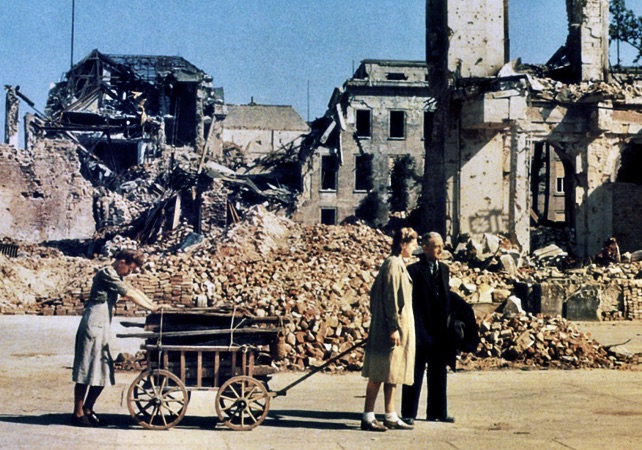
   Nuremberg was mess at the end of the war, blown up, torn apart, families lost and separated, the dead with no one to mourn them. Koste, Monica, and Angele were alone in Germany. Only Ele had family with her, two brothers. By 1948 all were looking for a way out.

   Angele was ready to go in the summer of 1948. She had not been able to get a visa to go to the United States. She was going to Canada, instead. She had a sponsor, since she worked in the children’s ward at the Army Hospital and had the skills to be a nanny. All she had to do was get there. It was a shot in the dark, now or never. It was time to stop marking time.

   After VE Day there were about twelve million refugees, displaced people known as DP’s, in Europe. Half of them were repatriated to their homelands within a few months. Almost four hundred refugee camps were set up in the Allied zones in Germany for the rest. Two years after the end of the war American policy was revised so that every refugee who wanted to emigrate had to have a sponsor. When not enough were found, Congress passed the Displaced Persons Act, providing for more than 200,000 of them to enter the United States. Nearly half of those designated were Ukrainian, who under no circumstances wanted to go home, home meaning almost certain death.

   Many Russian refugees flatly refused to board transports bound for Mother Russia. Some of them killed themselves rather than be repatriated. General Dwight Eisenhower banned the use of forced repatriation in the American zone. The Russians complained. “Should we call the president or just cry about it now?” a staff officer responded.

   By the early 1950s about a million refugees had been absorbed by Western European countries. Approximately half a million were accepted by the United States and a further half million by other nations. Some refugees remained in camps through the decade. It was only near the end of 1960 that the last refugee camp was finally closed.

   Angele was packing when she got a note from Vladas. “Merry Christmas on the first day of the holidays. My squad visited my quarters to wish me a happy holiday, but I wasn’t happy with them or myself. No matter, I wish you the best.”

   She caught a train the morning of November 16, 1948, for the Port of Hamburg, boarded the S. S. Marine Flasher, a repurposed troop carrier, sailed up the Elbe River, the next day crossed the North Sea, and out onto the Atlantic Ocean. It took nine days to cross the ocean. She landed in Halifax, Nova Scotia, boarded a train with the Canada-bound refugees who had been on the ship, disembarking a full day later in Montreal, where she was shuffled around like a second cousin for a week before getting her walking papers, and caught a second train to Sudbury, Ontario, riding the rails for another full day.

   Sudbury was the largest city in northern Ontario and by land area the largest in the province. Its economy was dominated by the mining industry for most of the 20th century. The big mining companies were the major employers in the city and the world’s leading producers of nickel. Outside the city proper the landscape looked like the landscape of the moon. The use of open coke beds well into the mid-20th century and logging for material to burn resulted in the nearly complete loss of trees far and wide. By the 1940s all the pink-gray granite for fifty miles around had long since been turned black by pollution from the roasting yards.

   She was going to be the nanny for the Lapalme’s, one of the leading families in the city, reportedly “the largest family in Sudbury.” Five of the thirteen children were under ten. They were going to be her responsibility. She celebrated Christmas alone that winter, at a desk writing a letter to Vytas.

   “Two of the grown-up Lapalme’s, in their early 20s, are in the next room with their friends, young French couples, dancing, as I write to you. They invited me to join them since one of them had been in a prisoner-of-war camp in Germany and speaks German, but I said thank you, no.”

   She stayed by herself in her room. The song “Chattanooga Choo Choo” bubbled into her room through the gap under the door. The Lapalme’s were dancing to the Glenn Miller Orchestra on a record player. The big-band man’s airplane had disappeared in bad weather over the English Channel four years earlier when he was traveling to France to entertain Allied troops. Only his music was still alive.

   “You don’t understand how lonely it is to be here. I am waiting,” Angele wrote.

   “She’s gonna cry, until I tell her that I’ll never roam, so Chattanooga choo choo, won’t you choo-choo me home?” The needle grooving the record started to skip. A blizzard had engulfed the Sudbury Basin. It was a white Christmas. She got in bed, gathered the quilt around her, and fell asleep shaping the time to come in her mind’s eye.

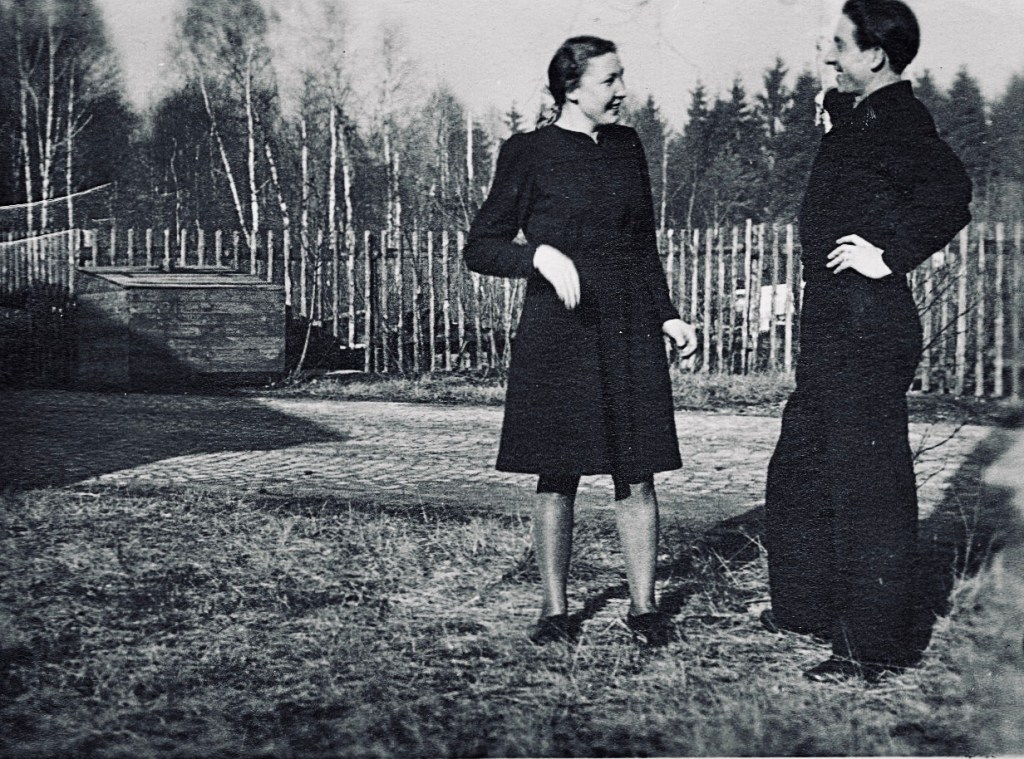
Photograph: Angele Jurgelaityte and Vladas Jankauskas, Nuremberg, 1947.

Ed Staskus posts monthly on 147 Stanley Street at http://www.147stanleystreet.com, Made in Cleveland at http://www.clevelandohiodaybook.com., Atlantic Canada at http://www.redroadpei.com, and Lithuanian Journal at http://www.lithuanianjournal, com. To get the site’s monthly feature in your in-box click on “Follow.”

More short stories can be found at Ed Staskus WordPress. His books are available on Amazon and Apple Books.

“Bomb City”

Cleveland, Ohio 1975. The John Scalish Crime Family and Danny Greene’s Irish Mob are at war. Car bombs are the weapon of choice. Two police detectives are assigned to find the bomb makers. It gets personal. Revenge is always personal.

Crossroad at Nuremberg

By Ed Staskus

   “The holy bishop from Kaunas fixed it up for us,” Angele Jurgelaitis said when she got to Berlin in the middle of the night. There was nothing holy about the last days of World War Two. It was a godless maelstrom. It helped to have a man of the cloth on your side when the devil was doing his best on the other side. There was more than enough hellfire on earth that winter.

   When Angele, sixteen years old, Ona Kreivenas, who was her aunt, and Ona’s four children got off one of the last trains that the Eastern Railway ran from East Prussia to Germany they were met at the station by Bishop Vincentas Brizgys. The clergyman was Ona’s husband’s cousin. Her husband, a Chief of Police, had been arrested by the Russians in 1941 and deported to Siberia, where he was stuck in a slave labor camp. By the early fall of 1944 Bishop Brizgys and more than two hundred other priests had already fled the Baltics on the heels of retreating German forces.

   Many Lithuanians barreled out of the Baltics in the fall and winter of 1944 as the Red Army overwhelmed the Wehrmacht and overran the land. The fighting was tenacious and terrible. Wartime losses of Estonians, Latvians, and Lithuanians were among the highest in Europe. They didn’t go down without protest. They were out-gunned, though.

   Ona had somehow located the bishop by telephone from East Prussia and he arranged to meet them at the train station. He was wearing a dark suit and a homburg. He was carrying a basket of hot buns. He looked like the churchman he was. Berlin didn’t look like the city it had once been. It looked like a wasteland.

   “He gave one of the buns to each one of us. I was so happy.”

   What the churchman fixed up for them was passage to Bavaria. They ended up in the north of the southeastern state. Bavaria shares borders with Austria, Switzerland, and the Czech territories. The Danube and Main rivers flow through it, the Bavarian Alps border Austria, and the highest peak in Germany is there. The Bohemian forests are nearby. The major cities of the region are Munich and Nuremberg. 

   “The bishop found a pig farm for us, people he knew,” Angele said. “We lived in a two-room apartment above the slaughterhouse. There was another Lithuanian with us, a woman in her 20s. She was a fancy woman.” One of the two rooms was a kitchen. They lived and slept in the larger room, two adults, a teenager, and four children. The fancy woman kept to herself. 

   There were three cots. “We took turns sleeping on them. We worked for our keep, helping with the cows, and cutting clover. There was no town, just country everywhere. The German family we stayed with fed us. They were good people.” There was no combat in their corner of the world. “We didn’t see any fighting all winter long. The war ended when the Americans came. They wore nice uniforms, not like the Russians, who were filthy and stank. They were friendly, completely different. They threw candy to us as they went past.”

   Bavaria was one of Adolf Hitler’s favorite places during the twelve years of his planned one thousand year Third Reich. He had a lavish residence at the Obersalzberg. Bavaria had been the scene of protests against Nazi rule in the late 1930s, but it didn’t matter to the Fuhrer. He had his own ask no questions security men. Their orders were to shoot first. After the war Nuremberg was chosen for the military tribunals trying Nazi war criminals because it had been the ceremonial birthplace of the party. It was where their annual propaganda rallies were held.

   Allied air forces bombed the hell out of the city in 1944 and 1945. One night in January 1945 more than five hundred British bombers dropped six thousand high-explosive bombs and more than a million incendiary devices. The historic old town was destroyed. Half of the rest of the city was destroyed. What wasn’t blown to bits or burnt down was damaged. Surviving the bombing meant you had to then survive the aftermath. The city was left with practically no heat, no electricity, and  no water supply in the middle of winter. The Palace of Justice and the prison that was part of the sprawling complex were spared. It was a sign of what was in store. It was spared because justice and revenge were in store.

   “In the fall after the war ended, we had to leave the pig farm and went to an American refugee camp near Regensburg. We had two rooms, but there was a Lithuanian man in the other room, so we had one room. We lived there and didn’t do anything. We waited and waited.”

   Before the Russians closed the borders, padlocking the Baltics behind the Iron Curtain, about seventy thousand Lithuanians were able to escape the country, almost all of them ending up in Germany. By the time the war ended nearly eleven million refugees had flooded the country, more than the total population of Austria. Many of them ended up in Displaced Persons camps in Bad Worishofen, Nordlingen, and Regensberg.

   In the spring of 1946, Angele, Ona, and the children moved to a new camp. “It was a castle that you got to down a long road through a forest in front of a lake. There was a big chapel and two big barracks. There were no owners anymore, and no workers, nobody. There were only the Americans and refugees. There were many of us, all of us homeless. We were almost all Lithuanians.”

   The Schwarzenberg castle on the outskirts of Scheinfeld in Bavaria is northwest of Nuremberg. From 1946 until 1949 thousands of Lithuanians were housed at the DP camp there while they waited for their chance to get to Australia, Canada, the United States, or anywhere else. “There was no future for us in Germany,” Angele said. There was flat out no going back. The system of revolving displacement the Russians proposed would have meant the end for many of them and suspicion and persecution for the rest of them. The Russians had no plans of letting repatriated Lithuanians off easy. They had no plans of letting any Lithuanians of any kind, unless they had converted to Communism, off easy. Even then it was dicey. If they wanted you to live and die in Siberia, and got their hands on you, the far east is where you went.

   The camp outside Nuremberg was administered by an American Army officer of Lithuanian descent. The military’s concern was providing shelter, nutrition, and basic health care. Although the Americans looked after vital supplies, everybody in the camp had to lend a hand. The refugees prepared their own food. They sewed new clothes from old cloth. They printed their own daily newspaper. They printed their own money, too. The currency could be earned by working around the camp and spent at the canteen, where you could buy shaving cream, combs, and cigarettes.

   “We had our own doctors, our own church, and even a school. My best friend was Maryte. Her parents were teachers. They taught the high school classes in the camp. Her mother knew how to sew.. She would take hand-me-downs that had been donated to us by the Red Cross, take them apart, and make new dresses. Whenever she made a dress for Maryte she made one for me, too.”

   Angeles’s aunt talked to her about becoming a seamstress. “She wanted me to learn how to sew, like my older brother Justinas, so I would have some way to make a living, but I said no.” She had already turned down her aunt’s advice about becoming a farmer’s wife. She wasn’t sure what she wanted to do, but she knew for sure what she didn’t want to do, which was no sewing and no farming.

   After her friend Maryte moved to Nuremberg, taking classes in x-ray technology, and was on the way to becoming a nurse assistant at the Army Hospital there, she wrote Angele. “She told me about it, told me it was a ten month course, and told me to come join her.” Angele packed a satchel with her clothes and slipped away as the weather warmed up in 1947. She waved goodbye to Ona and her four children. “By then my aunt was teaching kindergarten at the camp and she had her kids around her.” The boy Mindaugas had grown a few years older, was now a  teenager, and could take care of his three sisters.

   She hitchhiked the forty miles to Nuremberg. Even though there were travel restrictions, a German government barely existed to enforce its own laws, and the only thing she had to worry about was an over-zealous American officer in a Jeep who might take her back to where she came from. When she got to Nuremberg she asked where the hospital was and found her way there. It had been rebuilt after the bombings two years earlier. She was assigned a bed in a small room, which was twelve feet by twelve feet. She shared it with three other women.

   “There was Ele, who was twenty four and tall, Koste, who was twenty eight and stocky, Monica, who was the oldest and had been a nurse in Kaunas, and me. One of our teachers was Lithuanian and she helped me. We lived in the barracks. I worked in the hospital, cleaned, changed beds, and did whatever they told me to do. I studied whenever I could. There wasn’t time to do much else.”

   They had to do something, though. Most of them were young and raring to go. They staged dances at the hospital. “Somebody would play the accordion and we would all dance. There were never enough men to go around, so many had died.” Whenever they could they went to town on Saturdays. “We took a train, went to the movies, and the music shows. We loved it. Everything was so clean. It was all smashed during the war but two years later you wouldn’t have believed there had ever been a war.”

   There had not only been repeated bombing and shelling of the city, especially the medieval part of it, there had been street-by-street, house-to-house, and room-by-room fighting in April 1945. The city was rebuilt after the war and was partly restored to its pre-war aspect. “The Americans did it,” said Angele. “You could see them doing it every day.”

   The German government was being resurrected, as well, and order was the order of the day. “One day we were waiting in line for the movies, eating grapes, and spitting the seeds on the sidewalk. When a policeman saw us, he came over, and told us it was our responsibility to keep the city clean. He made us pick up all the seeds.”

   The circus was even better than movies or musical theater. It is in the movies and on stage that people fall in love and there is always a happy ending. The boy and girl kiss in a glowing haze. It is the circus, however, that is a live action fantasy. “Whenever it came to town, none of us could sleep,” Angele said.

   The Nazi era was good for circuses since they were not considered subversive. They were left alone by the tyrants. Between the two wars, through the 1930s, Germany was the epicenter of  European circus companies. There were more than forty of them on the road with clowns, acrobats, and animals. They were mostly family-run enterprises with large tents. The last year of World War Two, however, was bad for business. Many circuses lost all their equipment and animals. The postwar roadshows boomed after 1946. Circus Europa toured Germany in 1947. 

   “I loved the circus. I would have gone alone if I had to.”

   In mid-summer 1948 she got a week’s vacation from the Army Hospital. She and her friend Benas, his best friend Porcupine, and two of the Porcupine’s friends took a train the one hundred and seventy miles to Zugspitze on the border of Germany and Austria. On two sides of the Zugspitze are glaciers, the largest in Germany. Mountain guides lead climbers up three different routes to the summit at nearly ten thousand feet.

   “Benas was handsome with dark hair and his father was a minister back home. He was a good friend to me. Everybody called his friend Porcupine because my roommate Koste called him that. Nobody knew why. He thought he was Koste’s boyfriend, although that’s not what she thought.”

   They got to the mountains at night and stayed in a small hotel. “There were two rooms at the end of the corridor. We three girls went into one of them. There were two beds, so we pushed them together and slept together. The boys took the other room. In the morning I went to the window and threw open the heavy drapes. I had to take a step back. The mountain was right there. I was astonished and frightened. For a second I thought it was going to fall in on us.”

   They rode a rack railway up the northern flank of the mountain. “It went around and around.” At a landing they sunned themselves. “Even though there was snow everywhere, and people were skiing, looking like ants below us, we lay in the sun before going farther up.” They took the Eibsee cable car to an observation deck. “The gondola was all glass. You could see the whole world.” From the top a path led to the Cross of God.

   A fourteen-foot gilded iron cross had been lifted to the peak of the Zugspitze in 1851 by twenty-eight bearers under the direction of Karl Kiendl, a forester, and Christoph Ott, a priest. Father Ott was the brainstorm behind the cross, motivated by a vision of the mountain, “the greatest prince raising its head into the blue air towards heaven, bare and unadorned, waiting for the moment when patriotic fervor and courageous determination would see that his head too was crowned with dignity.”

   The Porcupine and his two companions wouldn’t go to where the cross was. They said the path was too icy and narrow. “Only Benas and I went. There was a ladder attached to a rock face you had to climb to get to where the cross stood on a flat space.” In 1888 the cross had been taken down and repaired after being struck by lightning. It had holes gouged out by the lightning bolts. A year later it was taken back to the top, onto the East Summit, where it had stayed ever since.

   The side rails of the metal ladder going up were secured by bolts to the rock. “I was near the top when a bolt came loose and the ladder jerked free,” Angele said. “I stopped and couldn’t go up or down. I stayed as still as I could. I was scared to death.”

   She had survived a Russian invasion, her mother’s untimely death, a subsequent German invasion, followed by another Russian invasion, making tracks out of Lithuania, the invasion of the Reich, the collapse of the German government, landing in DP camps in Bavaria, and finding her way to work at the Army Hospital in Nuremberg, all in the past eight years, all by the time she was nineteen years old. A broken ladder was not going to be the end of her. Benas helped her get down, extending his belt from the top, and another pilgrim helped her from below, coming partway up and carefully easing her down. Benas slid down the side rails without incident.

   Faith can be church-going or it can be personal. Life and death at ten thousand feet is personal, Cross of God or no Cross of God. Who thinks about God when they are about to meet their maker? They took their time on the icy path back to the observation deck. The rest of the week they hiked, took local trains to nearby alpine towns, ate, drank, smoked, talked, and had fun while it lasted.

   At the end of their vacation they went back to Nuremberg. In her room, Angele thought about the men in her life. There were two of them. One of them was Vladas, who was a Baltic soldier. The other one was Vytas, a Baltic civilian, who worked part-time for the Red Cross and part-time in the black market. They were both refugees from Lithuania, like her. Vladas brought her food and Vytas played cards with her. Vladas watched while she made dinner for him while Vytas let her win at the card table.

   Getting married might not be a matter of life and death, except when it is. She thought she was probably going to marry one of them, and thought she knew which one it would be, but knew for sure she wasn’t going to be staying in Europe. She was going to break free of nowhere. Making her way some place where there was a future was the most important thing on her mind. She wanted a bright future, not a dark past. The only way was up the ladder. 

   No matter what, she was going to have to make what lay ahead worth its while. Nobody else was going to do it for her. When she got a visa to go to Canada and work as a nanny for a family of thirteen children in Sudbury, an Ontario mining town, she took the chance. It was the chance she had been waiting for. She didn’t look back.

Ed Staskus posts monthly on 147 Stanley Street http://www.147stanleystreet.com, Made in Cleveland http://www.clevelandohiodaybook.com, Down East http://www.redroadpei.com, and Lithuanian Journal http://www.lithuanianjournal.com. To get the site’s monthly feature in your in-box click on “Follow.”

“Cross Walk” by Ed Staskus

“A Cold War thriller that captures the vibe of mid-century NYC.” Sam Winchell, Beyond Books

Available on Amazonhttps://www.amazon.com/dp/B0CRPSFPKP

Late summer and early autumn, New York City, 1956. Stickball in the streets and the Mob on the make. President Eisenhower on his way to Ebbets Field for the opening game of the World Series. A trigger man waits in the wings. A Hell’s Kitchen private eye scares up the shadows.

A Crying of Lot 49 Publication